

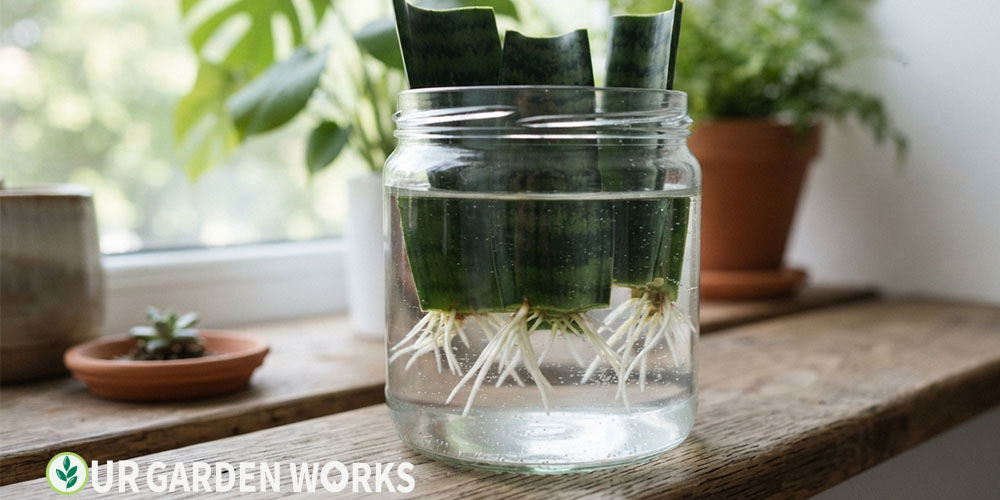
Snake plants (Sansevieria) tolerate more neglect than almost any other houseplant, and that same toughness carries over into propagation — they’re genuinely difficult to fail at, as long as you understand the two very different methods available and pick the right one for your goal.
How to Propagate Snake Plant – Quick Guide: Propagate snake plant either by leaf cutting (cut a healthy leaf into 3–4 inch sections, root in water or soil) or by division (separate an established clump at the rhizome). Division is faster and preserves variegated leaf patterns; leaf cuttings are slower and solid-green varieties may lose their variegation entirely.
Why Leaf Cuttings and Division Give Completely Different Results
This is the detail most propagation guides skip entirely, and it matters a lot if you’re growing a variegated variety like Sansevieria trifasciata ‘Laurentii.‘
Variegation — the yellow or white striping along the leaf edges — is a genetic mutation that exists in the plant’s growing point (the rhizome), not uniformly throughout every cell of the leaf tissue.
When you propagate by leaf cutting, the new plant grows from cells within the leaf itself, which often reverts to the plain green form the variegated variety originally mutated from.
Division, by contrast, separates an actual piece of the rhizome along with its leaves, carrying the variegation-producing growing point intact into the new plant. If keeping a striped pattern matters to you, division is the only reliable method — leaf cuttings are a gamble.
Why the Rhizome Is the Real Engine of the Plant
It’s worth understanding what a rhizome actually is, since it explains why division works so differently from a leaf cutting.
A rhizome is a thickened underground stem that stores energy and contains the plant’s actual growing points — the leaves you see above soil are really just the visible, photosynthesizing extensions of a plant whose core identity lives below the surface.
This is why division produces an instantly viable plant: you’re not asking a piece of leaf tissue to somehow generate an entire new growing point from scratch; you’re simply separating one already-complete growing point (with its own leaves and roots attached) from the larger clump it was part of.
A leaf cutting, by contrast, genuinely does have to build a new growing point essentially from nothing, which is both why it takes longer and why the genetic outcome (variegated or not) is less predictable.
This same rhizome structure is also why snake plant survives such extreme neglect in the first place — a thick, energy-storing underground stem gives the plant a substantial buffer against drought and inconsistent care that purely leaf-based or thin-stemmed plants simply don’t have.
Understanding the rhizome’s role explains both why the plant is famously hard to kill and why propagation methods that engage with it directly (division) work so differently from methods that don’t (leaf cuttings).
Method 1 — Leaf Cuttings (Best for Solid Green Varieties)
Directions
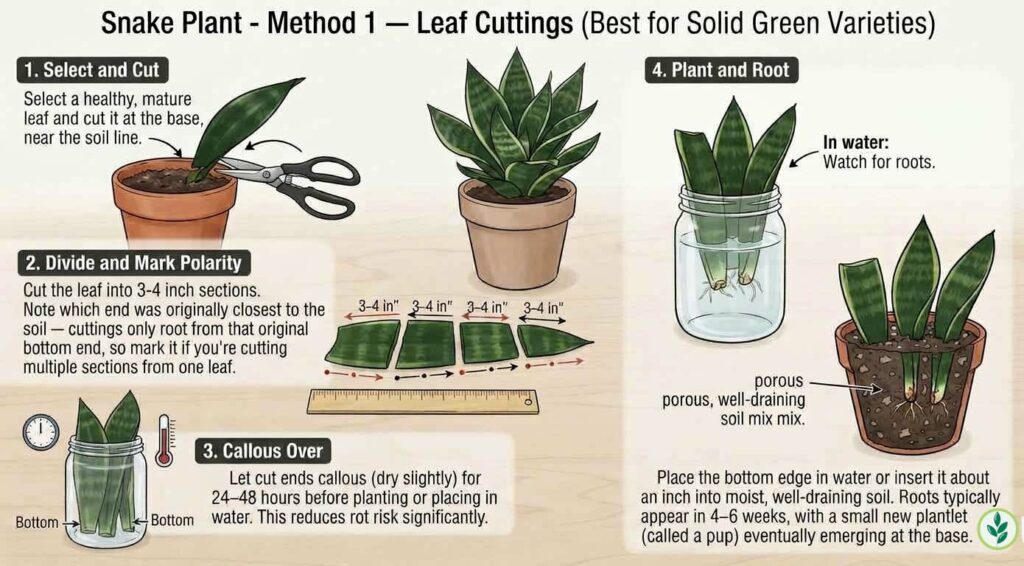
- Select a healthy, mature leaf and cut it at the base, near the soil line.
- Cut the leaf into 3–4 inch sections. Note which end was originally closest to the soil — cuttings only root from that original bottom end, so mark it if you’re cutting multiple sections from one leaf.
- Let cut ends callous (dry slightly) for 24–48 hours before planting or placing in water. This reduces rot risk significantly.
- Place the bottom edge in water or insert it about an inch into moist, well-draining soil.
- Roots typically appear in 4–6 weeks, with a small new plantlet (called a pup) eventually emerging at the base.
Marking the original orientation matters more than it might seem. Snake plant leaf tissue is genuinely polarized — the cells understand which end was closer to the soil and which end was reaching toward light, and that internal orientation is what determines where roots actually form.
A section planted upside down, with the wrong end in soil or water, simply will not root no matter how long you wait, since the cells at that end aren’t equipped to produce roots regardless of which way you’ve physically oriented the cutting.
⚠️ Don’t skip the callousing step
Snake plant leaves have a high water content, and an uncalloused cut placed directly into water or wet soil rots far more often than a properly dried one.
The 24–48 hour wait feels unnecessary but meaningfully improves your success rate.
Method 2 — Division (Best for Variegated Varieties and Speed)
Directions
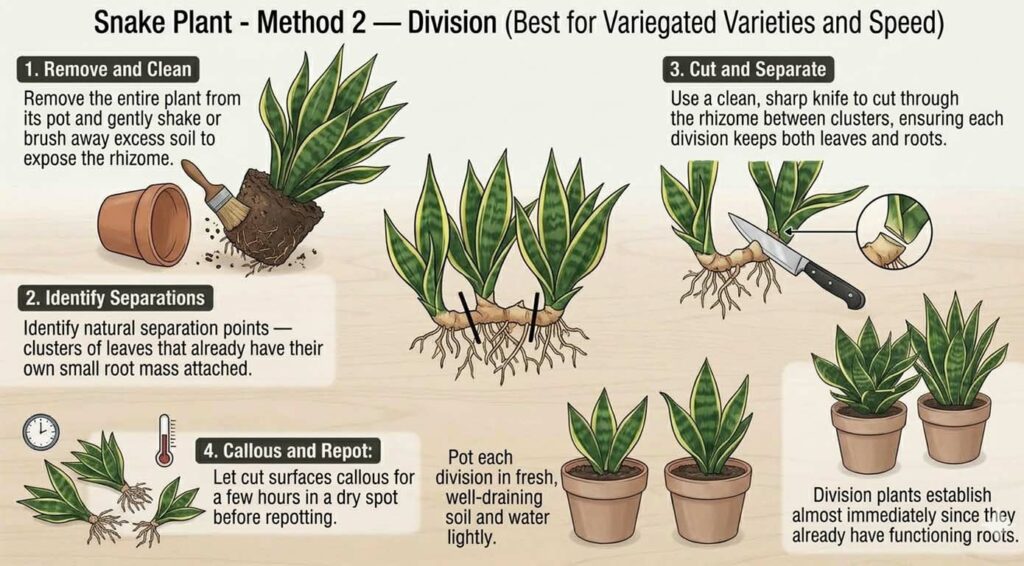
- Remove the entire plant from its pot and gently shake or brush away excess soil to expose the rhizome.
- Identify natural separation points — clusters of leaves that already have their own small root mass attached.
- Use a clean, sharp knife to cut through the rhizome between clusters, ensuring each division keeps both leaves and roots.
- Let cut surfaces callous for a few hours in a dry spot before repotting.
- Pot each division in fresh, well-draining soil and water lightly. Division plants establish almost immediately since they already have functioning roots.
Division works best on a plant that’s become genuinely crowded in its pot, with multiple distinct leaf clusters rather than one single fan of leaves.
If your plant only has one growing point and hasn’t yet produced offsets of its own, division isn’t an option yet — leaf cuttings are the only available method until the plant matures and spreads further.
Frequently Asked Questions
Why is my leaf cutting rotting instead of rooting?
Almost always insufficient callousing before placing the cutting in water or soil, or water that’s too cold. Snake plant cuttings root best at room temperature with the cut end given a full 24–48 hours to dry and seal before any moisture contact.
How long until a leaf cutting produces a full new plant?
Roots typically appear in 4–6 weeks, but a visible new pup (baby plant) at the base can take another 2–3 months beyond that. Leaf-cutting propagation is genuinely the slower of the two methods — division produces a usable plant in a fraction of the time.
Can I propagate snake plant in water permanently, or does it need to move to soil?
Once rooted, snake plants generally do better long-term in soil, which provides more stable nutrition and structural support for the plant’s stiff, upright leaves. Water propagation works well for the rooting stage, but plan to transition to soil within a few weeks of seeing roots.
How do I tell if a leaf cutting has actually rooted versus just sitting there?
Gently tug the cutting after about 4 weeks — genuine resistance means roots have formed and anchored the cutting in the soil or against the water container. A cutting that lifts freely with no resistance hasn’t rooted yet and simply needs more time, assuming it still looks firm and hasn’t shown signs of rot.
Is it better to propagate in spring, or does timing not matter much for such a tough plant?
Timing matters more than snake plant’s reputation for toughness might suggest. Spring and summer, during the plant’s active growth period, produce noticeably faster rooting than attempts made in winter when the plant’s metabolism naturally slows. A winter propagation attempt isn’t doomed, but expect it to take meaningfully longer than the ranges given above.
Which Method Should You Actually Choose?
If you’re working with a plain green snake plant and patience isn’t a major concern, leaf cuttings are perfectly reliable and let you generate many new plants from a single donor leaf without disturbing the parent plant’s root system at all.
If you’re working with a variegated variety, or if you want a usable plant as quickly as possible, division is unambiguously the better choice — faster, more predictable, and the only method that reliably preserves variegation.
The only real constraint is that your plant needs to have already produced multiple distinct growing points before division becomes an option; a young, single-rosette plant simply isn’t ready for it yet, regardless of which method you’d prefer.
Many snake plant owners end up using both methods over the life of a single plant — leaf cuttings early on while the plant is still young and single-stemmed, then division later once it’s matured into a multi-clump specimen with offsets ready to separate.
Caring for New Plants After Propagation
Whichever method you choose, the first few weeks after propagation call for slightly different care than an established plant gets.
Newly potted divisions, despite already having functioning roots, still benefit from a period of reduced watering and indirect rather than bright direct light while they adjust to their new individual pot and recover from the stress of separation.
Leaf cuttings need even more patience — avoid the temptation to check progress by repeatedly pulling the cutting out of its water or soil, since each disturbance can dislodge the earliest, most fragile root growth before it’s had a chance to properly anchor. A weekly check is plenty; daily inspection does more harm than good.
Once either type of new plant shows clear signs of active growth — a new leaf emerging, or visible increase in root mass — you can transition to a normal snake plant care routine: bright indirect light, water only when soil is fully dry, and minimal fertilizer until the plant is at least a few months established.
Related Articles in Our Plant Care Guide
- Can Spider Plants Grow in Water?
- Do Spider Plants Like to Be Root Bound?
- How to Propagate Money Tree
- How to Propagate Monstera from Stem Cuttings
- 9 Plants That Don’t Need Drainage Holes
- How to Propagate Pothos — 3 Easy Methods (Water, Soil, Moss)
- Propagation Q&A: Can You Propagate Peace Lily From Cutting?
Final Thoughts
We hope this clears up exactly which method to reach for, especially if you’re propagating a variegated variety and want to keep that pattern intact. Either way, snake plant remains one of the most forgiving plants in the propagation world. For care of the parent plant in between, our plant care guides cover the rest.
Whichever route you choose, the patience required is genuinely modest compared to many other houseplants — snake plant’s reputation for toughness extends fully into the propagation process, making it a reliable choice even for someone propagating a plant for the very first time.
Mark your calendar, check in weekly, and resist the urge to disturb the cutting more often than that. Snake plant has earned its reputation the hard way, surviving years of inconsistent care in offices and apartments everywhere — give it this one bit of patience during propagation, and it will return the favor for years afterward.
Share this post with a fellow gardener who’s ready to get growing — and let us know in the comments whether you went with leaf cuttings or division and how it’s going. Happy growing!
