

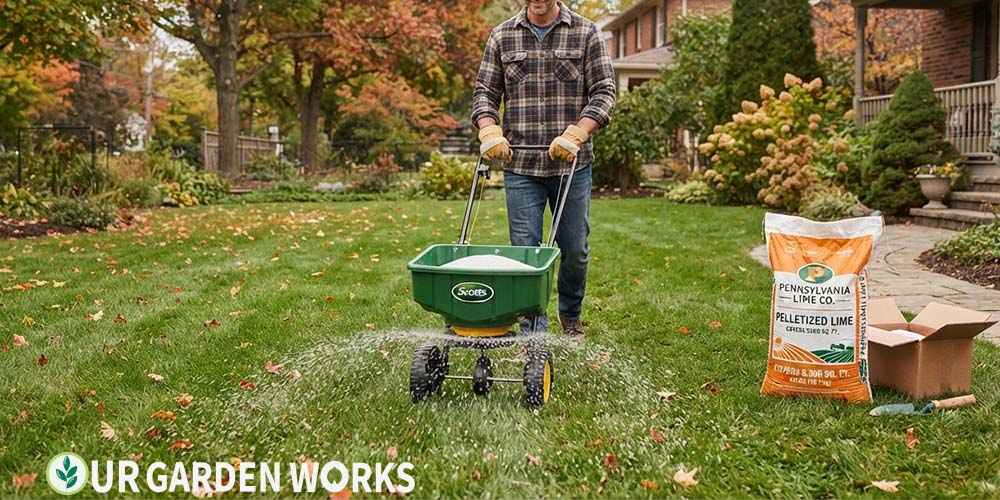
Lime is one of the most misapplied lawn products out there — partly because it works so slowly that people apply it again before the first application has even finished working, and partly because many homeowners apply it without ever confirming their soil actually needs it.
Done right, with a soil test guiding the dose and the right timing, lime can meaningfully improve a struggling lawn within a season or two. Done by guesswork, it’s at best wasted money and at worst counterproductive.
Quick Answer: Apply lime in fall or early spring, based on a soil test confirming pH below 6.0. Lime works slowly, often taking 6–12 months to meaningfully shift soil pH, so don’t expect immediate results or reapply out of impatience. Never apply lime without testing first — over-liming creates its own problems.
Why You Need a Soil Test Before Applying Any Lime
This is the step most lime application advice skips, and it’s the most important one. Lime corrects acidic soil (low pH), but plenty of lawns have neutral or even alkaline soil where lime does nothing helpful and can actually push pH too high.
Visual symptoms like moss, thin grass, or poor color don’t reliably indicate acidic soil specifically — those same symptoms can come from compaction, shade, poor drainage, or several other unrelated causes. A soil test is the only way to know for certain.
💡 Soil tests are inexpensive and worth the wait
Many county extension offices offer soil testing for a small fee, and results typically come back within a couple of weeks. Our soil pH calculator helps you interpret results and calculate the right lime dose once you have them.
The Best Timing by Region and Grass Type
| Region/Grass Type | Best Lime Timing | Why |
|---|---|---|
| Cool-season (most of the North) | Fall | Aligns with the fall growth surge and gives lime months to work before spring |
| Cool-season, alternate window | Early spring | Acceptable second option if fall was missed, though slower to show full effect |
| Warm-season (most of the South) | Late winter to early spring | Just before active growth resumes, giving lime time to work as the season starts |
| Any region, newly seeded lawn | At time of seeding, if test confirms need | Corrects pH before new roots establish in the wrong conditions |
Why Lime Works So Slowly
It’s worth understanding the actual chemistry, since “lime is slow” can sound vague without knowing why. Lime (calcium carbonate, in its most common garden form) needs to dissolve gradually in soil moisture to release the calcium ions that neutralize excess soil acidity.
This dissolution process depends on soil moisture, temperature, and the lime particle size — finer ground lime dissolves faster than coarser pelletized forms, though pelletized lime is easier to spread evenly. Either way, meaningful pH change typically takes a minimum of several months, often closer to a full year for the complete effect.
This slow timeline is exactly why fall application works so well for cool-season lawns — it gives the lime the entire fall, winter, and early spring to dissolve and act before the growing season that actually needs the corrected pH arrives.
How Much Lime to Apply
Your soil test results should specify a recommended application rate, usually in pounds per 1,000 square feet, calculated based on how far below the target pH range your current soil sits.
Without a specific recommendation, a general guideline of 20–50 pounds per 1,000 square feet for a moderate correction is common, but this varies enough by soil type that following your actual test result is meaningfully more accurate than any generic number.
⚠️ Don’t apply more than the recommended single-application maximum
If a large total amount is needed, split it into two applications spaced several months apart rather than applying it all at once. Excessive single doses can shock the soil system and overcorrect pH past the target range.
What Happens If You Over-Lime a Lawn
Over-liming pushes soil pH too high (alkaline), which creates a new, different nutrient availability problem rather than fixing anything. At high pH, several micronutrients — iron in particular — become less chemically available to grass roots, even when present in adequate soil quantities.
This often shows up as a yellowing similar to nitrogen deficiency, which can be confusing since it looks like the lawn needs more fertilizer when it actually needs the opposite intervention — correcting pH back down, which is a slower and more involved process than the original over-application.
This is the core argument for testing before liming rather than applying it preventively or by habit: getting it wrong in the alkaline direction is a genuinely harder problem to fix than simply not liming at all.
Types of Lime — Which One to Choose
Garden centers typically sell a couple of different lime products, and the difference matters more than the shared name suggests. Calcitic limestone (calcium carbonate) is the standard choice for most lawns, raising pH through calcium alone.
Dolomitic limestone contains both calcium and magnesium, which is the better choice specifically if your soil test shows a magnesium deficiency alongside low pH — a fairly common combination in some regions. Using dolomitic lime when magnesium is already adequate isn’t harmful, just unnecessary.
Your soil test results, if detailed enough, often specify which type would serve your particular soil best. When in doubt, calcitic lime is the safer general-purpose default.
How Acidic Soil Actually Limits Grass Growth
It’s worth understanding the underlying mechanism, since “acidic soil is bad for grass” can sound like a vague rule rather than something with a real cause. Soil pH directly affects how chemically available key nutrients are to plant roots, independent of how much of those nutrients are actually present in the soil.
In acidic conditions, nutrients like phosphorus and several micronutrients become less available, essentially locked in forms roots can’t efficiently absorb. This means a lawn growing in acidic soil can show nutrient deficiency symptoms even when soil testing confirms adequate nutrient levels are technically present — the problem is availability, not raw quantity.
Correcting pH with lime doesn’t add these nutrients directly; it unlocks access to nutrients that were often already there all along, which is why the visible improvement after liming can sometimes look disproportionate to what the lime product itself actually contains.
Frequently Asked Questions
How often does a lawn typically need lime reapplied?
This varies by soil type and regional rainfall patterns, but many lawns needing lime correction require reapplication every 2–3 years to maintain target pH, since rainfall gradually leaches calcium from soil over time. Retest periodically rather than reapplying on a fixed schedule without confirmation.
Can I apply lime and fertilizer at the same time?
Generally yes, though spacing them by a few weeks if possible avoids any interaction concerns, particularly with high-nitrogen fertilizers. Many homeowners do apply both around the same fall window without issue, just not necessarily on the exact same day.
Is pelletized lime better than powdered lime?
Pelletized lime is easier to spread evenly with a standard spreader and produces less dust during application, while powdered lime dissolves somewhat faster due to its finer particle size. Both work effectively — pelletized is simply more convenient for most homeowners despite the marginally slower dissolution.
Will lime kill moss in my lawn?
Not directly, though correcting acidic soil (a common moss-favoring condition) over time shifts the competitive balance back toward grass, which can reduce moss indirectly. Lime isn’t a moss-killer in the way an iron-based moss product is — it’s a soil correction that addresses one possible underlying cause.
Does rain right after applying lime wash it away and waste the application?
Light to moderate rain shortly after application is actually helpful, since moisture helps lime particles begin dissolving into the soil. Only an unusually heavy downpour causing visible surface runoff would meaningfully wash away granular product before it has a chance to settle.
Can I use garden lime meant for vegetable beds on my lawn instead of lawn-specific lime?
Yes, generally — the underlying product (ground limestone) is typically the same regardless of marketing, though application equipment and particle size may differ slightly between products labeled for lawns versus garden beds. Check the actual ingredient and particle size rather than relying solely on which section of the store it came from.
The Single Most Important Takeaway
If there’s one principle worth carrying away from this guide, it’s that lime is a correction for a specific, testable problem — not a routine lawn care product to apply on a calendar regardless of need.
Test first, apply based on that result, give it the months it needs to work, and retest before deciding whether more is needed. This patient, evidence-based approach consistently outperforms guesswork, both in actual results and in the money saved from not over-applying a product your lawn may not have needed in the first place.
Related Articles in Our Soil & Fertility Guide
- What Does Lime Do For Grass & Is it Important?
- How to Improve Clay Soil for Lawns
- 8 Best Soil Ph Testers For Your Gardening Needs – Top Picks & Reviews in 2026
- How to Prepare Garden Beds for Spring (8 Steps)
- Yellow Spots in Grass — Identification Chart
- Garden Soil Guide: Fix Your Soil, Grow Better Plants
Free Tools
Final Thoughts
We hope this gives you a clear, test-based approach to liming rather than the guesswork that causes so many lawns to either waste the product or overcorrect into a new problem.
The soil test really is the entire foundation this decision should be built on. For more on building healthy soil overall, our soil and fertility guides cover the rest.
Share this post with a fellow homeowner wondering if their lawn needs lime — and let us know in the comments what your soil test came back showing. Happy growing!
