

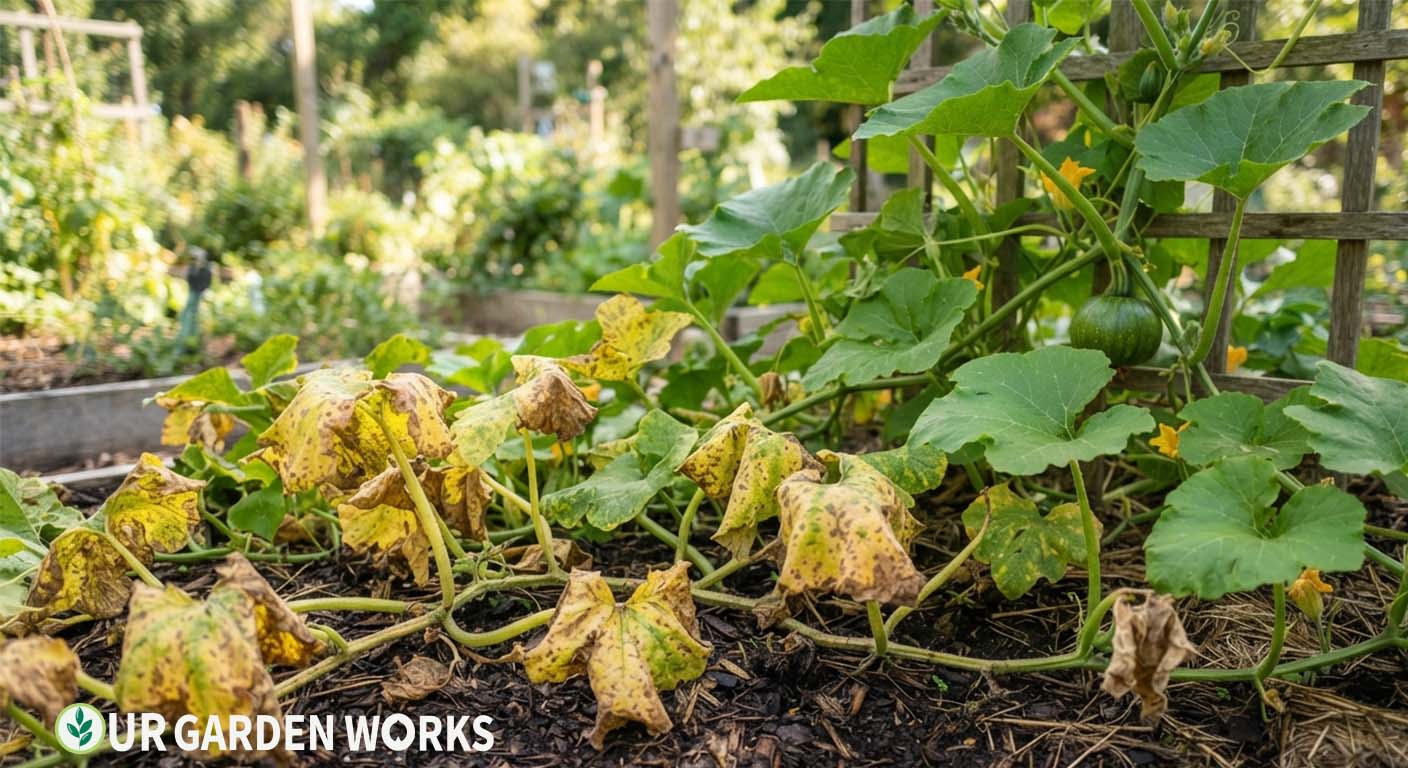
Pumpkin leaves yellowing sounds alarming — but many of the causes are normal, harmless, and require no intervention.
A pumpkin plant that’s been growing vigorously for 60+ days is going to have some yellow lower leaves. That’s not failure; that’s a plant directing energy toward the fruit it’s already made.
The key to diagnosing pumpkin leaf yellowing correctly is the same as with any vegetable: look at the pattern before you treat anything.
Quick Answer: Pumpkin leaves turn yellow from: natural aging of lower leaves (normal), nitrogen deficiency, powdery mildew (white coating before yellowing), squash vine borer damage, cucumber mosaic virus, or overwatering. Lower leaf yellowing on a mature fruiting plant is almost always normal.
Why Location on the Vine Matters So Much
Pumpkin vines are unusual among garden vegetables in just how much ground a single plant covers, and that sprawling structure means a vine can be experiencing several completely different things in different sections simultaneously.
The oldest growth, near the base where the plant first started, is naturally winding down as the plant ages — this is where you’d expect to see the harmless natural yellowing covered first below.
Meanwhile, the actively growing vine tips and the leaves closest to developing fruit are still in full production mode, and yellowing there means something is actually wrong rather than simply normal aging.
This is why checking exactly where on the vine yellowing is happening, before assuming any single cause, resolves a surprising amount of this diagnosis on its own.
A quick walk down the full length of the vine, noting which sections look concerning versus which look like normal expected aging, takes only a few minutes and narrows the list of likely causes considerably before you’ve even examined a single leaf closely.
Cause 1 — Natural Aging (Most Common — No Action Needed)
Pumpkin plants are large, sprawling, and fast-growing. As the plant directs more and more energy into developing fruit (which can weigh 10–30 lbs each), the lower leaves that were providing early-season energy are gradually abandoned.
Yellowing that starts at the lowest, oldest leaves and progresses slowly upward on a mature plant that’s fruiting normally — this is the plant’s natural lifecycle.
This same pattern shows up across nearly every vining and sprawling crop, since the underlying logic is universal: a plant with finite resources prioritizes its newest growth and developing fruit over leaf tissue that’s already done its job feeding the plant earlier in the season.
Fix: Remove yellowing leaves to improve airflow and move on. There’s no treatment needed beyond basic tidying.
Cause 2 — Nitrogen Deficiency
Uniform pale yellowing across all leaves (not just lower ones) in a young plant, combined with slow growth, suggests nitrogen deficiency.
Pumpkins are heavy feeders and deplete soil nitrogen quickly — especially in sandy soil, where nitrogen leaches away with rainwater faster than in heavier, more nutrient-retentive soil types.
Fix: Apply balanced fertilizer (10-10-10) at the planting rate and switch to a high-nitrogen liquid fertilizer every 2 weeks through mid-season.
Once fruit sets and begins sizing up, reduce nitrogen and increase potassium. Our fertilizer calculator works out the exact rate and timing shift for pumpkins specifically, since switching too late or too early between these two feeding phases can cost you fruit size.
Cause 3 — Powdery Mildew
Powdery mildew (a white powdery coating on leaf surfaces) often precedes yellowing — the affected leaf loses its ability to photosynthesise and eventually turns yellow.
Powdery mildew is nearly universal on pumpkins by late season in humid climates. It’s rarely fatal but reduces plant vigor and hastens end-of-season decline.
The white coating is actually a dense mat of fungal spores sitting on the leaf surface, blocking light from reaching the chlorophyll-containing cells underneath.
This is mechanically why affected leaves yellow even though the fungus itself isn’t directly killing the cells — it’s simply starving them of the light they need to keep producing energy.
Fix: Apply neem oil or baking soda solution (1 tsp per litre with a drop of dish soap) at first sign. Remove severely affected lower leaves.
Improve airflow. Prevention: correct spacing from the start. See our pest control guide.
Cause 4 — Squash Vine Borer
Squash vine borer is a caterpillar that tunnels inside pumpkin stems, causing sudden wilting and yellowing — often affecting an entire branch or large section of vine at once.
Look for a small hole at the stem base with frass (sawdust-like material) around it. The stem may be hollow or mushy when cut.
This pest does so much damage so quickly because it’s feeding from inside the stem itself, severing the vine’s internal water-transport tissue directly rather than just damaging surface leaf area the way most pests do. By the time wilting becomes visible above ground, the borer has often already been feeding for days or weeks unseen.
Fix: If caught early, slit the stem lengthwise, remove the caterpillar, and bury the damaged stem section in moist soil — roots will form from the buried stem.
Prevention is much more effective: apply row covers in late spring to exclude egg-laying adults, or wrap the base stems with aluminium foil as a physical barrier. See our pumpkin growing stages guide.
If you’re unsure whether what you’re seeing is actually vine borer damage, our pest identifier tool can help confirm it based on the specific damage pattern.
Cause 5 — Cucumber Mosaic Virus
CMV produces irregular mosaic yellowing with distorted, puckered leaves — often with lighter and darker green patches alongside the yellow.
New growth is most severely affected. Spread by aphids, the virus moves from plant to plant whenever an infected aphid feeds on a healthy one nearby, which is why aphid control matters as much for disease prevention as for the direct feeding damage aphids cause on their own.
No cure — remove infected plants and control aphid populations. There’s no point treating the yellowing itself once CMV is confirmed, since the virus has already altered how the plant’s cells function at a level no topical treatment can reverse.
Cause 6 — Overwatering
Pumpkins in waterlogged soil develop uniform yellowing across all leaves, often combined with soft, droopy stems.
Check that the growing area has adequate drainage — pumpkins prefer consistently moist but never wet soil, since their large, sprawling root systems need oxygen as much as water to function properly.
Fix: Reduce watering frequency and improve drainage where the bed tends to hold water after rain. Our garden watering calculator works out a more accurate watering schedule based on your bed size and local conditions, which helps avoid the overwatering that’s easy to fall into with such a large, thirsty-looking plant.
Telling the Six Causes Apart at a Glance
| Cause | Pattern | Key Clue |
|---|---|---|
| Natural aging | Lower leaves only, gradual | Plant is mature and fruiting normally |
| Nitrogen deficiency | Uniform, whole plant | Young plant, slow growth |
| Powdery mildew | Patchy, follows white coating | White powder visible before yellowing |
| Squash vine borer | Sudden, one branch/section | Hole + frass at stem base |
| Cucumber mosaic virus | Mosaic, distorted new growth | Aphids present, puckered leaves |
| Overwatering | Uniform, soft stems | Soil consistently wet |
Why Pumpkins Show These Patterns More Dramatically Than Smaller Squash
Pumpkins are essentially giant winter squash, and their sheer size amplifies every one of these six causes compared to a smaller-fruited relative like zucchini or yellow squash.
A pumpkin vine supporting one or two 20-pound fruit is making a far more extreme resource-allocation decision than a zucchini plant supporting a handful of one-pound fruit.
This is part of why natural lower-leaf yellowing looks so much more dramatic on pumpkins — the plant is genuinely sacrificing more leaf area to support that fruit size.
The same scaling applies to disease and pest pressure. A larger plant with more total leaf surface area gives powdery mildew more room to spread.
A thicker, more substantial main stem actually provides squash vine borer larvae with more material to tunnel through and more time before the damage becomes severe enough to kill the vine outright.
None of this changes the underlying diagnosis process, but it does explain why pumpkin problems can look more alarming at first glance than the same issue would on a smaller-vined relative.
Frequently Asked Questions
Is it normal for pumpkin leaves to turn yellow near harvest time?
Yes — very normal. As pumpkins near maturity in late summer/early fall, the plant naturally diverts energy away from leaves and into the fruit.
Should I remove yellow pumpkin leaves?
Remove lower yellowing leaves to improve airflow and reduce disease pressure. Don’t remove large sections of healthy green canopy — the leaves are still producing energy for the plant and shading developing pumpkins from sunscald.
My pumpkin leaves wilted and yellowed suddenly overnight — what happened?
Sudden overnight wilting and yellowing on a previously healthy plant is almost always squash vine borer. Check the stem base for a borer entry hole immediately and treat as described above.
Does pumpkin variety affect how susceptible it is to these problems?
Yes, somewhat — some modern hybrid varieties are bred with improved powdery mildew resistance, which can meaningfully delay the late-season decline this disease typically causes. Squash vine borer susceptibility doesn’t vary as dramatically by variety, since it’s more about the plant’s overall stem structure, which is fairly consistent across pumpkin types.
Can a pumpkin plant recover after losing several leaves to disease or pests?
Often yes, especially earlier in the season when the plant still has time to grow replacement foliage. A plant that loses significant leaf area close to harvest has less ability to recover meaningfully, since there’s limited remaining season for new growth to compensate for what was lost.
Related Articles in Our Vegetable Gardening Guide
- Pumpkin Growing Stages
- Do Deer Eat Pumpkin & Which Part Do They Love The Most?
- Pumpkin Care: Do Pumpkins Need Full Sun?
- Pumpkins 101: How Many Pumpkins Per Plant Can You Harvest?
- How to Grow Zucchini: The Complete No-Fail Guide (2026)
- 22 Heat-Loving Vegetables for Summer Gardens
- Garden Pest Control Guide
- Vegetable Gardening Guide
Free Tools for Diagnosing and Feeding Your Pumpkin Patch
Final Thoughts
We hope this guide helped you identify whether your pumpkin’s yellow leaves are a normal late-season occurrence or something that needs attention. Most of the time it’s the former — and knowing that is genuinely reassuring. For all our vegetable growing guides, our vegetable gardening guide links to everything.
Share this post with a fellow gardener who’s ready to get growing — and let us know in the comments which cause matched your plant’s symptoms. Happy growing!
