

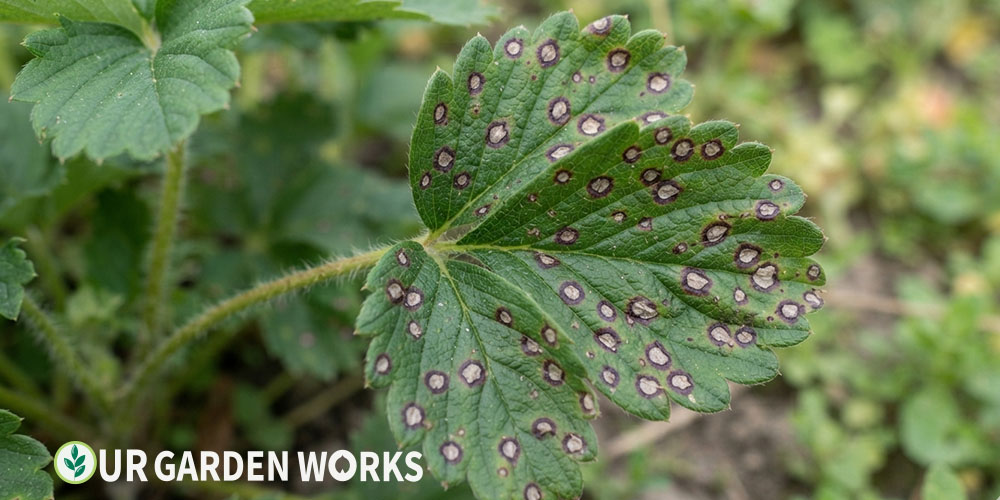
Strawberry plants are susceptible to a handful of common fungal leaf spot diseases, and while they share a similar general appearance at first glance, each has a slightly different visual signature once you look closely.
Since strawberries are typically grown for years in the same bed, getting ahead of these diseases matters more than it might for an annual crop you replant from scratch each season.
We’ll walk through the most common causes, with the details that separate one disease from another and the fixes that work for each.
Quick Answer: Spots on strawberry leaves are most often caused by common leaf spot (small purple-brown spots with tan centers), leaf scorch (purplish blotches that merge and look “scorched”), powdery mildew (purplish patches with a powdery coating, often curling leaf edges), or simple sunscald (irregular bleached patches with no defined border). Check spot color, border definition, and whether a powdery coating is present to narrow it down.
Cause 1 — Common Leaf Spot
Common leaf spot produces small, circular spots, typically a quarter inch or smaller, with a purple to reddish-brown border surrounding a tan to gray center.
As the disease progresses, these centers can develop tiny black specks, similar in concept to the fungal fruiting structures seen in other leaf spot diseases.
How to confirm it’s common leaf spot:
- Spots are small, round, with a distinct purple-brown border and pale center
- Tiny black specks may be visible in spot centers under close inspection
- Worse in wet, humid conditions and with overhead watering
- Older leaves typically affected first
Fix: Remove affected leaves and improve airflow through proper plant spacing. A copper-based fungicide helps manage active spread in more severe cases. Avoid overhead watering going forward, switching to drip irrigation or soil-level watering where practical.
Cause 2 — Leaf Scorch
Leaf scorch produces irregular purplish blotches that, as the disease progresses, merge together and give affected leaves an overall scorched or burned appearance, sometimes with the leaf edges curling upward.
This is generally considered more serious than common leaf spot since it can significantly reduce plant vigor in advanced infections.
How to confirm it’s leaf scorch:
- Purple blotches merge into larger irregular patches rather than staying as discrete small spots
- Leaves may curl or cup, especially at the edges, as the disease progresses
- Severely affected leaves take on an overall reddish-purple, scorched look
- Worse in warm, humid conditions, similar to common leaf spot
Fix: Remove and dispose of severely affected leaves and renovate the bed after harvest if scorch has been significant (mowing plants back and thinning, a standard strawberry bed maintenance practice). Fungicide treatment follows the same approach as common leaf spot.
Cause 3 — Powdery Mildew
Strawberry powdery mildew presents a bit differently than the classic white dusty coating seen on squash, often showing as purplish or reddish blotchy patches with a more subtle powdery texture, sometimes accompanied by upward leaf curling.
It’s easy to mistake for leaf scorch at a glance, but the powdery texture, even if subtle, is the distinguishing feature.
How to confirm it’s powdery mildew:
- Patches have at least a subtle powdery or dusty texture upon close inspection
- Leaf edges often curl upward, sometimes more pronounced than with leaf scorch
- Worse in warm days with cool nights and high humidity
Fix: A baking soda or potassium bicarbonate spray, following the same approach covered in our powdery mildew guide, works for strawberries as well. Improve airflow and avoid overhead watering to reduce the humid conditions the fungus favors.
Cause 4 — Sunscald
Sunscald produces irregular, bleached to tan patches with no defined border, distinct from the purple-bordered spots of the fungal diseases above.
This is a physiological response to intense sun exposure rather than a disease, and it’s far less common in strawberries than in some other garden plants since most strawberry varieties tolerate full sun reasonably well.
How to confirm it’s sunscald:
- Patches are irregular and bleached-looking rather than round with a defined border
- Correlates with recent intense sun exposure, often after a period of cloudy weather breaking into sudden full sun
- No purple coloring, powdery texture, or black specks present
Fix: No treatment reverses existing scald damage. Light afternoon shade during the most intense summer heat can prevent further occurrences if this becomes a recurring issue.
Telling the Four Causes Apart at a Glance
| Cause | Spot Appearance | Texture | Leaf Curling? |
|---|---|---|---|
| Common leaf spot | Small round, purple border, tan center | Flat, may have black specks | No |
| Leaf scorch | Merging purple blotches | Flat, scorched look | Sometimes |
| Powdery mildew | Purplish patches | Subtly powdery | Often, upward |
| Sunscald | Irregular, bleached | Papery, no border | No |
Are Container Strawberries Less Prone to Leaf Spot?
Container-grown strawberries generally face somewhat lower leaf spot pressure than in-ground bed plantings, mainly because containers offer better airflow around individual plants and don’t accumulate the same multi-year buildup of fungal spores in soil that a permanent in-ground bed can develop over several seasons.
This is one more advantage container strawberries offer beyond the variety and pest benefits covered in our container strawberry growing guide.
That said, containers aren’t immune, and overcrowding multiple plants into a single pot, or allowing runners to fill a container densely without any thinning, recreates similar humid, poor-airflow conditions to an unmanaged in-ground bed.
If you’re growing strawberries in containers specifically to avoid leaf spot issues, maintaining reasonable plant spacing within the container and trimming excess runners remains just as important as it is for in-ground plantings.
Watering and Spacing as Your First Line of Defense
Three of the four causes covered in this guide — common leaf spot, leaf scorch, and powdery mildew — share humidity and moisture as a common trigger, which means the same basic habits prevent the majority of strawberry leaf spot problems regardless of which specific disease eventually shows up.
Watering at the soil level using drip irrigation or a soaker hose, rather than overhead sprinklers, keeps foliage dry and dramatically reduces the leaf-wetness window these fungi need to establish.
Spacing plants generously when initially planting a bed, and thinning runners regularly throughout the growing season rather than letting a dense mat develop, maintains the airflow that keeps humidity from building up around the foliage.
These two habits — soil-level watering and deliberate spacing — do more preventive work across all the disease-based causes in this guide than any single treatment applied reactively once symptoms have already appeared.
Try our free tool:
- Plant Spacing Calculator — Exactly How Many Plants Fit in Your Bed
- Garden Watering Calculator — How Much Water Your Crops Actually Need
Why Strawberry Beds Need Annual Renovation
Unlike most annual vegetables that get replanted fresh each year, strawberry beds are typically maintained for several years, which means fungal diseases have an ongoing opportunity to build up in the same location season after season if left unmanaged.
Annual bed renovation — mowing plants back after harvest, thinning crowded runners, and removing old, diseased foliage — is a standard practice specifically because it interrupts this disease buildup cycle in a way that simply treating individual symptomatic leaves doesn’t achieve.
This renovation timing, typically done shortly after the main harvest concludes, also coincides with when many of these leaf spot diseases are actively producing the most fungal spores, making it an especially effective intervention point.
Skipping renovation in beds with a history of leaf spot or scorch issues is one of the more common reasons these diseases become a chronic, worsening problem rather than a manageable annual nuisance.
Frequently Asked Questions
Will spots on strawberry leaves affect the fruit?
Generally not directly, since these are leaf-specific diseases rather than fruit pathogens. The indirect risk is reduced plant vigor from significant leaf loss, which can in turn reduce berry size and yield if the infection is severe and left unmanaged across multiple seasons.
Can I still eat strawberries from a plant with leaf spot disease?
Yes — these leaf diseases don’t affect fruit safety, and berries from an infected plant are perfectly fine to eat as long as the fruit itself looks and feels normal. The concern is plant health and future yield, not food safety.
Are some strawberry varieties more resistant to these leaf spot diseases?
Yes, resistance varies meaningfully by variety, and many modern strawberry cultivars are bred with improved tolerance to common leaf spot and leaf scorch specifically.
If these diseases have been a persistent, significant problem in your strawberry bed, researching disease-resistant varieties before your next planting cycle is a worthwhile long-term investment.
Should I remove and replace my entire strawberry bed if leaf spot keeps recurring?
Not necessarily as a first step — annual renovation, improved airflow through proper spacing, and switching to soil-level watering often bring chronic leaf spot problems under control without needing to start completely over.
Full bed replacement is worth considering only if these management steps have been consistently applied for a couple of seasons without meaningful improvement.
Is it safe to use leaves and runners from a leaf-spot-affected plant to start a new bed?
It’s generally safer to avoid this if you can, since transplanting runners from visibly affected plants can carry the fungal disease directly into a fresh planting location and undo much of the benefit of starting somewhere new.
If disease-free, healthy-looking runners are available from the same general planting, those are a better choice than propagating specifically from the most heavily symptomatic plants in the bed.
Related Articles in Our Strawberry Care Guide
Final Thoughts
We hope this guide has helped you identify exactly what’s behind the spots on your strawberry leaves — and given you a clear path to managing it through this season and beyond with proper bed renovation.
For all our vegetable growing guides, our vegetable gardening guide links to everything.
Share this post with a fellow gardener who’s troubleshooting their strawberry patch — and let us know in the comments which cause matched what you found. Happy growing!
