

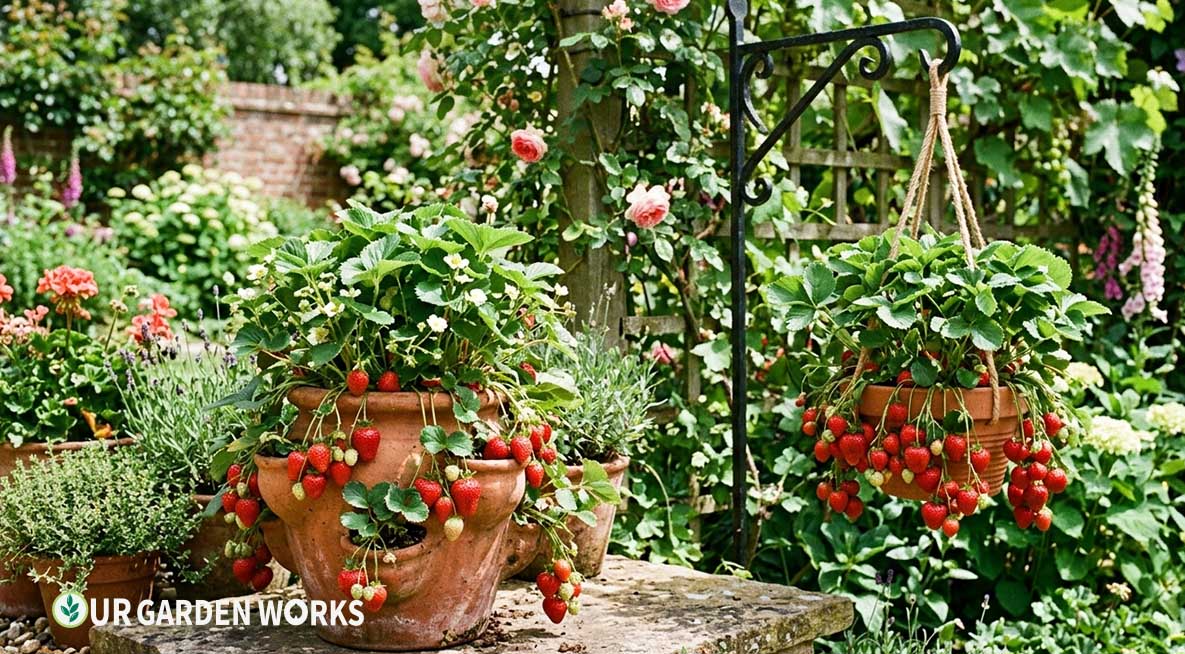
Container strawberries are one of the most popular and most commonly disappointing patio crops — and the reason for that disappointment is almost always variety choice.
Plant a June-bearing strawberry in a container and you get one crop over 3 weeks, then nothing. Plant a day-neutral variety and you get a steady stream of berries from June through October. That single substitution transforms the experience completely.
The other difference: containers eliminate the slug, bird, and soil moisture problems that frustrate in-ground strawberry growers. Berries hang away from soil, drainage is controlled, and you can move the container to protect from a late frost or position it for maximum sun.
There’s a real case that containers produce better strawberries than beds for many home gardeners.
How to grow strawberries in containers: Use day-neutral varieties (Albion, Seascape, Tristar) for continuous production all season. Plant in containers with at least 8-inch depth and excellent drainage. Feed every 2 weeks with a balanced liquid fertilizer. Water consistently — containers dry out fast. Remove runners to keep energy in fruit production.
Why Containers Are Often Better Than Ground Beds for Strawberries
In-ground strawberry beds face a particular set of frustrations that containers simply sidestep.
Slugs travel along the soil surface to reach low-hanging fruit, and a heavy summer rain can splash soil-borne fungal spores directly onto ripening berries sitting at ground level.
Birds learn the location of an in-ground strawberry patch quickly and return season after season. None of these pressures disappear entirely in a container, but they’re meaningfully reduced simply by elevation and isolation.
Containers also solve the soil drainage problem that plagues strawberries in heavy clay gardens. Strawberry crowns rot quickly in waterlogged soil, and many home gardens — especially newer subdivisions built on compacted fill dirt — simply don’t drain fast enough for strawberries to thrive without significant amendment. A container filled with a well-draining potting mix sidesteps that problem entirely from day one, no soil improvement project required.
Perhaps the most underrated container advantage is mobility. A strawberry planter can be moved into full sun in spring, shifted to afternoon shade during the most brutal stretch of summer heat, and tucked against a sheltered wall when an unexpected frost threatens in fall.
In-ground strawberries take whatever conditions their bed location provides for the entire season; container strawberries get the best conditions you can offer at any given moment.
Varieties: Day-Neutral Are Essential for Containers
| Variety | Type | Production | Notes |
|---|---|---|---|
| Albion | Day-neutral | All season | Top container strawberry; large berries; excellent flavor; heat-tolerant |
| Seascape | Day-neutral | All season | Reliable producer; adapts well to coastal and inland climates |
| Tristar | Day-neutral | All season | Smaller berries but exceptional flavor; compact plant |
| Ozark Beauty | Everbearing | Spring + fall | Two production peaks; good flavor; readily available |
💡 Albion is our top pick
Albion is the most productive and reliable day-neutral container strawberry available. It handles heat better than most, produces large, flavorful berries continuously, and stays compact enough for pots as small as 8 inches. Start here — it’s the variety most likely to make you love container strawberries.
It’s worth understanding the difference between the three flowering types you’ll encounter on plant tags, because the terminology genuinely changes how you should plan your container.
June-bearing varieties set one flush of flowers triggered by day length in spring and produce a single, often very heavy, harvest over two to three weeks before going dormant for the rest of the season.
Everbearing varieties produce two distinct flushes — one in late spring and a second smaller one in fall — with little production in between. Day-neutral varieties, the category we recommend almost exclusively for containers, don’t respond to day length at all and instead flower and fruit continuously from late spring through the first hard frost, provided you keep up with feeding and watering.
How to Grow Strawberries in Containers: Step by Step
Step 1 — Container Selection
Almost any container works if it has drainage holes and at least 8 inches of depth. Most popular options:
- Standard round pots (8–12 inch): One plant per pot; simple and reliable
- Strawberry planters (tiered ceramic or plastic): Multiple pockets allow 8–12 plants in a compact footprint; water management requires attention to ensure all levels get adequate moisture
- Hanging baskets (12–14 inch): Beautiful and space-efficient; dry out fastest and need daily watering in summer
- Window boxes: Plant 6–8 inches apart in length; excellent for balconies
Step 2 — Soil and Planting
Directions
- Fill with premium potting mix with added perlite (20%) for drainage. Strawberry roots are highly sensitive to waterlogging.
- Adjust pH: strawberries need 5.5–6.5. Add acidifying fertilizer or sulfur if your tap water is alkaline.
- Plant crowns at exactly soil level — same critical technique as in-ground planting. Crown buried = rot. Crown too high = desiccation.
- Water immediately and thoroughly.
Step 3 — Feeding Every 2 Weeks
Container strawberries flush nutrients with every watering. Unlike in-ground plants that can access a wider soil nutrient pool, container plants depend entirely on what you provide.
Feed every 2 weeks throughout the growing season with a balanced liquid fertilizer (10-10-10). Switch to a lower-nitrogen, higher-potassium formula once the first flowers open to direct energy toward fruiting rather than vegetative growth.
Step 4 — Remove Runners
Day-neutral varieties produce runners — long stems that root to form new plants. In containers, runners steal energy from fruit production and have nowhere useful to root. Remove them as soon as they appear by snipping at the base. This keeps energy concentrated in your existing plants and maximizes berry production throughout the season.
💡 Save a few runners if you want to expand
If you’d like to grow your collection for free rather than buying new plants next year, let one or two healthy runners root into a small adjacent pot of soil before snipping the connecting stem. This gives you new, genetically identical plants ready to start their own season — useful for filling out a hanging basket or starting a second planter without an additional purchase.
Step 5 — Overwintering Container Strawberries
In Zone 6 and colder, container strawberry roots freeze solid in an exposed pot — the container provides no insulation the way in-ground planting does.
Options: move containers to an unheated garage for winter (they need cold but not freezing), bury the entire pot in the ground up to its rim, or in Zone 7+, simply leave in a sheltered spot with straw mulch over the crown.
Whichever method you choose, resist the temptation to bring strawberries into a warm, heated indoor space for winter. Strawberries require a genuine cold dormancy period to flower reliably the following spring — without it, you’ll often see vigorous leafy growth in year two but disappointing fruit set, because the plant never received the cold signal it needs to shift back into reproductive mode.
Frequently Asked Questions
How many strawberry plants do I need for a family of four?
For fresh eating, 6–12 day-neutral plants produces a steady daily supply through the season. For a significant fresh supply plus some for jam or freezing, plan for 20–30 plants. Day-neutral varieties each produce continuously rather than all at once, so fewer plants deliver a more consistent daily harvest than the same number of June-bearers.
Can strawberries grow in hanging baskets?
Yes — and the trailing habit looks beautiful. Use a 14-inch basket minimum, 2–3 plants per basket. The main challenge is drying out: hanging baskets in full sun can dry completely in a single summer day. Plan for daily watering, or use a self-watering liner.
Why are my container strawberries producing small fruit?
Usually insufficient feeding or a pot that’s too small. Strawberries in under-fertilized containers direct very little energy to fruit size. Feed every 2 weeks without fail. Small pot = crowded roots = small berries. Repot into a larger container if plants look rootbound (roots emerging from drainage holes).
How long do container strawberry plants stay productive?
Most day-neutral varieties produce well for 2–3 years before yields decline noticeably, after which replacing the plants (or the runners they’ve produced) gives better results than continuing with aging crowns.
Refresh the potting mix entirely whenever you replace plants, since strawberry roots can deplete and compact container soil considerably faster than most other container crops over multiple seasons.
Do container strawberries need pollinators to set fruit?
Strawberries are self-pollinating and don’t strictly require bees, but cross-pollination by bees and other insects does meaningfully improve berry size and shape compared to wind or gravity alone.
On an enclosed balcony with no insect access, you can hand-pollinate using a small soft paintbrush, gently swirling it in the center of each open flower every day or two while they’re blooming. Misshapen, lopsided berries are usually a sign of incomplete pollination rather than a disease or nutrient problem.
Related Articles in Our Vegetable Gardening Guide
Final Thoughts
We hope this guide has given you a clear path to successful container strawberries — and the day-neutral variety choice really is the key that makes it work. For all our vegetable growing guides, our vegetable gardening guide has them all.
Share this post with a fellow gardener who’s ready to grow their own — and let us know in the comments which variety you’re starting with and what kind of container you’re using. Happy growing!
