

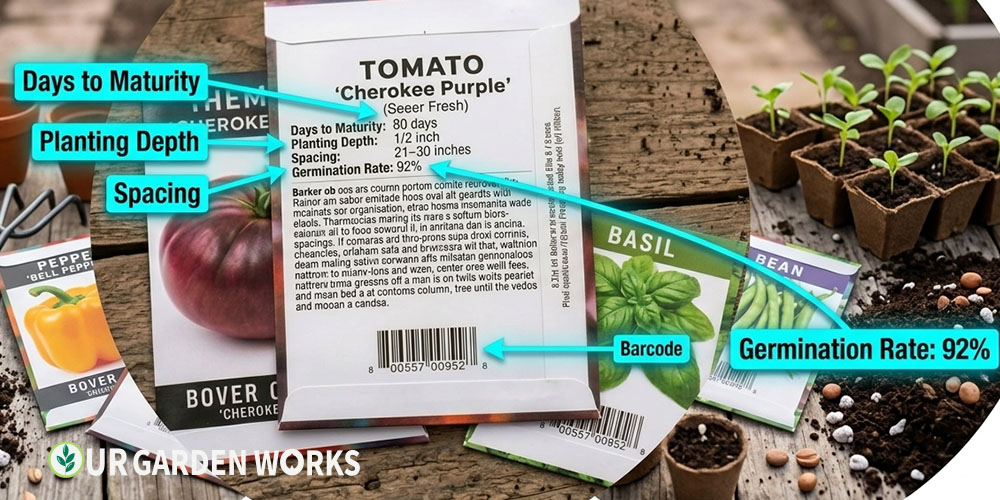
A seed packet is a dense little document. It contains everything you need to know about growing that plant — timing, spacing, depth, temperature, expected performance — packed into a 3×4-inch envelope. Most gardeners read the front (the pretty picture and the name) and the back just enough to find planting depth. The rest stays mystery.
Understanding every field on a seed packet makes you a more efficient planner. You stop buying seeds that won’t mature in your growing season. You know before planting whether germination rate means you need to sow 2 seeds per cell or 3. And you understand what “days to maturity” actually counts from. This guide covers every field — what it means and how to use it.
Quick Answer: “Days to maturity” counts from transplant date (for crops started indoors) or from direct sowing date (for direct-sow crops) — not from seed packet purchase date. “Germination rate” tells you what percentage of seeds should sprout under ideal conditions — use it to calculate how many seeds per cell to sow. Everything else on the packet guides your sowing depth, spacing, light, and temperature decisions.
The Front of the Packet
Crop Name + Variety Name
The crop name (Tomato, Basil, Broccoli) is straightforward. The variety name is more specific and more important than most gardeners realize.
“Tomato” tells you nothing about size, color, days to maturity, or disease resistance. “Brandywine” tells you: large beefsteak heirloom, 80+ days, pink-red, exceptional flavor, susceptible to blight. “Sun Gold” tells you: cherry tomato, 57 days, orange, crack-resistant, very sweet, prolific. The variety name is the actual thing you’re buying.
Annual, Biennial, or Perennial
- Annual: Completes its full life cycle in one growing season. Must be replanted every year. Most vegetables are annuals.
- Biennial: Two-year cycle — vegetative growth in year one, flowers and seeds in year two. Relevant mainly to seed saving.
- Perennial: Returns every year. Asparagus, artichokes, rhubarb, most herbs.
Hybrid (F1) vs. Heirloom vs. Open-Pollinated
- F1 Hybrid: Cross between two parent varieties. More uniform, often higher yielding, often disease resistant — but seeds saved from F1 plants won’t grow true to the parent. Buy fresh seeds each year.
- Open-Pollinated (OP): Pollinated naturally, grows true from seed. You can save seeds. Includes heirlooms.
- Heirloom: Open-pollinated variety that’s been grown for 50+ years. Often exceptional flavor, more variety in appearance, usually less disease resistant than modern hybrids.
- Organic: Seed was produced without synthetic pesticides or fertilizers. The plant you grow from organic seed is no different from conventional — the certification refers to seed production, not your growing method.
The Back of the Packet — Field by Field
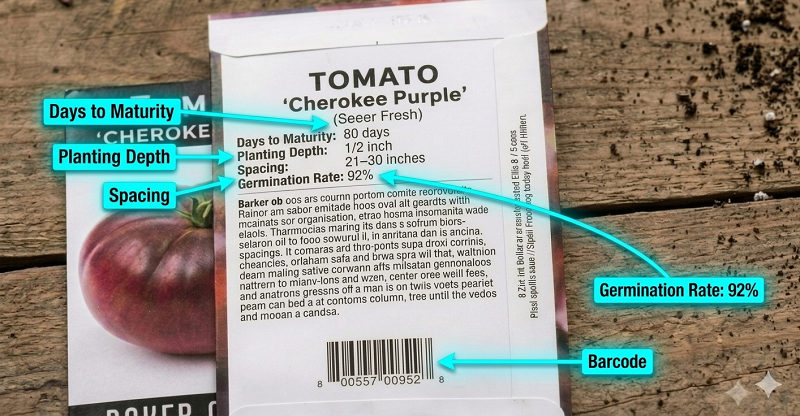
Days to Maturity (DTM)
This is the most misunderstood number on the packet. It does not count from the day you sow seeds indoors.
| Crop Type | Days to Maturity Counts From | Example |
|---|---|---|
| Transplanted crops (tomatoes, peppers, broccoli) | Date of outdoor transplanting | Tomato “65 days” means 65 days after the plant goes in the ground — not after sowing |
| Direct-sown crops (carrots, beans, beets) | Date of outdoor seed sowing | Bean “55 days” means 55 days from the day you sow outdoors |
| Succession crops (lettuce, radish) | Date of sowing | Lettuce “45 days” from sowing — whether indoors or direct |
Why it matters for season planning: Add the DTM to your outdoor planting date. If your first fall frost is October 1 and you’re considering a tomato variety with 85 DTM, you need to transplant by July 8 at the latest — or that tomato won’t ripen before frost.
For short-season gardeners in Zones 3–5, DTM is one of the most critical purchase decisions. Choose varieties with shorter DTM to ensure harvest within your season.
Germination Rate (or Germination Percentage)
The percentage of seeds expected to germinate under ideal conditions, established by the seed company through testing. A packet labeled “Germination: 85%” means that in ideal conditions, approximately 85 out of 100 seeds will sprout.
How to use it:
- 85–95% germination rate: Sow 1–2 seeds per cell. Thin to one after germination.
- 70–84% germination rate: Sow 2 seeds per cell to ensure at least one germinates per cell reliably.
- Below 70%: Seeds are declining in viability. Sow 3 per cell. Consider buying fresher seeds for reliable results.
Germination rate from the packet assumes ideal conditions — proper temperature, consistent moisture, correct depth. Poor conditions reduce actual germination well below the stated rate.
Seed Packet Date / Pack Year
Usually shown as “Packed for 2026” or “Best by 2026.” This is the year the company guarantees the stated germination rate — not the year seeds expire. Seeds from a 2024 pack used in 2026 are two years old and may have declined below the stated germination rate, especially for short-lived seeds like onions and parsnips.
Planting Depth
How deep to place the seed below the soil surface. Follow this precisely — too shallow risks drying out or exposure; too deep and seeds run out of energy before emerging.
General rule: 2–3× the seed’s diameter. The packet’s specific instruction overrides the general rule.
Spacing (Plant Spacing + Row Spacing)
Two numbers, sometimes shown as “Thin to 12 inches / Rows 24 inches apart.” Plant spacing is between individual plants in a row. Row spacing is between parallel rows.
For raised beds using square-foot planting, use only the plant spacing number and plant in a grid pattern — row spacing is designed for in-ground row cultivation.
Sun Requirements
- Full Sun: 6+ hours of direct sunlight daily. Required for tomatoes, peppers, cucumbers, squash, beans, and most fruiting vegetables.
- Partial Sun / Partial Shade: 3–6 hours. Suitable for lettuce, spinach, herbs, and some root vegetables.
- Full Shade: Under 3 hours. Very few vegetables, primarily some leafy greens.
Soil Temperature for Germination
The range at which the seed will reliably germinate. This is soil temperature at seed depth — not air temperature.
A seed packet that says “Soil temperature: 65–85°F” for peppers is telling you that germination below 65°F will be slow and unreliable.
Use this number with a soil thermometer for outdoor direct sowing, and with a heat mat thermometer for indoor trays. For the full temperature table by crop, see our why seeds don’t germinate guide.
Days to Germination
How many days to expect before the first seedling emerges under ideal conditions. Add 50% to this number for real-world conditions (soil temperature variability, moisture inconsistency). If nothing has appeared after 1.5× the maximum stated days, begin diagnosing the cause.
When to Start Indoors / Direct Sow
Usually stated as “Start indoors 6–8 weeks before last frost” or “Direct sow after last frost when soil reaches 60°F.”
These generic ranges are starting points — use our free Seed Starting Calculator to get exact dates for your specific ZIP code rather than relying on the packet’s regional average.
Disease Resistance Codes
Hybrid varieties often carry coded disease resistance, shown as letter abbreviations after the variety name.
Common ones for tomatoes: V (Verticillium wilt), F (Fusarium wilt), N (nematodes), T (tobacco mosaic virus), A (Alternaria). A tomato labeled “VFFNT” is resistant to all five.
For gardeners who’ve had repeated disease problems with a specific crop, choosing resistant varieties is more effective than any spray program.
Frequently Asked Questions
The packet says "days to maturity: 75 days" — does that mean 75 days from when I plant the seed?
For transplanted crops like tomatoes and peppers, no — it counts from the day the transplant goes into the garden, not from seed sowing. Add your indoor growing period (6–8 weeks for tomatoes) to the 75 days and you have a total of roughly 120 days from sowing to harvest. For direct-sown crops like beans and carrots, it counts from the day of outdoor sowing.
What does "treated seed" mean on the packet?
Treated seeds have been coated with a fungicide (usually shown in pink, red, or blue coloring) to protect against soil-borne diseases during germination. Common for corn, beans, and some flowers. If you’re growing organically, avoid treated seeds — look for OMRI-listed or untreated seeds specifically. Don’t save or eat treated seeds.
Can I use seeds from last year's packet?
Usually yes, with adjustments. Do a germination test on 10 seeds (paper towel method) before committing to a full tray. If 8+ germinate, use them. If 5–7 germinate, sow more per cell. If fewer than 5 germinate, buy fresh seeds — unreliable germination means unpredictable results no matter how good your technique is.
Check out Full Seed Starting Guides:
- Seed Starting Guide – Everything You Need to Start Seeds Indoors
- When to Start Seeds Indoors — Region-by-Region Schedule (2026)
- Seed Starting Calculator — When to Start Every Crop Indoors
- Why Seeds Won’t Germinate — 7 Causes and Exactly How to Fix Each
- How to Germinate Seeds Fast — Paper Towel Method, Pre-Soaking & Heat Tricks
- Vegetable Gardening Guide
Final Thoughts
We hope this breakdown means you never stand in a garden center squinting at a seed packet wondering what ‘F1 hybrid 78 DTM VFFNT‘ means again. The packet has everything you need — it just needs translating once.
For timing those days-to-maturity numbers against your specific frost dates, our free Seed Starting Calculator does that automatically. And for the full seed starting journey, our Seed Starting Guide hub links to every stage.
Share this post with a fellow gardener who’s ready to get growing — and let us know in the comments which packet field you found most confusing before reading this. Happy growing!
