

![Lush bushy basil plant with large fragrant leaves growing in a terracotta pot on a sunny kitchen windowsill]" alt="How to grow basil — healthy basil plant with large green leaves growing indoors in a terracotta pot](https://ourgardenworks.com/wp-content/uploads/2026/05/how-to-grow-basil.jpg)
Basil is the herb most home cooks wish they had more of. A bunch from the grocery store costs $3, wilts in 3 days, and tastes like a pale memory of what fresh basil can be. A single well-maintained basil plant produces more than most households can use all summer — for almost nothing.
The challenge: basil is one of the most commonly killed herbs in the home garden. Not because it’s difficult, but because it gets one of two things wrong — not enough sun, or too much water. Nail those two variables and basil practically grows itself.
In this guide, we’ll cover how to grow basil both indoors and outdoors, from seed or transplant, in the ground or in containers — including the pruning technique that keeps one plant producing for months instead of bolting in six weeks.
Quick Answer: Basil needs 6–8 hours of direct sun daily, well-draining soil, and watering only when the top inch of soil is dry. Pinch flowers as soon as they appear to prevent bolting. One plant pinched correctly produces continuously for 3–4 months. Indoors, a south-facing window or grow light is essential — basil cannot thrive in low light.
Choosing Your Basil Variety
Most gardeners default to Genovese basil — the large-leaved Italian variety used in pesto and caprese. It’s the right default. But the basil family is worth exploring once you’ve got the basics down.
| Variety | Flavor | Best Use | Notes |
|---|---|---|---|
| Genovese | Classic sweet basil | Pesto, caprese, pasta | The standard — start here |
| Thai basil | Anise / licorice | Thai and Vietnamese cooking | More heat-tolerant than Genovese |
| Lemon basil | Citrus + basil | Fish, salads, drinks | Excellent container variety |
| Purple / Dark Opal | Slightly spicier | Garnish, infused vinegar, visual | Striking in container plantings |
| Dwarf / Spicy Globe | Compact, peppery | Containers, edging, indoor growing | Compact mound — ideal for windowsills |
| Holy basil (Tulsi) | Clove-like, peppery | Ayurvedic tea, Indian cooking | Most drought-tolerant type |
💡 Best variety for indoors
Spicy Globe or Dwarf basil varieties are the best choice for windowsill growing — their compact, mounding habit means they don’t stretch toward light the way tall Genovese plants do, and they produce the same fragrant leaves in a fraction of the space.
Basil Growing Requirements
🌿 Basil Growing Requirements at a Glance
- Sunlight: 6–8 hours of direct sun minimum. Outdoors: full sun position. Indoors: south-facing window or LED grow light (14–16 hrs/day).
- Temperature: 65–85°F ideal. Basil is one of the most cold-sensitive herbs — below 50°F causes blackening and death. Never leave outdoors when nights drop below 50°F.
- Soil: Well-draining, slightly rich. pH 6.0–7.0. Basil hates wet feet more than almost any other herb.
- Watering: Water when the top 1 inch of soil is dry. Deeply, then let it dry again. Never let it sit in standing water.
- Fertilizer: Light feeder. A diluted balanced liquid fertilizer (10-10-10 at half strength) once a month is plenty. Too much nitrogen produces lush leaves but weaker flavor.
- Days to harvest: 30–60 days from seed; ready to begin harvesting when 6–8 inches tall with multiple sets of leaves.
Growing Basil Outdoors
Starting from Seed
Basil seed is inexpensive and germinates quickly — one of the most satisfying seeds to grow for beginners. Direct sow outdoors after your last frost when soil temperature reaches 60°F, or start indoors 6 weeks before last frost for an early crop.
Materials
- Basil seeds (any variety)
- Seed-starting mix or fine potting mix
- Small pots or seed tray
- Spray bottle
Directions
- Fill pots or trays with damp seed-starting mix. Basil seeds are tiny — use a fine-textured medium so they make good contact with the soil.
- Scatter 3–4 seeds on the surface per cell or small pot. Press gently — do not bury. Basil seeds need light to germinate; cover with just a dusting of mix or leave completely uncovered.
- Mist the surface and cover with a humidity dome or plastic wrap.
- Place in a warm spot — 70–75°F minimum. On top of the refrigerator or on a heat mat works well. Basil germinates in 5–7 days in warm conditions.
- As soon as seedlings emerge, move immediately to bright light. Basil etiolates (stretches) extremely fast without adequate light — within 2 days in a dim spot it will be leggy and weak.
- Thin to one plant per cell when seedlings reach 2 inches.
Transplanting Outdoors
Transplant basil outdoors only when nighttime temperatures are reliably above 50°F — basil blackens and collapses at cold temperatures even without a frost. In most of the US, this is 2 weeks after your last frost date.
Directions
- Choose a full-sun location — 6–8 hours of direct sun daily. South or west-facing bed exposure is ideal.
- Amend the planting area with compost if soil is poor. Basil likes moderately rich, well-draining soil — heavy clay is its enemy.
- Space transplants 12–18 inches apart. Basil gets bushy when well-managed — give it room.
- Plant at the same depth as the nursery pot. Unlike tomatoes, don’t bury the stem.
- Water in well and apply a light layer of mulch around the base to retain moisture and prevent soil splash.
- Protect with row cover if temperatures threaten to drop below 50°F in the first few weeks after transplanting.
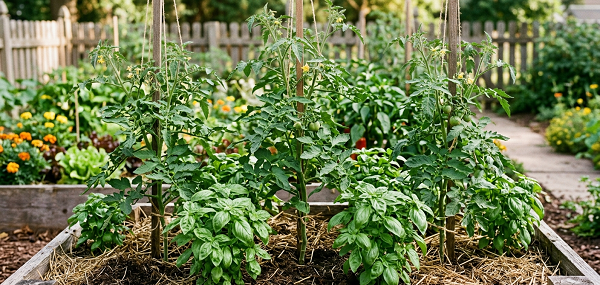
Basil is one of the best companion plants for tomatoes — it repels thrips and aphids through its volatile oils and is said to improve tomato flavor when planted in close proximity. See our best companion plants for tomatoes guide for the full companion planting strategy.
Watering and Fertilizing Outdoors
Watering: Water deeply when the top inch of soil is dry — push a finger into the soil to check. In hot summer weather this may be every 2 days; in cooler or rainy periods, much less. Basil shows drought stress quickly — leaves lose their perky upright posture and droop slightly. At this sign, water immediately.
Never overhead water on basil leaves in the evening — wet foliage overnight encourages fungal disease (particularly downy mildew, which devastates basil quickly in humid conditions).
Fertilizing: Feed monthly with a balanced liquid fertilizer at half the recommended rate. Basil grown in rich compost-amended soil may not need supplemental feeding at all. Over-fertilising with nitrogen produces rapid leafy growth but significantly dilutes the essential oils — and the flavor — in the leaves. Less is more with basil fertilising.
Growing Basil Indoors
Growing basil indoors is entirely possible, but it requires one thing most kitchens don’t naturally have: enough light. This is the reason most “grocery store basil pots” die within two weeks — they’re placed on a counter or dim windowsill with nowhere near the light basil needs to thrive.
Light — The Non-Negotiable
Basil needs 6–8 hours of direct sun per day. In practice, this means:
- South-facing window: The only windowsill direction that works in the Northern Hemisphere. East or west-facing windows provide 3–4 hours — survivable for basil, not thriving. North-facing: basil will die slowly.
- Grow light: The most reliable indoor solution. A basic LED grow light positioned 4–6 inches above the plant, running 14–16 hours per day, produces results equal to or better than an outdoor plant. This is the recommended approach if you don’t have a strong south window.
Container Selection for Indoor Basil
- Size: Minimum 6-inch pot for a single Genovese plant; 4-inch for compact dwarf varieties. Basil in too-small a pot dries out within hours on a hot windowsill and becomes stressed.
- Drainage: A drainage hole is non-negotiable. Basil sitting in water — even briefly — develops root rot and dies fast. Empty saucers within 30 minutes of watering.
- Material: Terra cotta is ideal — it breathes, reducing overwatering risk. Plastic retains moisture longer, which increases root rot risk in lower-light indoor conditions.
Indoor Watering
The most common indoor basil killer is overwatering, followed closely by underwatering. Both look similar at first — wilting leaves. The difference: overwatered basil has soft, mushy stems at the base; underwatered basil has firm stems and completely dry soil.
- Check soil daily by pushing a finger 1 inch into the mix
- Water only when that top inch is dry to the touch
- Water until it flows from the drainage hole, then empty the saucer
- In low light or cool conditions, basil needs water far less frequently than on a hot south windowsill — there’s no fixed schedule
The Pruning Technique That Makes All the Difference
This is the single most important skill in basil growing. Most people snip individual leaves from the top of the plant. This is exactly wrong — it encourages the plant to grow taller and thinner, then bolt.
Correct basil pruning turns one stem into two, and two into four — creating a bushy, productive plant that delays flowering for weeks or months.
How to Prune Basil Correctly
- Wait until the plant has at least 3 sets of leaves on each stem and is 6–8 inches tall.
- Identify a stem you want to harvest from. Look at the stem — you’ll see a pair of small leaves emerging from the main stem just above a leaf node (the junction where a leaf meets the stem).
- Cut the stem just above that leaf node — not at the top of the plant, but 1/3 to 1/2 way down the stem, just above where two small leaves are emerging.
- Those two small leaves will now grow into two full branches. One cut = two new stems. This is how one plant becomes bushy.
- Repeat this on every stem every 2–3 weeks. After 3 rounds of pruning, a single plant has 8–12 productive stems instead of 2–3.
- Always prune in the morning. The plant heals faster and the harvested stems stay fresh longer.
💡 Use everything you cut
The stems you remove when pruning are usable basil. Strip the leaves for cooking and place the stems in a glass of water on the counter — they’ll stay fresh for 5–7 days and often sprout roots after 10–14 days, giving you free new plants to pot up.
Pinching Flowers — The Most Time-Sensitive Task in Basil Growing
When a basil plant produces flowers (bolts), the leaves become smaller, tougher, and more bitter almost immediately. The plant’s energy shifts entirely from leaf production to seed production. Once bolting begins, it’s difficult to reverse — which is why catching it early matters so much.
What to look for: Flower stalks emerge from the centre top of each branch — they look different from regular growth, taller and more upright with tightly clustered small leaves and then tiny flower buds at the tip.
What to do: Pinch or cut the flower stalk off immediately — all the way back to the nearest leaf node below it. Do this the moment you see any flower stalk beginning, before buds open. If you catch it at this stage, the plant produces new vegetative growth from the surrounding nodes and continues producing quality leaves for several more weeks.
⚠️ Check twice a week in summer
In hot weather (above 80°F consistently), basil can go from no flower buds to full bloom in 5 days. Check your plants when you harvest — don’t wait for a weekly garden visit during summer peak heat.
Harvesting Basil
Begin harvesting when the plant is 6–8 inches tall with multiple sets of leaves — typically 4–6 weeks after transplanting. The more frequently you harvest (using the correct pruning technique above), the more the plant produces.
- How much to take: Never more than one-third of the plant at any single harvest
- When to harvest: Morning, after dew has dried — highest essential oil concentration and best flavor
- How to store fresh basil: Do NOT refrigerate — cold damages basil leaves and turns them black within hours. Trim stems and place in a glass of water at room temperature, like fresh-cut flowers. Keeps 5–7 days on the counter.
- Preserving the harvest: Blend fresh basil with olive oil and freeze in ice cube trays — each cube is one serving of pesto base. This is the most practical preservation method for a large harvest.
Common Basil Problems and Fixes
| Problem | Cause | Fix |
|---|---|---|
| Black or brown leaf edges | Cold damage (below 50°F) or refrigeration | Keep above 50°F; never refrigerate. Affected leaves won’t recover — trim and continue growing. |
| Yellowing lower leaves | Overwatering or nutrient deficiency | Check drainage; allow soil to dry between waterings. Feed with diluted balanced fertilizer. |
| Wilting despite moist soil | Root rot from waterlogging | Check drainage holes are clear. Repot into fresh mix if roots are mushy. Prevention is easier than cure. |
| Leggy, stretching stems | Insufficient light | Move to brighter window or add grow light. Prune leggy stems back hard — new growth will be more compact in better light. |
| White powdery coating on leaves | Powdery mildew — common in humid conditions | Improve airflow, reduce overhead watering. Remove badly affected leaves. Baking soda spray (1 tsp per litre with dish soap) at first sign. |
| Downy mildew (yellow patches, grey fuzz on underside) | Fungal disease — spreads rapidly | Remove affected leaves immediately. Improve airflow dramatically. This disease can kill a plant quickly — act fast. |
| Tiny holes in leaves | Flea beetles or slugs | Flea beetles: neem oil spray. Slugs: check at night with a torch and remove by hand. See our pest control guide. |
| Plant suddenly bolting in midsummer | Heat stress or long days triggering flowering | Pinch flower stalks immediately. Provide afternoon shade. If already fully flowered, harvest everything and start a new plant from seed. |
Can You Overwinter Basil?
Basil is a tropical annual — it does not survive frost outdoors and is not perennial in any climate below Zone 10. However, you can extend a plant’s life significantly by bringing it indoors before first frost.
- When to bring it in: Before nighttime temperatures drop below 50°F — not after the first cold snap, which will have already damaged it
- What to expect: Indoor basil in winter grows slowly and produces less than summer outdoor plants. It needs a grow light to perform at all — a windowsill alone in winter (low sun angle, short days) is usually not sufficient
- Practical alternative: Take cuttings from your outdoor plant in late summer, root them in water, and pot them up as compact indoor plants for winter use. These young rooted cuttings adapt to indoor conditions better than mature plants moved in from outside
- Easiest approach: In October, sow fresh seeds directly into a pot and grow them under a grow light indoors through winter. Fresh-seeded plants are more vigorous than transplanted mature plants
Frequently Asked Questions
Why does my grocery store basil plant always die?
Grocery store basil pots contain 10–20 seedlings crammed together — they’re grown for immediate sale, not long-term production. The overcrowded roots compete and the plant exhausts itself within weeks.
The fix: buy one pot, separate the seedlings into individual 6-inch pots with fresh potting mix, and put them in full sun. The same plant that would die in the supermarket pot thrives when given space, light, and proper drainage.
How often should I water basil indoors?
There’s no fixed schedule — it depends on pot size, temperature, light level, and soil type.
The only reliable method: push a finger 1 inch into the soil. Dry = water thoroughly. Still moist = wait. In a south window in summer, this might be every 2 days. In a lower-light spot in winter, it might be every 5–7 days. Never water on a schedule without checking the soil first.
Can basil grow in partial shade?
It will survive in 4–5 hours of sun but won’t thrive. Partial-shade basil grows slowly, stretches toward available light, produces smaller leaves, and bolts faster. The essential oil content — which is what makes basil fragrant and flavorful — is directly proportional to sun exposure. More sun = more flavor.
How do I get basil to grow bushier?
The pruning technique described above — cutting each stem back to just above a leaf node rather than snipping individual leaves from the top. Do this consistently every 2–3 weeks and a single plant becomes a dense, bushy producer. The other factor is light — adequate sun produces compact, sturdy growth; insufficient light produces tall, weak stems that won’t bush out regardless of pruning.
Is flowering basil still usable?
Yes — the leaves are still edible, just more bitter and smaller. The flowers themselves are edible and make a pretty garnish. If a plant has fully flowered, harvest all the leaves and flowers at once, use them immediately (cooked applications where bitterness is less noticeable work well), and start a fresh plant. Don’t try to pull a fully bolted basil plant back into vegetative production — it rarely works.
How much basil does one plant produce?
A well-managed Genovese basil plant in full sun can produce 1–2 cups of leaves per week during peak summer season. Over a 3–4 month growing season, that’s enough for multiple batches of pesto, several weeks of fresh caprese salads, and more herb-topped pasta than most families can eat. Two plants gives most households a continuous supply with enough to freeze or preserve.
🥬 Related Basil Articles in Our Vegetable Gardening Guide
Final Thoughts
We hope this guide means your basil plant survives past the second week and produces all summer.
The pruning technique and the flower-pinching habit are the two things that separate a basil plant that bolts in June from one that’s still producing in September. For all our vegetable and herb growing guides, our vegetable gardening guide links to everything.
Share this post with a fellow gardener who’s ready to get growing — and let us know in the comments whether you’re growing indoors or out this season — and which variety you chose. Happy growing!
