

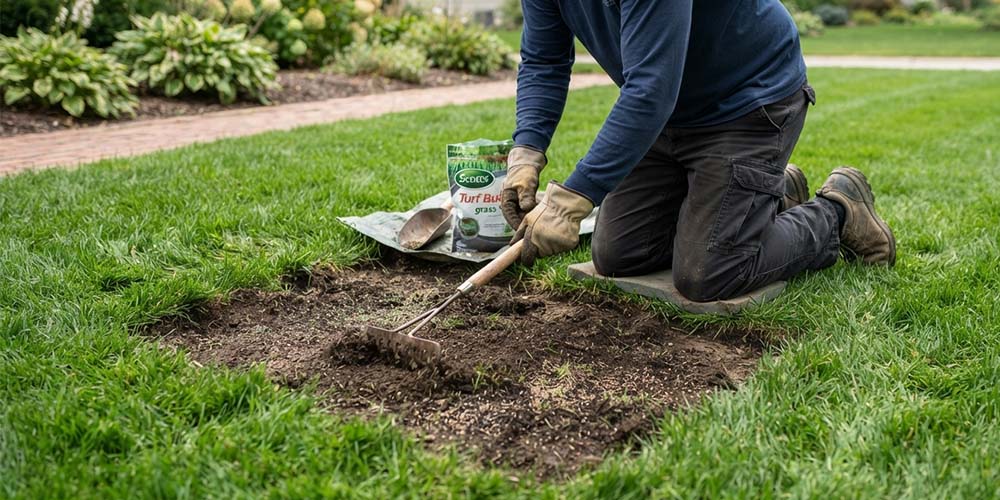
A bare patch doesn’t fix itself. Left alone, it usually gets bigger — weeds move into the open soil faster than grass does, and by next season you’re looking at a weed patch instead of a bare one.
The good news is that fixing a bare patch correctly isn’t complicated. It just needs the right steps done in the right order.
Most quick “just throw some seed down” advice skips exactly those steps.
Quick Guide: Identify and remove the cause first, then loosen the top 2–3 inches of soil, mix in compost, spread grass seed matched to your existing lawn, cover lightly with straw or a seed-starting mulch, and keep the area consistently moist for 2–3 weeks until germination. Skipping the cause-removal step is why most bare patch repairs fail within a season.
Step 1 — Find Out Why the Patch Went Bare
Reseeding over an unresolved cause is the single most common reason bare patch repairs fail. The new grass grows for a few weeks, then dies back for the same reason the original grass did.
Walk the area and check for the usual suspects before doing anything else.
| Likely Cause | What to Look For |
|---|---|
| Heavy foot traffic | Patch follows a worn path — a shortcut, a gate, a dog’s regular route |
| Grub damage | Turf lifts easily like a loose carpet; birds or animals digging at the spot |
| Fungal disease | Patch has a distinct ring shape or discolored border |
| Compacted soil | Screwdriver won’t push in past 2–3 inches |
| Pet urine spot | Small, roughly circular, often with a darker green ring around a dead center |
| Deep shade | Patch sits under a tree canopy or the north side of a structure |
If the cause is still active — a dog still using that spot, soil still compacted — fix that first. New grass seed in the same unresolved conditions just repeats the cycle.
⚠️ Check for grubs before you reseed
If turf lifts up easily like a loose rug, grubs may have eaten the roots. Reseeding without treating grubs means the new roots get eaten too. See our grub damage guide to confirm before moving forward.
Step 2 — Prep the Soil
Directions
- Remove any dead grass, thatch, or debris from the bare area with a hard rake.
- Loosen the top 2–3 inches of soil with a hand cultivator or garden fork. Compacted soil needs this step even if it looks bare and open already.
- Mix in a half-inch layer of compost, working it into the loosened soil rather than leaving it sitting on top.
- Rake the area smooth and level, so water doesn’t pool in one low spot or run off a high one.
If the underlying soil is heavily compacted across a wider area, not just this one patch, a broader fix is worth doing at the same time. Our lawn aeration guide covers the full process for the rest of the yard.
Step 3 — Choose the Right Seed
Matching new seed to your existing grass type matters more than most people expect. A patch reseeded with a different grass type often grows in a visibly different shade of green or a different blade texture — technically fixed, but obviously mismatched.
Not sure what you’re working with? Our grass identification guide walks through blade shape and growth pattern to help you match it correctly.
💡 Buy a little more seed than the patch needs
Bare patch repair rarely uses a full seed bag, and seed doesn’t store indefinitely once opened.
Grass seed doesn’t store indefinitely once opened — check the germination date on the bag and buy fresh if it’s been sitting more than a season or two.
Step 4 — Seed and Cover
Directions
- Spread seed evenly over the prepped area by hand for a small patch, or with a handheld spreader for anything larger than a few square feet.
- Press the seed lightly into the soil — a light pass with the back of a rake or a light foot-tamp works well. Seed needs soil contact to germinate reliably.
- Cover with a thin layer of straw mulch or a seed-starting mulch product. This holds moisture and protects seed from birds without smothering it.
Straw is the traditional choice here, and it works well. A thin, even layer is enough — thick enough to shade the soil and hold moisture, thin enough that light still reaches the seed underneath.
Step 5 — Water Consistently Until Established
New grass seed needs consistent surface moisture to germinate — not soaked, just reliably damp. This usually means light watering once or twice a day for the first 2–3 weeks, rather than a single deep watering every few days.
Once the new grass reaches mowing height and has been mowed 2–3 times, you can transition to your lawn’s normal deeper, less frequent watering schedule.
Why Bare Patches Often Come Back in the Same Spot
It’s worth understanding this pattern. A bare patch is rarely random — it’s usually the visible symptom of a specific, localized condition that’s been quietly present all along.
Compacted soil doesn’t decompact itself once grass is reseeded on top of it. The same foot traffic pattern that wore the grass down the first time will wear it down again unless something about the traffic pattern changes.
The cause-identification step matters more than any other part of this process. Skipping it doesn’t just risk failure — it almost guarantees the patch reappears in the exact same spot within a season or two.
Large Bare Areas vs. Small Patches
A few small patches scattered across an otherwise healthy lawn are a reasonable weekend fix using the steps above. A large, connected bare area — more than roughly 25% of the total lawn — is a different situation and usually calls for a different approach.
At that scale, overseeding the entire lawn rather than spot-treating individual patches gives more even results and is often less total work. Our full lawn overseeding guide covers that broader process.
For genuinely dead, compacted areas larger than a few square feet — where even prepped soil struggles to hold new seed — laying sod instead of seeding can be the faster, more reliable fix. Sod gives you an established root mat immediately rather than waiting weeks for seed to germinate and fill in.
Frequently Asked Questions
How long does it take for a reseeded bare patch to fill in?
Germination typically starts within 7–14 days for most cool-season grasses, with the patch looking reasonably filled in by 4–6 weeks under good conditions. Warm-season grasses can take slightly longer depending on the variety and soil temperature at planting.
Can I just throw grass seed on top of a bare patch without prepping the soil?
You can, but germination rates drop significantly without soil contact — much of the seed sits on the surface, dries out, or gets eaten by birds before it has a chance to root. The soil prep steps above take an extra 15–20 minutes and meaningfully improve the odds the repair actually works.
Why did my newly seeded patch turn yellow before it filled in?
Early yellowing in freshly germinated grass is often a sign of inconsistent watering — the surface dried out between waterings during the fragile early root stage. Confirm you’re watering lightly once or twice daily rather than less frequently, especially in the first two weeks after germination.
Is it better to fix bare patches in spring or fall?
For cool-season grasses, fall is generally the stronger window — cooler air temperatures and typically more consistent rainfall reduce the stress on new seedlings. Spring works too, just with a slightly narrower margin for error before summer heat arrives. Warm-season grasses do best reseeded in late spring to early summer instead.
Will grass seed spread into the patch on its own from the surrounding lawn?
Some spreading grass types will slowly fill in small bare spots on their own over a full season through natural spreading via rhizomes or stolons, but bunch-type grasses generally won’t. Actively reseeding is faster and more reliable than waiting on natural spread, especially for a patch of any meaningful size.
Related Articles in Our Soil & Fertility Guide
Free Tools for Lawn Repair Planning
Final Thoughts
We hope this gives you a repair process that actually holds instead of one that needs redoing every few months. The cause-first approach takes a little more time up front, but it’s the difference between a patch that’s genuinely fixed and one that’s just temporarily covered.
For the rest of a complete lawn care routine, our soil and fertility guides cover the year ahead.
Share this post with a fellow homeowner staring at a bare spot in their lawn — and let us know in the comments what caused yours. Happy growing!
