

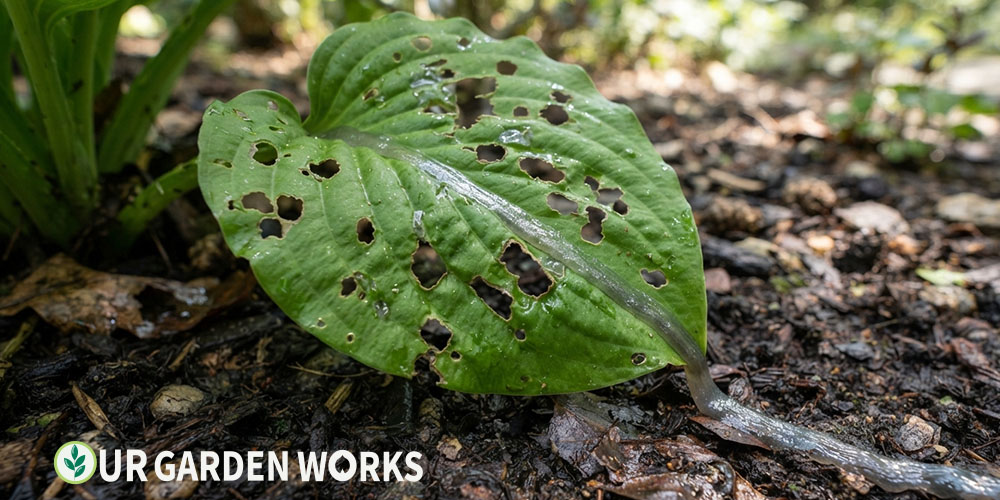
Slugs deserve their reputation as the primary cause of holes in hosta leaves — they genuinely are responsible for the large majority of cases, and hostas are practically a slug delicacy.
But a small number of other culprits can produce similar-looking damage, and it’s worth knowing how to tell them apart before assuming every hole is slug-related.
We’ll cover how to confirm slug damage with confidence, then walk through the less common alternatives worth ruling out when something doesn’t quite match the classic pattern.
Quick Answer: Holes in hosta leaves are most often slugs and snails — irregular holes with smooth edges, often accompanied by silvery slime trails, worse after rain and at night. Less common causes include black vine weevil larvae (notched leaf edges, larvae feed on roots too), deer or rabbit browsing (larger, more ragged damage), and hail damage (sudden, affects nearby plants too). Check for slime trails first, since this single clue confirms the vast majority of cases.
Cause 1 — Slugs and Snails (By Far the Most Common)
Slugs and snails are drawn to hosta foliage more reliably than almost any other common garden plant, and the damage pattern is genuinely distinctive once you know what to look for.
Irregular holes, ranging from small perforations to large ragged sections, appear scattered across the leaf surface, often starting from the edges but capable of appearing anywhere.
How to confirm it’s slugs or snails:
- Silvery slime trails visible on damaged leaves or nearby soil and mulch
- Holes have relatively smooth, rounded edges rather than jagged or notched margins
- Damage is worse following rain or in consistently moist, shaded conditions
- Checking at night with a flashlight often reveals the slugs or snails directly on the plant
Fix: Iron phosphate slug bait is effective and safe around pets and wildlife when used as directed. Beer traps, copper tape barriers around particularly prized plants, and reducing nearby hiding spots (dense mulch, debris) all help reduce slug pressure. Hand-picking at night with a flashlight is tedious but genuinely effective for smaller populations.
💡 Thick-leafed and textured hosta varieties resist slug damage better
Hosta varieties with thicker, more substantial leaves and a textured, puckered surface (often blue-toned varieties) tend to show less slug damage than thin-leafed, smooth varieties.
If slug damage has been a persistent frustration, gradually transitioning to these more resistant varieties reduces the problem without needing to abandon hostas altogether.
Cause 2 — Black Vine Weevil Larvae
Black vine weevil adults create distinctive notched, scalloped damage along leaf edges, which can be mistaken for slug damage at a glance but has a more regular, repeating notch pattern rather than slugs’ more randomly placed holes.
The larvae, living in soil, also feed on hosta roots, which can cause additional decline beyond just the visible leaf damage.
How to confirm it’s black vine weevil:
- Damage shows a repeating, scalloped notch pattern along leaf edges specifically, rather than holes scattered across the leaf surface
- No slime trails present
- Plant may show additional decline or weakness beyond what leaf damage alone would explain, suggesting root feeding as well
- Adult weevils, if seen, are small, dark, and flightless, often found at the base of plants at night
Fix: Beneficial nematodes applied to the soil target the root-feeding larvae effectively. For adult weevils, sticky traps or barriers around the base of affected plants can reduce their ability to climb up and feed on foliage.
Cause 3 — Deer or Rabbit Browsing
Larger mammals like deer and rabbits produce more substantial damage than slugs or insects — entire leaf sections or whole leaves missing, often with a more torn or ragged edge from the browsing action rather than the comparatively cleaner holes left by slugs. This damage also tends to appear suddenly, sometimes overnight, affecting many plants in the area at once.
How to confirm it’s deer or rabbit browsing:
- Damage is substantial — significant portions or entire leaves missing
- Edges of remaining leaf tissue look torn or ragged rather than cleanly holed
- Multiple plants in the area show similar damage simultaneously
- Other signs of deer or rabbit activity nearby (tracks, droppings, browsing on other plants)
Fix: Physical barriers — fencing, individual plant cages, or netting — provide the most reliable protection. Repellent sprays offer some deterrence but typically need reapplication after rain and aren’t as consistently effective as physical exclusion. Our guide to rabbits and hostas covers rabbit-specific deterrence in more detail.
Cause 4 — Hail Damage
Hail produces sudden, somewhat round holes or tears scattered across leaves, distinguishable from pest damage primarily by timing — it appears immediately following a specific storm event and affects all nearby plants similarly, regardless of species or typical pest preferences.
How to confirm it’s hail:
- Damage appeared suddenly, coinciding with a recent storm
- Other nearby plants, including non-hosta species, show similar sudden damage
- No slime trails, notching pattern, or signs of larger animal browsing
Fix: None needed for existing damage, since this is a one-time weather event rather than an ongoing pest issue. Affected leaves will simply grow out the damage over the rest of the season, or you can trim severely damaged leaves for tidiness.
Telling the Four Causes Apart at a Glance
| Cause | Pattern | Key Clue | Timing |
|---|---|---|---|
| Slugs/snails | Irregular holes, smooth edges | Slime trails | Worse after rain, at night |
| Black vine weevil | Scalloped edge notching | No slime, possible root decline | Ongoing through season |
| Deer/rabbit | Large missing sections, ragged | Multiple plants affected | Often overnight |
| Hail | Round holes/tears, sudden | Other plants affected too | Immediately after a storm |
Building a Garden-Wide Slug Management Strategy
Since hostas rarely exist in isolation from the rest of a shaded garden bed, thinking about slug control at the garden level rather than plant by plant produces better long-term results than spot-treating individual hosta clumps after damage appears.
Reducing the overall habitat slugs favor — excess mulch depth, dense ground-level debris, and consistently damp, shaded hiding spots near the base of plants — lowers the baseline slug population available to find and damage your hostas in the first place.
Watering in the morning rather than evening, a habit already recommended for disease prevention throughout this series, also reduces slug activity somewhat, since it gives soil and mulch surfaces time to dry out somewhat before the slugs’ preferred nighttime feeding hours begin.
While morning watering won’t eliminate slug pressure entirely, it removes one more factor working in their favor when combined with the more direct control methods covered above.
For gardens with severe, chronic slug pressure despite consistent control efforts, introducing slug-eating predators — certain ground beetles, some bird species, and in appropriate climates even ducks in larger garden settings — provides an additional layer of biological control that works alongside rather than instead of the direct methods already covered.
This is a longer-term, more involved strategy, but worth considering if slugs have been a persistent, garden-wide problem rather than an isolated hosta-specific issue.
The Slime Trail Test — Your Fastest First Check
Given how overwhelmingly common slug and snail damage is compared to the alternatives, checking for slime trails should be your very first diagnostic step before considering anything else on this list.
A quick inspection of the damaged leaf and the soil or mulch immediately beneath it, ideally in early morning before trails have had a chance to dry and become less visible, resolves the majority of cases within seconds.
If slime trails are genuinely absent despite clear leaf damage, that’s the signal to move through the other three causes systematically, checking for the scalloped notching of black vine weevil, the scale of damage suggesting larger animal browsing, or the sudden, multi-plant pattern of hail.
This sequential approach — slime trail check first, then pattern and timing for everything else — resolves nearly every case of hosta leaf holes efficiently.
Frequently Asked Questions
Will holes in hosta leaves heal or close up over time?
No, existing holes are permanent damage to that specific leaf and won’t heal or close, though the plant will produce new, undamaged leaves as the season progresses if the underlying pest pressure is addressed.
Severely damaged leaves can be trimmed away for appearance without harming the plant, since hostas regenerate new foliage readily during the growing season.
Do all hosta varieties get slug damage equally, or are some more resistant?
Resistance varies meaningfully — thick-leafed, heavily textured varieties (many blue-toned hostas in particular) show noticeably less slug damage than thin-leafed, smooth, often yellow or chartreuse varieties.
If slug pressure in your garden is severe and ongoing, factoring this resistance difference into future hosta purchases can reduce the problem more sustainably than relying purely on slug control measures.
Can I use the same slug control methods for hostas as for other garden plants?
Yes, the same iron phosphate bait, beer traps, and copper barrier methods that work for vegetables and other ornamentals work equally well for hostas, since slugs and snails aren’t picky about which plant they’re being controlled around.
The main consideration specific to hostas is their typically shaded, moist growing environment, which tends to support higher slug populations than a sunnier vegetable garden bed might, so more consistent and proactive control is often warranted.
Related Articles in Our Plant Care Guide
Final Thoughts
We hope this guide has confirmed what you probably already suspected if slime trails were present — and given you a clear path to checking the alternatives if they weren’t.
Slugs explain the overwhelming majority of hosta hole damage, which is good news since they’re also one of the more manageable garden pests once you commit to a consistent control approach.
Share this post with a fellow gardener who’s troubleshooting their hostas — and let us know in the comments which cause matched what you found. Happy growing!
