

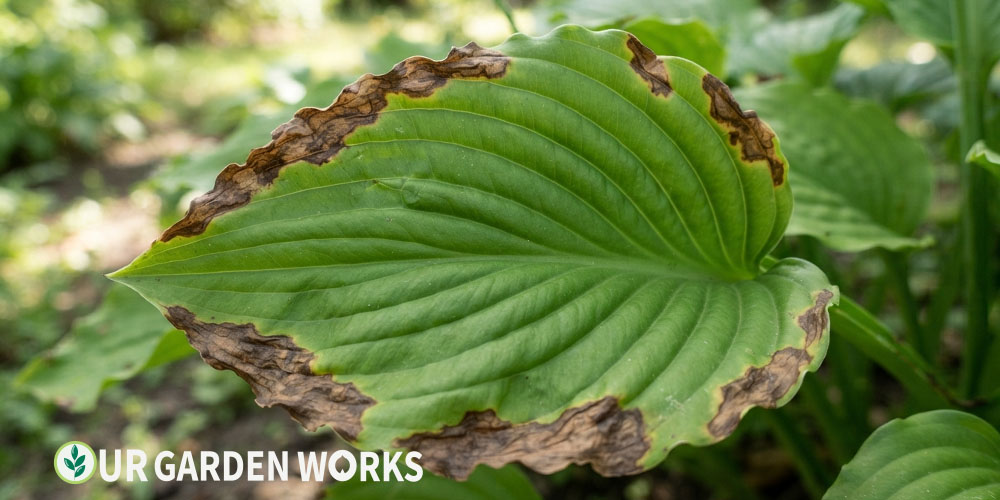
Brown spots on hostas tend to alarm gardeners more than the situation usually warrants, partly because hostas are prized for their pristine, unblemished foliage and any blemish feels like a bigger problem than it often is.
The good news is that most causes are manageable, and a few aren’t even problems at all.
We’ll walk through the most common causes in order of how frequently we see them, with the visual details that set each one apart. Pattern and location on the leaf matter just as much here as they do for any other leaf diagnosis.
Quick Answer: Brown spots on hostas are most often caused by sunscald (irregular bleached-brown patches on sun-exposed leaves), fungal leaf spot (small, round, often with a darker border), slug damage that’s dried out (irregular holes with browned edges), or simply normal end-of-season decline. Check whether the spots correlate with sun exposure, have a defined fungal pattern, or are part of natural fall dieback before treating anything.
Cause 1 — Sunscald
Hostas are shade-loving plants by nature, and many varieties — especially those with thinner, more delicate leaves or blue-green coloring — scorch when exposed to more direct sun than they’re suited for.
This produces irregular, papery brown to tan patches, often concentrated on the side of the plant facing the most intense afternoon sun.
How to confirm it’s sunscald:
- Damage concentrates on the sun-facing side of the plant or clump
- Patches are irregular, dry, and papery rather than round with defined borders
- Worse on varieties known to be more shade-dependent (blue and gold-leafed types especially)
- Often follows a hot, sunny stretch or a recent move to a brighter location
Fix: No treatment reverses existing scald damage, but relocating the plant to better shade, or adding shade from nearby plantings or structures, prevents further damage. If relocation isn’t practical, choosing more sun-tolerant hosta varieties for that specific spot going forward is the more sustainable solution.
💡 Not all hostas need the same amount of shade
Gold and yellow-leafed hosta varieties generally tolerate more sun than blue-leafed types, which are bred to maximize their blue coloring under low light and scorch more readily in bright conditions.
If sunscald is a recurring issue in a particular spot, switching to a gold or chartreuse variety there often solves the problem without needing to change the planting location.
Cause 2 — Fungal Leaf Spot (Anthracnose)
Anthracnose and other fungal leaf spot diseases produce smaller, more uniformly round or oval brown spots, often with a darker brown or purplish border and sometimes a slightly sunken or water-soaked appearance at the center.
Unlike sunscald, these spots aren’t tied to sun exposure and can appear anywhere on the leaf, including shaded portions of the plant.
How to confirm it’s fungal leaf spot:
- Spots are relatively round or oval with a defined, often darker border
- Appears regardless of sun exposure, including on shaded leaves
- Worse in humid conditions or after periods of frequent rain
- May show a slightly sunken or water-soaked texture at the spot’s center
Fix: Remove and dispose of affected leaves rather than composting them. A copper-based fungicide can help manage active spread in more severe cases. Improving airflow around the plant and avoiding overhead watering reduces the humid conditions the fungus favors.
Cause 3 — Slug Damage That’s Since Dried Out
Fresh slug damage shows as ragged holes, but as those damaged areas dry out over subsequent days, the edges and surrounding tissue can brown and create what looks like a brown spot rather than an obvious hole.
This is a common point of confusion, especially when you’re inspecting damage well after the actual feeding occurred.
How to confirm it’s old slug damage:
- Spots have an irregular, ragged outline rather than a clean round shape
- Some areas may show a true hole at the center surrounded by browned, dried tissue
- Slime trail residue, even if faded, may be visible nearby
- Damage concentrates on lower leaves closest to the ground
Fix: Address the slug population directly — iron phosphate bait, beer traps, or copper barriers all help — rather than treating the existing brown patches, which won’t improve once the tissue has already died. New growth, once slugs are controlled, should emerge undamaged.
Cause 4 — Natural End-of-Season Decline
As hostas move toward natural dormancy in late summer and fall, it’s completely normal for leaves to develop brown patches, edges, and overall discoloration as part of the plant’s seasonal cycle. This is the least concerning cause on this list and requires no intervention at all.
How to confirm it’s seasonal decline:
- Timing coincides with late summer or fall, well into the second half of the growing season
- Browning is widespread and gradual rather than appearing suddenly mid-season
- Plant has otherwise had a normal, healthy growing season
Fix: None needed. You can cut back foliage once it’s fully browned for tidiness, typically after the first hard frost in most climates.
Telling the Four Causes Apart at a Glance
| Cause | Shape | Location | Timing |
|---|---|---|---|
| Sunscald | Irregular, papery | Sun-facing side | Hot, sunny stretches |
| Fungal leaf spot | Round/oval, defined border | Anywhere, even shade | Humid, rainy periods |
| Old slug damage | Ragged, irregular | Lower leaves | Following active feeding |
| Seasonal decline | Widespread, gradual | Whole plant | Late summer/fall |
Less Common Causes Worth Ruling Out
If the four causes above don’t match what you’re seeing, a couple of additional possibilities are worth checking before assuming the worst.
Hail damage, while not a disease or pest at all, can produce small, somewhat round brown or tan marks scattered across hosta leaves following a storm, distinguishable by the fact that it appears suddenly after a specific weather event and affects other nearby plants similarly.
Chemical or fertilizer burn from a misapplied herbicide drift or an overly concentrated fertilizer application can also produce brown patches, often with a more uniform or streaked pattern than disease-related spotting, and typically appearing shortly after a specific lawn or garden treatment nearby.
If brown spots appeared suddenly after mowing, spraying, or fertilizing nearby areas, this is worth considering even though it’s a less frequent cause than the others covered above.
Choosing the Right Spot to Prevent Future Damage
Since sunscald is one of the most common causes of hosta brown spots, getting the planting location right from the start prevents a recurring problem rather than managing it every season.
Most hostas perform best in dappled or filtered shade, with protection from intense afternoon sun being more important than morning sun exposure, which is generally gentler and less likely to cause scorching.
If you’re working with an existing planting that gets more sun than ideal, especially after nearby trees have been removed or a building’s shadow pattern has changed over years, relocating mature hosta clumps in early spring or fall is entirely possible and often less disruptive than people expect.
Hostas are resilient to division and transplanting when done at the right time of year, well outside the heat of summer.
Frequently Asked Questions
Will brown spots on hostas spread to other plants in my garden?
Fungal leaf spot diseases affecting hostas are generally specific to hostas and closely related plants, and won’t typically spread to unrelated garden plants like roses, vegetables, or most other perennials.
They can spread between different hosta plants growing nearby, however, so removing affected leaves promptly helps protect other hostas in the same bed.
Should I cut off hosta leaves that have brown spots?
For fungal leaf spot specifically, yes — removing and disposing of affected leaves helps limit spread to the rest of the plant and nearby hostas.
For sunscald or natural seasonal decline, removal is purely a cosmetic choice rather than a necessary treatment, since neither cause is contagious or actively spreading.
Are some hosta varieties more resistant to brown spots than others?
Thicker-leafed varieties generally show better resistance to both sunscald and some fungal issues compared to thin-leafed types, and certain modern cultivars are specifically bred with improved disease resistance.
If brown spots have been a persistent problem with a particular hosta in your garden, researching that variety’s known sun tolerance and disease resistance reputation before planting more of the same type is worthwhile.
Why do my hostas get brown spots every single year despite treatment?
This pattern often points to either a planting location issue that hasn’t been addressed (too much sun for that variety) or a fungal disease that’s overwintering in fallen leaf debris and reinfecting the plant each spring.
Thorough fall cleanup of all hosta foliage, combined with reassessing whether the planting site provides appropriate shade, addresses both possibilities directly.
Can overwatering or underwatering cause brown spots on hostas?
Underwatering is the more likely culprit of the two, producing crispy, brown leaf edges and tips especially during hot, dry stretches, though this tends to show as marginal browning rather than scattered spots across the leaf surface.
Overwatering more commonly causes yellowing or root problems than distinct brown spotting, making it a less likely explanation for this specific symptom compared to the four causes covered above.
Related Articles in Our Hosta Care Guide
Final Thoughts
We hope this guide has helped you figure out exactly what’s behind the brown spots on your hostas — and in several cases, reassured you that it’s nothing to worry about at all. Getting the planting location right is the single biggest factor in preventing this from becoming a recurring issue.
For more Hosta care, our plant care guides cover everything from planting to seasonal maintenance.
Share this post with a fellow gardener who’s troubleshooting their hostas — and let us know in the comments which cause matched what you found. Happy growing!
