

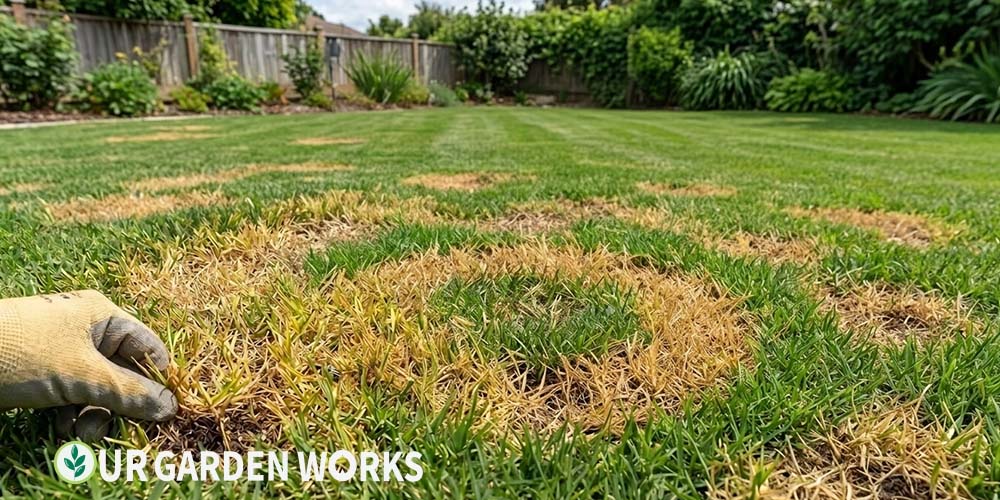
Brown patches are probably the single most common lawn complaint we hear, and the frustrating part is that at least eight genuinely different problems can produce roughly the same basic symptom. Get the diagnosis wrong, and a whole season of treatment effort goes toward the wrong fix.
The good news is that each cause leaves a slightly different signature once you know what to look for — patch shape, edge definition, and what’s happening at the soil level all tell a different part of the story.
We’ll walk through each one so you can match what’s actually happening in your yard.
Quick Answer: Brown patches in lawn are most often caused by grub damage (patches lift up like loose carpet), fungal disease like brown patch or dollar spot (circular patches, often with a darker ring), dog urine spots (small, very dark green-edged dead circles), drought stress (large irregular areas, worse on slopes), grub or chinch bug damage, or simple compaction from heavy foot traffic. Check patch shape and whether the grass pulls up easily to narrow it down.
Cause 1 — Grub Damage (Most Destructive)
Grubs — the larval stage of Japanese beetles and June beetles — feed on grass roots from below, and the damage they cause has a genuinely distinctive tell: affected turf lifts up easily, almost like a loose carpet, because the roots have been eaten away and no longer anchor the grass to the soil.
Patches are often irregular and can expand rapidly through late summer and fall.
How to confirm it’s grubs:
- Grass in the brown patch pulls up easily, like rolling back a rug
- Cream-colored, C-shaped larvae visible in the soil just beneath the patch
- Increased bird or skunk activity nearby (both dig for grubs)
- Most active and most damaging in late summer and early fall
Fix: A grub count test (cutting a small square of turf and counting larvae) confirms whether populations exceed the treatment threshold, typically 8-10 grubs per square foot. Beneficial nematodes or a targeted grub control product applied at the right life stage (usually mid-summer) provides effective control.
Cause 2 — Brown Patch or Dollar Spot Fungal Disease
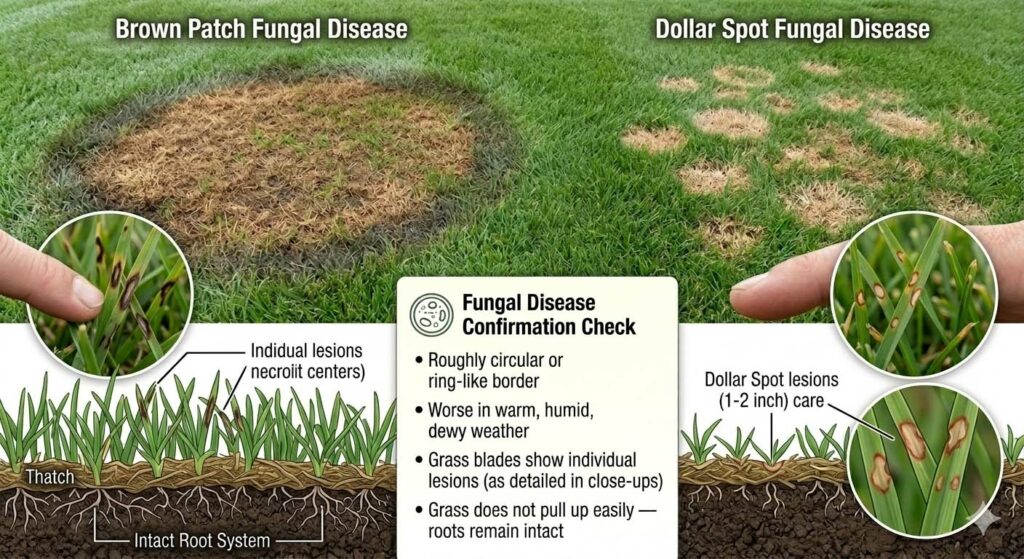
Brown patch fungus produces roughly circular dead patches, often with a darker, smoke-colored ring around the patch’s outer edge in humid morning conditions.
Dollar spot, a related but distinct disease, produces smaller, silver-dollar-sized circular patches, often numerous across the lawn rather than just one or two large areas.
How to confirm it’s fungal disease:
- Patches are roughly circular or have a ring-like border
- Worse in warm, humid weather, especially after periods of dew or overnight leaf wetness
- Grass blades within the patch may show individual lesions if examined closely
- Grass doesn’t pull up easily — roots remain intact
Fix: A fungicide labeled for the specific disease helps manage active outbreaks. Reducing overwatering and improving morning sun exposure (which dries dew faster) addresses the underlying humid conditions both diseases favor.
Cause 3 — Dog Urine Spots
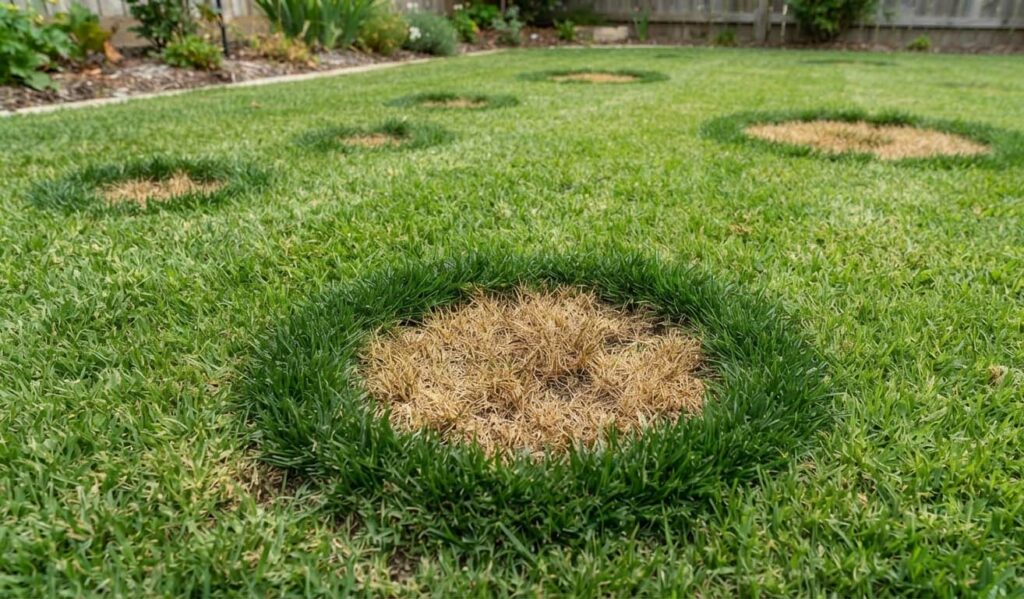
Dog urine produces a very recognizable pattern: a small, intensely dead, often brown or yellow circular spot, frequently surrounded by a ring of darker, lusher green grass where diluted nitrogen acted as a mild fertilizer rather than a burn.
This pattern — dead center, green halo — is distinctive enough to confirm the cause without much guesswork.
How to confirm it’s dog urine:
- Small, roughly circular dead spots with a green ring around the dead center
- Concentrated in areas where a dog regularly relieves itself
- New spots continue appearing in the same general area over time
Fix: Flush the area with water immediately after the dog urinates to dilute the nitrogen concentration before it burns the grass. For an already-damaged spot, watering thoroughly and reseeding once the area is no longer being repeatedly targeted resolves it.
Cause 4 — Drought Stress
Drought-stressed lawns show large, irregular brown areas rather than the more discrete, defined patches of disease or pest damage, often appearing first and worst on slopes, near pavement that radiates heat, or in compacted areas where water runs off rather than soaking in. The grass typically isn’t dead, just dormant, which matters for how you respond.
How to confirm it’s drought stress:
- Browning is widespread and irregular rather than patchy with defined edges
- Worse on slopes, near hardscaping, or in compacted soil areas
- Coincides with a dry stretch of weather and reduced watering
- Grass often shows some green at the crown even when blades are brown
Fix: Most cool-season grasses go dormant rather than dying outright during drought and recover with consistent watering once conditions improve. Deep, infrequent watering (rather than light daily sprinkling) encourages deeper root growth that’s more drought-resilient long-term.
Cause 5 — Chinch Bug Damage
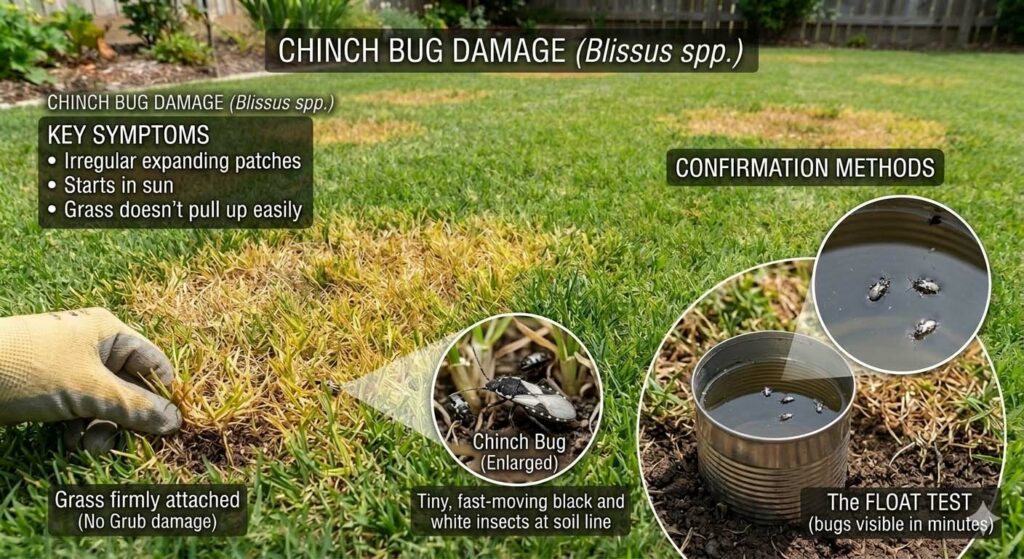
Chinch bugs feed on grass at the soil surface, injecting a toxin that causes irregular yellow-to-brown patches, often starting in the sunniest, driest parts of the lawn and expanding outward if left untreated.
Unlike grub damage, the grass doesn’t pull up easily, since chinch bugs don’t damage roots directly.
How to confirm it’s chinch bugs:
- Patches start in hot, sunny, dry areas and expand gradually
- Grass doesn’t lift up easily like grub-damaged turf
- Small, fast-moving black and white insects visible if you part the grass at the soil line
- The float test confirms presence: cut both ends off a coffee can, push it into the soil at the patch edge, fill with water, and watch for insects floating to the surface within a few minutes
Fix: An insecticide labeled for chinch bugs, applied at the soil surface where the insects feed, provides effective control. Reducing thatch buildup and maintaining consistent watering reduces the hot, dry conditions chinch bugs favor.
Cause 6 — Soil Compaction From Foot Traffic
Heavily compacted soil, common in high-traffic areas like along a regular walking path or near a gate, restricts root growth and water penetration enough to produce chronic thin, brown patches that persist regardless of watering or fertilizing. This cause is often overlooked since it doesn’t show the dramatic, sudden onset of pest or disease damage.
How to confirm it’s compaction:
- Patches correlate with known high-traffic areas — paths, gates, play areas
- Persists chronically rather than appearing suddenly
- Soil feels notably hard and resistant to a screwdriver or probe pushed into it
Fix: Core aeration relieves compaction and allows water, air, and nutrients to reach roots more effectively. See our spring lawn aeration guide for the full process. Redirecting foot traffic with a path or stepping stones prevents recurrence in chronic problem areas.
Cause 7 — Improper Mowing
Mowing too short (“scalping”), mowing with dull blades that tear rather than cut cleanly, or mowing during the hottest, driest part of the day can all stress grass enough to produce browning that looks similar to disease but traces back entirely to mowing practice. This is one of the more easily fixed causes once identified.
How to confirm it’s mowing-related:
- Browning appeared shortly after a mowing session
- Grass blade tips may look frayed or torn rather than cleanly cut when examined closely
- Pattern sometimes follows mower path or wheel tracks
Fix: Sharpen mower blades at least once or twice per season, never remove more than about a third of the grass blade height in a single mowing, and avoid mowing during peak afternoon heat or when grass is drought-stressed.
Cause 8 — Nutrient Deficiency or Fertilizer Burn
Both underfertilizing (leading to weak, thin, browning turf) and overfertilizing (causing actual chemical burn) can produce brown patches, though they look somewhat different from each other.
Underfertilized lawns brown gradually and uniformly in affected areas, while fertilizer burn produces faster, more defined dead patches that often follow a fertilizer spreader’s actual application pattern.
How to confirm it’s fertilizer-related:
- Burn pattern: sudden browning following a recent fertilizer application, sometimes in stripes matching spreader overlap
- Deficiency pattern: gradual, widespread thinning and yellowing-to-browning, no recent fertilizer history
Fix: For burn, water thoroughly and immediately to dilute and flush excess fertilizer salts. For deficiency, follow a proper seasonal feeding schedule — see our spring lawn care schedule for timing guidance, and use a fertilizer calculator to apply the correct rate going forward.
Telling the Eight Causes Apart at a Glance
| Cause | Patch Shape | Grass Pulls Up? | Key Clue |
|---|---|---|---|
| Grubs | Irregular | Yes, easily | C-shaped larvae in soil |
| Fungal disease | Circular/ring | No | Worse in humid weather |
| Dog urine | Small circle, green ring | No | Concentrated in dog’s area |
| Drought stress | Large, irregular | No | Slopes, dry weather |
| Chinch bugs | Irregular, expanding | No | Float test confirms |
| Compaction | Follows traffic paths | No | Hard soil, chronic |
| Mowing damage | Follows mower pattern | No | Recent mowing, frayed tips |
| Fertilizer burn/deficiency | Stripe pattern or gradual | No | Recent fertilizing history |
The Tug Test — Your Fastest First Diagnostic Step
Before working through the full list above, gently tug on the grass at the edge of a brown patch.
- If it lifts away easily with little resistance, revealing damaged or absent roots beneath, grub damage is the strong frontrunner and worth confirming with a soil check before considering anything else.
- If the grass holds firm and doesn’t pull up, you can move directly to considering the remaining seven causes based on patch shape and recent history.
This single test, taking just a few seconds, immediately rules in or out the most destructive cause on this list, since grub damage left untreated can spread dramatically through a lawn in just a few weeks during peak feeding season.
Frequently Asked Questions
Will brown patches recover on their own without treatment?
It depends entirely on the cause. Drought-stressed dormant grass typically recovers fully with consistent watering once conditions improve, while grub damage, fungal disease, and dog urine spots generally require active intervention or reseeding to recover, since the underlying root or tissue damage doesn’t reverse on its own.
How long does it take for a brown patch to turn green again after treatment?
For dormancy-related browning, recovery often begins within 1-2 weeks of consistent watering once weather conditions improve.
For patches requiring reseeding (grub damage, severe disease, urine spots), expect 3-6 weeks for new grass to establish and fill in, depending on grass type and season.
Can I have more than one cause of brown patches in the same lawn?
Yes, and this is fairly common, especially since stressed or weakened grass from one cause (like drought) becomes more vulnerable to a second cause (like fungal disease or pest damage) at the same time.
If patches in different areas of your lawn show different patterns, it’s worth diagnosing each section separately rather than assuming a single universal cause.
What's the best time of year to address brown patches for the best results?
Timing depends on the cause — grub treatment works best in mid-summer when larvae are small and most vulnerable, fungal disease management focuses on adjusting watering and improving airflow as soon as symptoms appear, and reseeding for any cause works best in early fall for cool-season grasses or late spring for warm-season varieties.
Related Articles in Our Lawn Care Guide
- Yellow Rings in Grass — What’s Causing Them
- How to Fix Bare Patches in a Lawn – Step-by-Step
- Dead Patches in Lawn After Rain
- Spongy Lawn — Thatch vs Grub Damage
- How to Aerate Your Lawn in Spring
- Spring Lawn Care Schedule
- Fall Lawn Care Calendar – Everything to Do Before Winter
- How to Overseed a Lawn for Thick, Green Growth
Final Thoughts
We hope this guide has helped you match the exact pattern of your brown patches to the right cause — that simple tug test alone resolves a good share of cases before you need to dig any deeper.
For more lawn care guidance, see our full collection of lawn articles in soil and fertility guides covers everything from seasonal maintenance to pest management.
Share this post with a fellow homeowner who’s troubleshooting their lawn — and let us know in the comments which cause matched what you found. Happy growing!
