

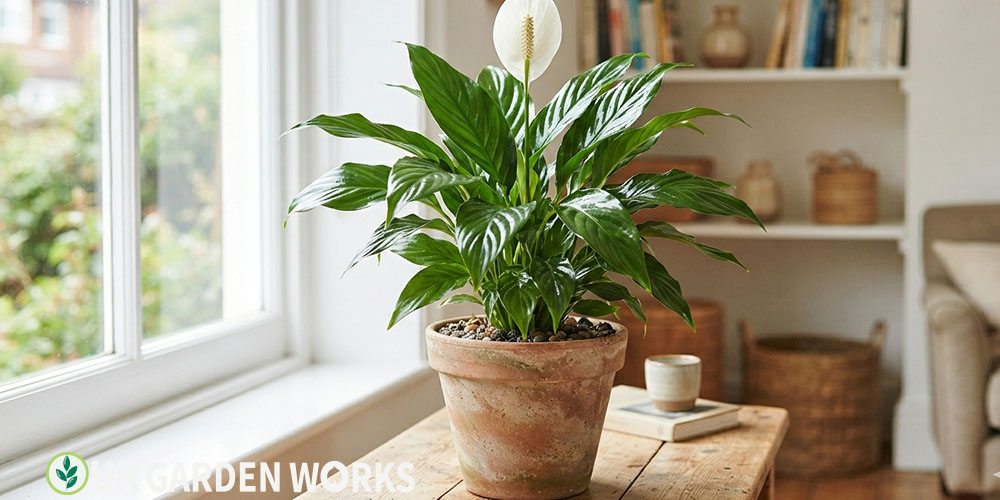
Peace lily is one of the most forgiving flowering houseplants you can grow, partly because it gives you an unmistakable signal when it needs water — its leaves droop dramatically, then bounce back within hours of a good drink.
That built-in feedback loop is exactly why so many people succeed with peace lily even as beginners. This guide covers everything else around that one helpful quirk.
Quick Guide: Peace lily wants medium to low indirect light, water when the top inch of soil is dry (or when leaves droop, whichever comes first), and consistent warmth above 60°F. It flowers best with slightly brighter light, though it tolerates surprisingly dim conditions for a flowering plant.
Why the Drooping Signal Is So Reliable
Peace lily leaves are unusually responsive to water stress compared to most houseplants, wilting dramatically and visibly within a day or two of the soil drying out.
This isn’t a flaw — it’s genuinely useful feedback. As soon as you see the leaves go limp, water thoroughly, and the plant typically perks back up within a few hours to a day. Few houseplants communicate their needs this clearly.
💡 Don’t wait too many cycles before adjusting your schedule
An occasional droop-and-recover cycle is fine and harmless. But if your peace lily droops on a predictable schedule every week, it’s telling you something useful — water slightly more often, on a schedule that anticipates the droop rather than always reacting to it.
Light Requirements
Peace lily tolerates low light better than most flowering houseplants, which is part of its popularity for offices and dim corners. It will survive — and stay green — in fairly shaded spots.
However, flowering specifically requires brighter, indirect light. A peace lily kept in deep shade may grow attractive foliage but rarely produces the white spathe blooms it’s known for.
Bright, indirect light — near but not directly in a window — gives you the best of both: healthy foliage and regular flowering.
Watering
How to Water Correctly
- Check the top inch of soil with a finger. Water once it feels dry.
- Water thoroughly until it drains from the bottom of the pot.
- Empty the saucer afterward — peace lily dislikes sitting in standing water for extended periods.
- If leaves droop before your next scheduled check, water immediately rather than waiting.
Peace lily prefers consistently moist (not soggy) soil. It tolerates occasional dry spells better than most flowering plants, thanks to that visible wilting warning system.
Humidity and Temperature
Peace lily appreciates higher humidity, being native to tropical rainforest understories, but adapts reasonably well to average indoor humidity. Brown leaf tips are a common sign humidity is too low for its preference.
Keep temperatures above 60°F — peace lily is sensitive to cold and can suffer damage below that threshold, especially from cold drafts near doors or windows in winter.
Why Peace Lily Tolerates Low Light So Much Better Than It Flowers In It
This distinction confuses a lot of peace lily owners, since the plant clearly survives in dim spots but then never blooms there. The explanation comes down to the very different energy requirements of leaf maintenance versus flower production.
Maintaining existing foliage requires relatively little light energy — enough for basic photosynthesis to keep cells alive and functioning. Producing a flower spathe, by contrast, is a much higher energy investment, requiring surplus photosynthetic output beyond what’s needed just to survive.
In low light, a peace lily often has just enough energy to maintain itself but none left over for the additional cost of flowering. This is why moving a non-blooming peace lily to a brighter (still indirect) spot is usually the single most effective fix for a plant that’s healthy but stubbornly flowerless.
Fertilizing
Feed with a balanced liquid fertilizer every 6–8 weeks during spring and summer, diluted to half strength. Skip fertilizing in fall and winter when growth naturally slows.
Over-fertilizing causes brown leaf tips and can actually suppress flowering rather than encourage it — more isn’t better with this particular plant.
Soil and Repotting
Peace lily does well in a standard, well-draining potting mix with good organic content. A mix amended with some perlite improves drainage without sacrificing the moisture retention this plant prefers.
Repot every 1–2 years once roots fill the pot, or when you notice the plant wilting faster than usual between waterings — a clear sign roots have outgrown the available soil volume. See our repotting guide for the full process.
Propagating Peace Lily by Division
Peace lily propagates almost exclusively by division rather than stem or leaf cuttings, since it grows as a clumping plant with multiple independent crowns rather than a single vining or branching stem.
Directions
- Remove the plant from its pot at repotting time and gently separate the root ball into sections by hand, following natural divisions between crowns.
- Each division should have its own leaves and a reasonable portion of roots attached.
- Pot each division separately in fresh, well-draining soil.
- Water thoroughly and keep divisions out of direct sun for the first couple of weeks while they recover from the disturbance.
Division is most successful when done on a mature plant with multiple visible crowns already established, rather than attempting it on a young, single-crown plant that hasn’t yet developed separate growing points.
Common Problems
| Symptom | Likely Cause |
|---|---|
| Brown leaf tips | Low humidity, fluoride/chlorine sensitivity, or over-fertilizing |
| Yellowing leaves | Overwatering or too much direct light |
| No flowers despite healthy leaves | Insufficient light, as covered above |
| Drooping that doesn’t recover after watering | Root rot from chronic overwatering — check roots |
Peace lily can be sensitive to tap water containing high levels of fluoride or chlorine, which sometimes shows up as brown tip burn even with otherwise correct watering habits. Letting tap water sit out for 24 hours before use, or switching to filtered water, resolves this for sensitive plants.
Frequently Asked Questions
Does peace lily clean the air, as often claimed?
Peace lily was included in NASA’s well-known clean air study and does measurably remove some airborne toxins in controlled lab conditions. In a typical home, the effect is real but modest — you’d need an impractical number of plants to meaningfully change a room’s air quality. It’s a nice bonus, not a substitute for ventilation.
Is peace lily toxic to cats and dogs?
Yes — peace lily contains calcium oxalate crystals that cause mouth and throat irritation, drooling, and digestive upset if chewed or eaten by pets. It’s not typically life-threatening but is genuinely unpleasant for the animal, so keep it out of reach of curious cats and dogs.
Why won't my peace lily flower even though it looks healthy?
Insufficient light is the most common cause, as explained above — healthy foliage doesn’t guarantee enough surplus energy for flowering. A peace lily that’s also slightly root-bound and due for repotting sometimes flowers more reliably afterward, since fresh nutrients and root space support the extra energy investment.
How tall can a peace lily grow indoors?
Most common indoor varieties reach 1–4 feet tall, though some larger cultivars can reach 6 feet or more given a large pot, bright light, and consistent care over several years. Most home-grown peace lilies stay in the more modest 1–3 foot range.
Should I cut off the flowers once they turn green or brown?
Yes — the white spathe naturally turns green and eventually brown as it ages, and trimming spent blooms at the base redirects the plant’s energy toward new growth and future flowers rather than maintaining a fading one. This is purely about energy allocation, not preventing any kind of problem.
Can peace lily survive being moved between very different light conditions, like from an office to a home?
It adjusts reasonably well compared to more sensitive houseplants, though expect a brief adaptation period of a week or two where growth may pause and a leaf or two could yellow as it recalibrates. Moving from low light to bright light, or the reverse, isn’t usually fatal — just give it time rather than judging the move a failure too quickly.
Why Peace Lily Remains Such a Popular Beginner Choice
Stepping back from the individual care details, it’s worth noting what makes peace lily genuinely well-suited to people just starting with houseplants, beyond the obvious drooping signal already discussed.
It tolerates a wider range of light conditions than most flowering plants, recovers quickly from minor care lapses, and provides visible, rewarding feedback — both the wilt-and-recover cycle and the occasional white bloom — that keeps new plant owners engaged and paying attention.
That combination of forgiveness and feedback is rare among flowering houseplants specifically, most of which are considerably less tolerant of inconsistent care than peace lily turns out to be.
Related Articles in Our Plant Care Guide
- Growing Peace Lily From Seed: A Step-by-Step Guide
- Propagation Q&A: Can You Propagate Peace Lily From Cutting?
- Is Peace Lily Toxic to Cats?
- Does Peace Lily Clean the Air?
- How Tall Can Peace Lily Grow?
- How Tall Can Peace Lily Grow? [15 Varieties From Tallest to Shortest]
- 15 Cold-Hardy Vegetables to Plant Before Last Frost
- How to Repot a Plant Without Killing It
Final Thoughts
We hope this gives you everything you need to keep your peace lily healthy and, ideally, flowering. The drooping leaves really are one of the most useful built-in signals any houseplant offers — learn to read it and the rest of the care routine falls into place easily.
For care of other common flowering houseplants, our plant care guides cover the rest.
Share this post with a fellow plant parent — and let us know in the comments whether yours is currently blooming. Happy growing!
