

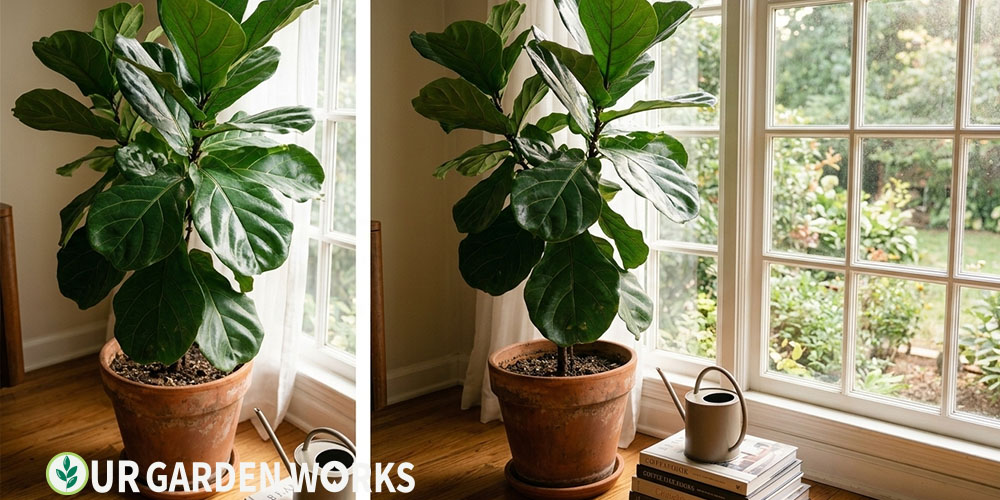
Fiddle leaf fig has earned its reputation as a finicky houseplant honestly — it really is less forgiving than a pothos or snake plant. But “difficult” doesn’t mean “impossible,” and most fiddle leaf fig deaths trace back to the same handful of specific, avoidable mistakes.
Get light, water, and consistency right, and a fiddle leaf fig is genuinely manageable. This guide covers exactly what that means in practice.
Quick Guide: Give it bright, indirect light near (not in) a sunny window. Water only when the top 2 inches of soil are dry, then water thoroughly. Keep it in the same spot — fiddle leaf figs hate being moved or rotated frequently. Avoid cold drafts and sudden temperature swings.
Why Fiddle Leaf Fig Has Such a Difficult Reputation
Fiddle leaf fig (Ficus lyrata) comes from West African rainforests, where it grows as an understory plant in consistently warm, humid, and bright-but-filtered conditions. Most homes don’t naturally replicate that environment.
The plant also responds to stress slowly and dramatically — leaf drop or brown spots often show up weeks after the actual stressful event, which makes cause-and-effect hard to track without understanding the delay.
Light — The Single Biggest Factor
Fiddle leaf fig wants bright, indirect light — more light than most houseplants tolerate, but not direct sun, which scorches the large, thin leaves.
A spot within a few feet of a south- or west-facing window, with the plant out of the direct sun path but still in bright ambient light, is usually ideal. Too little light causes leggy growth and leaf drop from the bottom up.
💡 Don’t rotate it constantly
Fiddle leaf fig leans toward its light source over time, which is normal. Rotating the pot a quarter turn every couple of weeks keeps growth balanced, but avoid moving the whole plant to a new location repeatedly — it needs time to adjust to any light change.
Watering — Consistency Matters More Than Frequency
How to Water Correctly
- Check the top 2 inches of soil with a finger before watering. If still moist, wait.
- Once dry at that depth, water thoroughly until it runs from the drainage holes.
- Empty the saucer — never let the pot sit in standing water.
- Water again only once the same 2-inch check shows dry soil, typically every 7–10 days depending on light and season.
Overwatering is the single most common cause of fiddle leaf fig decline. Brown spots with yellow halos, especially on lower leaves, are the classic overwatering signature.
Underwatering causes a different pattern — crispy brown edges and leaf drop, but the plant usually recovers fast once watering resumes consistently.
Humidity and Temperature
Fiddle leaf fig prefers humidity above 40%, which most homes fall short of, especially in winter with heating running. A humidifier nearby, or grouping with other plants, helps meaningfully.
Keep it away from cold drafts, air conditioning vents, and heating vents. Sudden temperature swings are a common, underrated stress trigger that causes leaf drop days or weeks later.
Why the Stress Response Is So Delayed
It’s worth understanding why fiddle leaf fig problems seem to appear “out of nowhere,” since this delay is genuinely part of the plant’s biology rather than a mystery. Large, established leaves represent significant energy investment, and the plant doesn’t abandon them at the first sign of stress.
Instead, it reallocates resources gradually, and a leaf already weakened by an earlier stress event (a cold draft, a missed watering, a light change) often doesn’t show visible decline until weeks later, once the damage has compounded enough to become visible.
This is exactly why tracking changes — a recent move, a new draft, a watering lapse — matters more for this plant than for most. The cause and the visible symptom are rarely close together in time.
Common Problems and Their Causes
| Symptom | Likely Cause |
|---|---|
| Brown spots with yellow halo | Overwatering |
| Crispy brown edges | Underwatering or low humidity |
| Sudden leaf drop, several at once | Recent move, draft, or temperature shock |
| Small or no new growth | Insufficient light |
| Leggy growth, leaning hard one direction | Light too low or too one-directional |
Fertilizing and Repotting
Feed with a balanced liquid fertilizer every 2–4 weeks during active growth (spring through summer), diluted to half the label-recommended strength. Skip fertilizing entirely in fall and winter when growth slows.
Repot every 1–2 years once roots fill the pot, sizing up by only 1–2 inches in diameter at a time. See our repotting guide for the full step-by-step process and how to avoid shock during the move.
Soil and Drainage
Fiddle leaf fig needs well-draining soil — a standard potting mix amended with perlite or orchid bark works well. Heavy, water-retentive soil compounds the overwatering risk discussed above.
A pot with drainage holes is essentially non-negotiable for this plant. Without it, even careful watering eventually leads to waterlogged roots, since there’s no way for excess moisture to escape. See our best soil for fiddle leaf fig guide for specific product recommendations and mix ratios.
Common Pests to Watch For
Fiddle leaf fig isn’t especially pest-prone compared to many houseplants, but a few specific pests do show up, usually on a plant that’s already somewhat stressed from other care issues.
Spider mites cause fine stippling and sometimes faint webbing on leaf undersides, often in dry indoor air during winter. Scale insects appear as small, immobile brown bumps along stems and leaf midribs, often accompanied by sticky honeydew residue.
Both are easier to manage if caught early — a weekly glance at leaf undersides while wiping dust off catches most infestations before they become established. Insecticidal soap treats both effectively when applied thoroughly and repeated on schedule.
Choosing the Right Spot in Your Home
Beyond just light, a few other location factors matter more for fiddle leaf fig than for tougher houseplants. Avoid spots near exterior doors that open and close frequently, since the resulting drafts and temperature swings are exactly the kind of inconsistency this plant struggles with.
Give it enough physical space to grow into — fiddle leaf fig can reach 6–10 feet tall indoors over time, and a cramped corner limits both light access and the plant’s ability to spread its canopy evenly.
Once you’ve found a spot that works — good light, stable temperature, away from drafts — resist the temptation to move it elsewhere for purely decorative reasons. The adjustment period after any move is real, and frequent relocation is one of the most common reasons an otherwise well-cared-for fiddle leaf fig still struggles.
What to Do If You’re Just Not Sure What’s Wrong
Sometimes a fiddle leaf fig shows mild symptoms that don’t clearly match overwatering, underwatering, or temperature stress. In these cases, going back to basics rather than guessing at increasingly specific fixes tends to work best.
Confirm the pot has drainage, confirm you’re checking soil moisture before watering rather than watering on a fixed schedule, confirm the light is bright but indirect, and confirm the plant hasn’t been moved or exposed to a draft recently. More often than not, one of these fundamentals turns out to be the actual issue, even when the visible symptom doesn’t point directly to it.
Frequently Asked Questions
Why is my fiddle leaf fig dropping leaves even though I haven't changed anything?
Given the delayed stress response described above, “nothing changed” often means the trigger happened weeks ago and has been quietly compounding.
Check for recent temperature swings, a slightly missed watering pattern, or even seasonal light changes as the sun’s angle shifts — these are easy to overlook as “no change” when they’re actually the cause.
Can fiddle leaf fig grow in low light?
It will survive in lower light for a while but won’t thrive — expect slow, leggy growth and eventual lower-leaf drop as the plant prioritizes the leaves closest to whatever light is available. If bright indirect light genuinely isn’t available, a different, more shade-tolerant plant will likely be more satisfying to grow.
Should I wipe the leaves clean?
Yes — fiddle leaf fig’s large, glossy leaves accumulate dust that blocks light absorption over time. Wipe gently with a damp cloth every few weeks. This is also a good opportunity to check leaf undersides for early signs of pests like spider mites or scale.
Is it normal for a fiddle leaf fig to lose its very bottom leaves over time?
Occasional loss of the oldest, lowest leaves as the plant grows taller is normal, especially if new growth is appearing at the top. Rapid loss of multiple leaves at once, or loss combined with brown spotting, points to one of the stress causes above rather than normal aging.
My fiddle leaf fig has one bare, leggy stem with no branching — can I fix this?
Yes — notching or pruning the main stem just above a node encourages branching at that point, since it removes the plant’s single dominant growing tip and redirects energy to dormant side buds. This works best on an actively growing, otherwise healthy plant rather than one already stressed.
How do I know if my fiddle leaf fig is getting too much direct sun versus too little light overall?
Too much direct sun typically shows up as bleached, pale, or scorched patches on the leaves facing the window, often with a crispy texture concentrated in that one area. Too little light shows up more gradually as smaller new leaves, increased spacing between leaves on the stem, and leaning dramatically toward whatever light source exists.
Related Articles in Our Plant Care Guide
- 5 Best Soil for Fiddle Leaf Fig – Reviews & Top Picks in 2026
- 10 Best Fiddle Leaf Fig Fertilizers – Reviews for 2026
- Easy Fig Propagation: How To Grow Figs From Cuttings
- 9 Best Fig Tree Fertilizers – Reviews and Top Picks (2026)
- Rubber Plant Drooping Leaves — Causes and Fixes
- How to Repot a Plant Without Killing It
Final Thoughts
We hope this takes some of the mystery out of fiddle leaf fig’s reputation. The plant isn’t unreasonable — it just asks for more consistency than most houseplants, and once you settle into a steady routine, it tends to reward you with genuinely dramatic growth.
For more on related ficus relatives, our plant care guides cover rubber plant and other common houseplants in depth.
Share this post with a fellow plant parent wrestling with their own fiddle leaf fig — and let us know in the comments what finally clicked for yours. Happy growing!
