

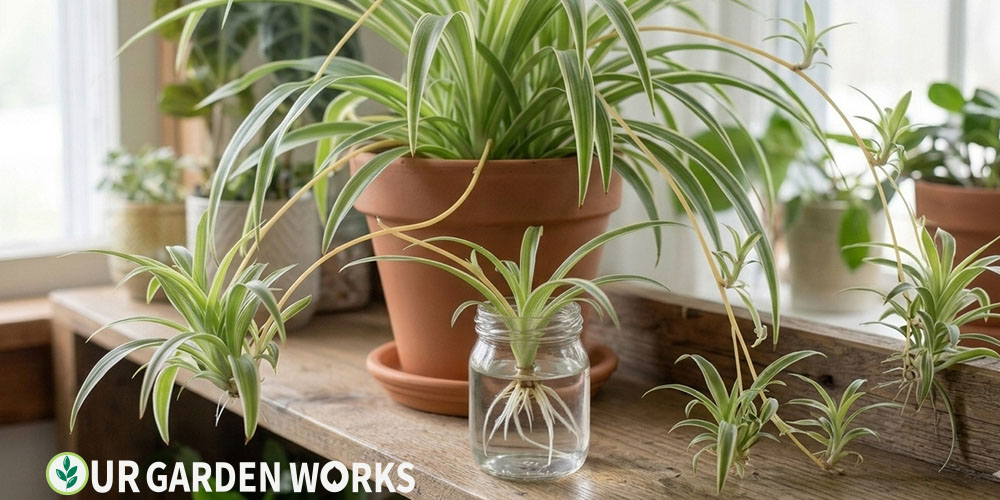
Spider plants are about as close to self-propagating as a houseplant gets. A mature, happy spider plant naturally sends out long runners (technically called stolons) tipped with miniature versions of itself called pups — baby plants that are already most of the way to being independent before you even touch them.
How to Propagate Spider Plant Pups – Quick Guide: Wait until a pup has small white root nubs already visible at its base, then either root it in water while still attached to the runner, or snip it free and root separately. Most pups develop usable roots within 2–3 weeks once given water or moist soil contact.
Why Spider Plant Pups Are Different From Most Cuttings
A typical houseplant cutting starts as undifferentiated stem or leaf tissue that has to activate dormant root cells from scratch — that’s the multi-week process you’ll see in propagation guides for pothos, monstera, or rubber plant.
A spider plant pup is fundamentally different: it’s already a complete miniature plant, frequently with tiny root nubs already forming at its base while still attached to the parent via the runner.
This means spider plant propagation isn’t really about coaxing a cutting into rooting — it’s about giving an already-rooting baby plant the contact with water or soil it needs to finish the job.
That’s the entire reason spider plant propagation is consistently rated one of the easiest in the houseplant world.
Why Spider Plants Produce Pups in the First Place
It’s worth understanding the biological purpose behind this unusual reproductive strategy, since it explains both why pups form and why flowering triggers the process.
Spider plants are native to parts of South Africa where they grow in conditions that can shift between favorable and harsh fairly unpredictably, and producing pups on long runners is a survival strategy that lets the plant establish new individuals at some physical distance from itself.
In the wild, this distance matters — a runner extending outward and rooting a pup in a slightly different spot increases the odds that at least one of the resulting plants ends up in conditions favorable enough to survive, even if the parent’s immediate location becomes less hospitable over time.
The flowering that typically precedes pup formation is part of this same reproductive strategy, with the plant essentially attempting both seed production and vegetative cloning as parallel paths to producing offspring.
This dual strategy — flowers for genetic diversity through seed, pups for guaranteed genetic copies through cloning — is a reasonably common pattern across many plant families that evolved in environments where reliable pollination couldn’t always be counted on.
Pup production essentially functions as the plant’s backup plan, ensuring offspring exist even in a season where pollinators were scarce or seed production failed for any other reason.
Method 1 — Root While Still Attached (Most Reliable)
Directions
- Identify a pup with visible white root nubs at its base — these often look like small bumps or short white threads.
- Without cutting the runner, simply rest the pup’s base in a small cup or jar of water positioned near the parent plant, or directly into a small pot of moist soil.
- Leave the runner attached to the parent the entire time. The pup continues receiving some support from the parent plant while developing its own independent root system.
- Once roots reach 1–2 inches, cut the runner to separate the pup, which is now a fully independent plant.
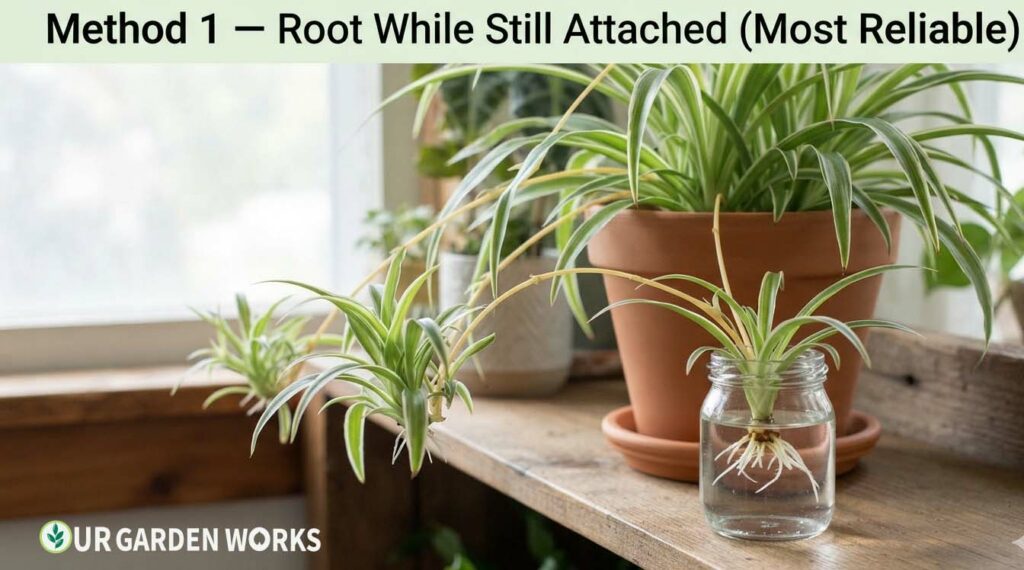
This approach has a real advantage: if the pup struggles or rots, the parent plant suffers no real loss, and you can simply try again with the next pup that develops.
It also tends to produce a slightly more robust independent plant than cutting first and rooting separately, since the pup has continuous access to the parent’s resources throughout the entire rooting period rather than relying solely on its own small reserves from the moment of separation.
Method 2 — Cut and Root Separately
Directions
- Cut the pup free from the runner, leaving a small stub of runner attached to the pup itself if possible.
- Place the cut end in water, keeping leaves above the waterline, or directly into moist potting soil.
- Position in bright, indirect light. Change water every 5–7 days if water rooting.
- Roots typically develop within 2–3 weeks given the pup already had some root development started.
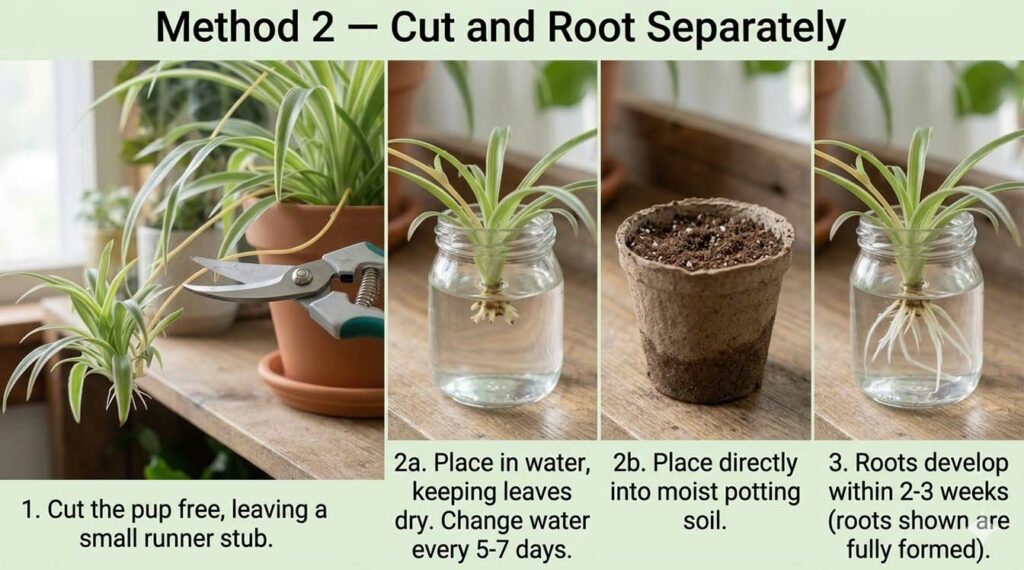
This method is particularly useful if the runner is awkwardly positioned, or if you want to give a pup as a gift right away rather than waiting for it to finish rooting while still attached to the parent. The tradeoff in speed compared to Method 1 is usually minor, since most of the pup’s development happens before separation either way.
💡 Pups without any visible roots can still work — just expect more patience
A pup with no visible root nubs yet can still be rooted, but treat it more like a standard cutting and expect 3–4 weeks rather than 2.
If possible, simply wait another week or two on the parent plant until root nubs appear before separating — it meaningfully speeds up the process.
How Pup Production Relates to Repotting and Division
Spider plants offer a second, related propagation route worth knowing about: division of the parent plant’s main root mass, separate from the pup-based method described above.
As a spider plant matures and fills its pot, it often develops multiple distinct growth points within the same root ball, similar in concept to how snake plant rhizomes can be divided.
When repotting a mature spider plant, you can gently separate these natural divisions at the root ball rather than cutting through anything, producing several independent plants from one overgrown specimen in a single repotting session.
This is a useful technique to combine with regular pup propagation, particularly if your parent plant has become large enough that a full repot is overdue anyway.
Division at repotting time is also a good opportunity to refresh old, depleted potting soil for whichever divisions you decide to keep growing as larger specimens, rather than splitting everything into small starter plants.
A plant that’s been producing pups steadily for a year or more has put real demand on its growing medium, and a fresh start at division time helps both the divided sections and any portion you choose not to split establish more vigorously going forward.
Frequently Asked Questions
Why isn't my spider plant producing any pups?
Spider plants typically need to become at least moderately root-bound and mature before they flower and produce pups — a young plant in a large pot with lots of room to grow may take longer to start producing offsets. Slightly more cramped conditions and consistent light often encourage pup production sooner.
Can I leave pups attached to the parent plant indefinitely instead of propagating them?
Yes — many gardeners simply let pups hang and grow as part of the display, never separating them at all. This is purely aesthetic preference; there’s no requirement to propagate every pup a plant produces.
How many pups can one spider plant produce in a season?
A healthy, mature spider plant can produce a dozen or more pups across a single growing season, particularly if conditions stay favorable. This is part of why spider plants are such a popular plant to propagate and share — one parent plant can realistically supply pups to several friends in a single year.
Should I leave several pups attached to the same runner, or separate them as soon as possible?
Either approach works, and the choice is mostly aesthetic. Many spider plant runners produce a small cluster of multiple pups along their length, and leaving them attached longer creates an attractive cascading display many growers prefer to maintain rather than separating immediately.
There’s no biological downside to leaving pups attached for an extended period as long as the parent plant remains otherwise healthy.
Do all spider plant varieties produce pups the same way?
Most common varieties, including the classic green-and-white striped type and the solid green ‘Bonnie’ curly variety, produce pups through the same runner-based mechanism described here.
Pup production rate can vary somewhat by variety and by individual plant maturity, but the underlying propagation method is consistent across virtually all spider plant types commonly sold.
Encouraging a Reluctant Spider Plant to Produce Pups
If your spider plant hasn’t produced any pups yet despite seeming otherwise healthy, a few specific adjustments tend to help.
Light is the most common limiting factor — spider plants flower and subsequently produce pups more readily under bright, indirect light than in genuinely low-light conditions, even though the plant can survive (without necessarily thriving or reproducing) in fairly dim spots.
Allowing the plant to become somewhat, though not severely, root-bound also seems to encourage pup production in many cases, possibly as part of the same stress-response mechanism that drives the plant’s natural reproductive strategy in the wild.
A plant repotted into an excessively large container, with abundant room to expand its own root system, sometimes delays pup production in favor of simply growing larger itself first.
Finally, consistent care over time matters more than any single intervention. A spider plant that’s experienced significant stress — drastic temperature swings, prolonged drought, or repeated relocation — often pauses reproductive activity, including pup production, until conditions stabilize and the plant has rebuilt sufficient energy reserves.
Related Articles in Our Plant Care Guide
Final Thoughts
We hope this shows just how little effort spider plant propagation genuinely takes — most of the hard work is already done by the plant itself before you even pick up a pair of scissors.
For care of the parent plant between propagation rounds, our plant care guides cover watering, light, and root-bound timing in more depth.
Spider plants make an especially good gift plant precisely because of how reliably their pups root — a single mature plant can comfortably supply several friends with a healthy starter plant each, all while continuing to produce more pups for the next round.
Few houseplants make sharing this effortless, and fewer still ask so little of the person propagating them in return — about the only real requirement is a windowsill, a small jar, and the patience to wait a couple of weeks for nature to finish what it already started growing on its own, long before you ever picked up a pair of scissors.
Share this post with a fellow gardener who’s ready to get growing — and let us know in the comments how many pups your spider plant has produced this season. Happy growing!
