

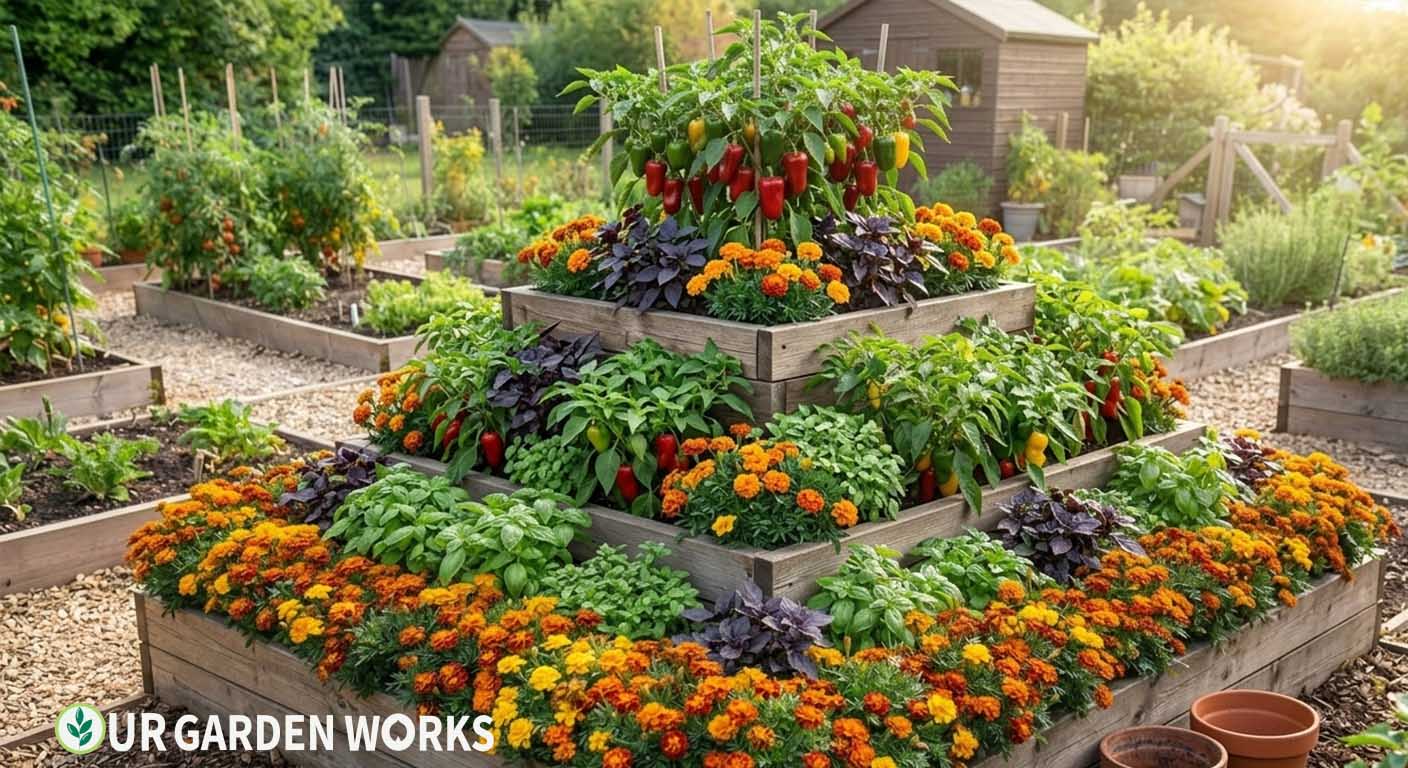
Peppers and tomatoes share similar growing needs — and many of the same pests. That means their companion plant lists overlap significantly. If you’ve already built a good tomato companion system, the principles translate directly to your pepper bed.
Unlike more complicated companion planting schemes that claim dozens of benefits, pepper companion planting really comes down to a short list of crops that do measurable, specific things: repel key pests, attract beneficial insects, improve pollination, or occupy root zones that don’t compete with pepper roots.
This guide covers each companion in enough detail that you understand the mechanism — not just “plant marigolds near peppers” but why that actually works, and where the evidence is thinner than the folklore suggests.
Quick Answer: The best companion plants for peppers are basil (repels aphids and spider mites), marigolds (deter whiteflies, attract beneficials), carrots (loosen soil around roots), and geraniums (repel Japanese beetles and leafhoppers). Keep fennel, brassicas, and apricot trees away.
6 Best Companions for Peppers — And Why Each One Works
| Companion Plant | Primary Benefit | Planting Distance |
|---|---|---|
| Basil | Repels aphids, spider mites, thrips | 12–18 inches from pepper |
| French marigolds | Deters whiteflies, attracts hoverflies, suppresses nematodes | Border of bed |
| Geraniums | Repels Japanese beetles and leafhoppers | Perimeter |
| Carrots | Soil aeration, no nutrient competition | Between plants |
| Borage | Attracts bumblebees for buzz pollination | 1–2 feet away |
| Spinach | Living mulch in spring, suppresses weeds | Between transplants |
Companion 1 — Basil
Basil is the companion most consistently backed by both research and grower experience for pepper beds. It produces volatile aromatic compounds — primarily linalool and eugenol — that interfere with aphids’ and spider mites’ ability to locate host plants by scent.
The mechanism isn’t a toxin or a repellent in the way an insecticide would work. It’s an interference signal. Aphids use airborne chemical cues to find host plants, and the aromatic output of a nearby basil plant introduces enough competing chemistry into the local air column that aphids navigate less efficiently and settle on pepper leaves at lower rates than they would without it.
This effect is proximity-dependent and drops off sharply with distance. Basil planted across the garden doesn’t help much. Basil planted within 12–18 inches of each pepper plant is where the effect is most reliable.
💡 Pinch flower buds to keep basil working
Once basil bolts and flowers, the plant redirects energy from volatile oil production to seed development.
Pinch flower buds regularly to keep the plant in active vegetative growth — and the aromatic output high — throughout the pepper growing season.
Plant: 1 basil plant per 2 pepper plants, 12–18 inches away. Genovese and Thai basil both work — the Thai varieties tend to be more heat-resistant and may work better in southern climates where summers get hot enough to stress sweet basil quickly.
Companion 2 — French Marigolds
French marigolds (Tagetes patula, specifically) earn their place in a pepper bed through multiple overlapping mechanisms rather than one single benefit.
The most well-documented: their root exudates contain alpha-terthienyl, a compound toxic to root-knot nematodes when marigolds are grown densely in affected soil.
This isn’t a one-season effect — it builds over time with consistent marigold planting. Their flowers also produce nectar that specifically attracts hoverflies (syrphid flies), whose larvae are voracious aphid predators.
Above ground, the flower’s scent appears to deter whiteflies — a major pepper pest — though the strength of this effect depends on the density of marigold planting. A sparse border of two or three plants produces a weaker effect than a continuous dense row around the bed perimeter.
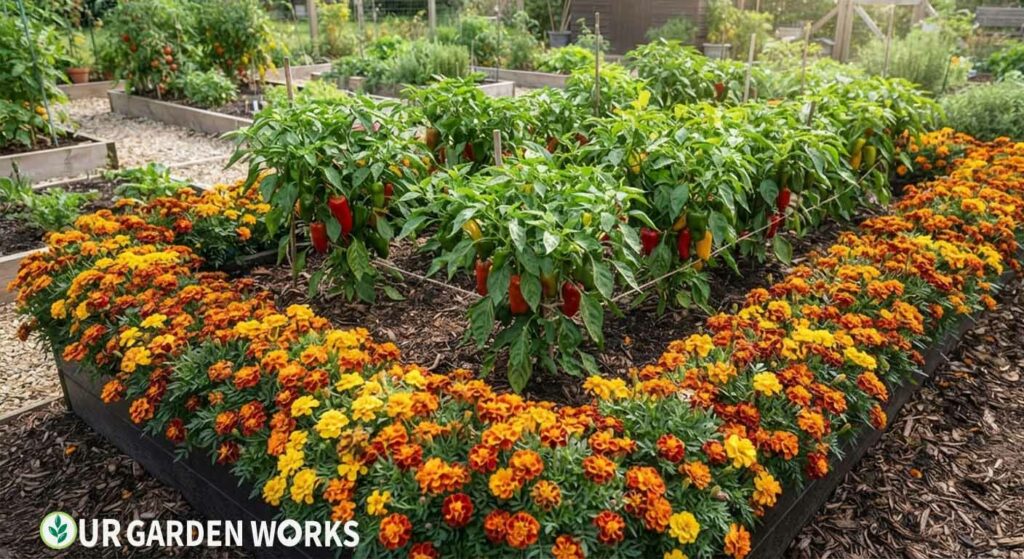
Plant: Dense continuous border around the pepper bed, not scattered between plants. For full nematode suppression in heavily affected soil, plant marigolds as a cover crop for a full season before growing peppers, then till them in.
Companion 3 — Geraniums
Scented geraniums (Pelargonium species, particularly Pelargonium citrosum and rose-scented types) have documented effects on Japanese beetles and leafhoppers — both of which can cause significant damage to pepper plants and, critically, spread bacterial and viral diseases through feeding wounds.
Japanese beetles that consume geranium leaf tissue become temporarily paralyzed — a well-documented response to geraniol and related compounds in the plant’s scent glands. They fall from the plant and recover, but the behavioral deterrence appears to persist, reducing their feeding activity near geranium plantings.
Leafhoppers are more straightforwardly deterred by the scent profile, finding the aromatic output confusing or unappealing as a host-location cue.
Plant: Perimeter of the pepper bed, or interspersed at the ends of rows. Scented varieties are more effective than common bedding geraniums, which have been bred primarily for flower color rather than aromatic output.
Companion 4 — Carrots
Carrots are one of the few companion planting choices that works through a purely mechanical rather than chemical mechanism. Their deep, penetrating taproots loosen compacted soil between pepper plants, creating channels that improve both drainage and air flow through the root zone.
Peppers are notably sensitive to poorly draining, waterlogged soil. Even brief periods of root anaerobia (oxygen deprivation from waterlogging) weaken the plant’s immune response and leave it more vulnerable to the bacterial diseases that spread most readily in wet conditions. Anything that improves drainage around pepper roots directly reduces this vulnerability.
Carrots and peppers also occupy different nutrient zones — carrots take up potassium and phosphorus from deeper soil layers, while pepper roots feed mostly from the upper 12 inches. This difference in root depth minimizes competition even when the two crops share the same bed.
Plant: Sow carrot seeds directly between pepper transplants at 2–3 inch spacing. Harvest carrots as peppers begin to fill in and need the space.
Companion 5 — Borage and Sunflowers
Peppers require buzz pollination — a specific vibrational frequency produced by bumblebees that shakes pollen loose from the flower’s anthers. Honeybees don’t produce this vibration and are largely ineffective at pollinating peppers.
This is why pepper plants in low-bumblebee environments (enclosed greenhouses, areas with few wildflowers nearby) often show poor fruit set even when they’re flowering prolifically.
Borage is one of the most effective bumblebee attractors in the kitchen garden — it produces nectar continuously and its blue flowers are particularly visible to bees. Sunflowers attract both bumblebees and beneficial predatory insects including predatory wasps.
The goal here isn’t pest control — it’s ensuring the pollinator traffic needed for fruit set happens consistently, which matters especially during hot spells when bumblebee activity naturally decreases.
Plant: Borage 1–2 feet from pepper plants. Sunflowers north of the pepper bed (so they don’t shade out the light-hungry peppers beneath them).
Companion 6 — Spinach
Spinach sown between pepper transplants in spring acts as a living mulch — a role that’s more practically useful than it might initially sound. In the 4–6 weeks after pepper transplants go in, the ground between plants is bare, exposed to sun and rain, and vulnerable to rapid moisture loss and weed establishment.
Quick-growing spinach fills that gap, shading the soil to reduce both temperature swings and evaporation, while its shallow roots don’t compete meaningfully with pepper roots below.
By the time temperatures climb to the point where spinach bolts (mid-to-late spring in most climates), the pepper plants have typically spread enough to fill the spaces spinach has vacated.
💡 Pull bolting spinach before it goes to seed
Once spinach bolts, pull it immediately rather than leaving it in the ground to flower and set seed.
Bolted spinach has no pest-deterrent or mulch value, and allowing it to complete its seed cycle wastes the nitrogen it stored in its leaf tissue — which can instead be captured by tilling or composting the pulled plants directly into the bed.
Plant: Sow spinach seeds between transplants at the same time peppers go in. No need to transplant spinach starts — direct seeding is faster and the seedlings establish well alongside newly planted peppers.
What to Keep Away from Peppers
The “avoid” list for peppers is shorter than for some vegetables, but the items on it matter. These aren’t just neutral — they actively harm pepper production or health in ways that outweigh any claimed benefit.
- Fennel: Allelopathic to peppers and most vegetables. Fennel root exudates suppress the germination and growth of a wide range of crops. Keep it isolated — ideally in its own container or a separate bed entirely.
- Brassicas (cabbage, broccoli, kale, cauliflower): Heavy feeders with broad, shallow root systems that compete directly with pepper roots for nutrients in the same zone. They also attract caterpillars and flea beetles that can cross to peppers.
- Tomatoes in very close proximity: The plants are compatible and share care needs, but don’t plant so close that a pest infestation in one immediately transfers to the other. Both attract aphids, spider mites, and whiteflies — keep 18–24 inches of separation at minimum between the crops.
- Apricots and stone fruit trees: Host shared aphid species and specific fungal diseases that also affect peppers. Avoid planting peppers directly under or immediately beside stone fruit.
How to Lay Out a Companion-Planted Pepper Bed
Knowing which companions work is only half the answer — where you physically place them in relation to your pepper plants determines whether the effect is strong enough to matter.
The most effective layout for a 4×8 pepper bed: marigolds as a continuous dense border on all four sides, basil planted between every other pepper plant in the row, carrots sown in the gaps between transplants, and borage or sunflowers positioned on the north side of the bed (to avoid shading the peppers from the south).
Geraniums work better at the ends of rows or at the corners of the bed rather than between plants, since they need to intercept insects approaching from the perimeter rather than the interior of the planting.
Don’t try to plant every companion in one bed all at once. A first-year companion planting bed typically does best with two or three of these — basil plus marigolds is the most productive starting combination, adding a third element once you’ve seen how the first two establish in your specific conditions.
Frequently Asked Questions
Can peppers and tomatoes be planted together?
Yes — they’re compatible. Both are in the Solanaceae family with similar care needs. The only consideration is pest concentration — planting them together means pests that affect both (aphids, spider mites) find a larger food source. Maintain good spacing and airflow between plants.
Does basil actually improve pepper flavor?
The evidence is anecdotal but consistent among experienced companion planters. The more certain benefit is pest deterrence — healthier, less-stressed pepper plants produce better fruit regardless of any direct flavor mechanism from nearby basil. Focus on the pest-repellent benefit rather than counting on flavor improvement.
How close do marigolds need to be to actually deter pests?
Close enough that the marigolds form a genuine barrier rather than a decorative border. A continuous line of marigolds 6–12 inches from the outermost pepper plants, around the full perimeter of the bed, is far more effective than three or four marigold plants scattered loosely in the bed interior.
Do companion plants replace the need for pest control?
No — they reduce pest pressure rather than eliminate it. Think of companion planting as a preventive layer that keeps pest populations from building as quickly, not as a treatment for an existing infestation. If aphids are already established on your pepper plants, treat them directly with insecticidal soap and then reinforce with companions going forward.
Will these same companions work for hot peppers as well as sweet peppers?
Yes — hot peppers and sweet peppers have the same growing requirements and attract the same pest species, so the companion plant logic is identical for both. The only practical difference is that many hot pepper varieties are more heat-tolerant and may grow more vigorously, potentially shading out smaller companions like spinach faster than a sweet bell pepper would.
Is there any companion plant that actually improves pepper yield?
Borage and sunflowers come closest by improving pollination — more effective buzz-pollination visits per flower directly translates to more fruit set and higher yield. This effect is most noticeable in enclosed growing spaces like a greenhouse or polytunnel where wild bumblebee access is limited.
Related Articles in Our Vegetable Gardening Guide
- How to Grow Peppers: Sweet, Hot & Bell Peppers (Complete 2026 Guide)
- Best Companion Plants for Tomatoes
- Best Companion Plants for Cucumbers
- What to Plant with Garlic – Best and Worst Companion Plants
- How to Grow Spinach: Fast Harvests in Cool Weather (2026)
- Companion Planting Chart — What Grows Well Together
- Do Marigolds Repel Pests? (What They Actually Keep Away)
- Vegetable Gardening Guide
Free Tools for Planning Your Pepper Bed
Final Thoughts
We hope this gives you a companion planting system for your pepper bed that’s grounded in actual mechanisms rather than gardening folklore. The short list — basil between plants, marigolds around the border, borage nearby for pollination — is genuinely proven and worth starting with before adding anything more complex.
For all our vegetable growing guides, our vegetable gardening guide links to everything.
Share this post with a fellow gardener who’s ready to get growing — and let us know in the comments which companions you’re planting alongside your peppers this season. Happy growing!
