

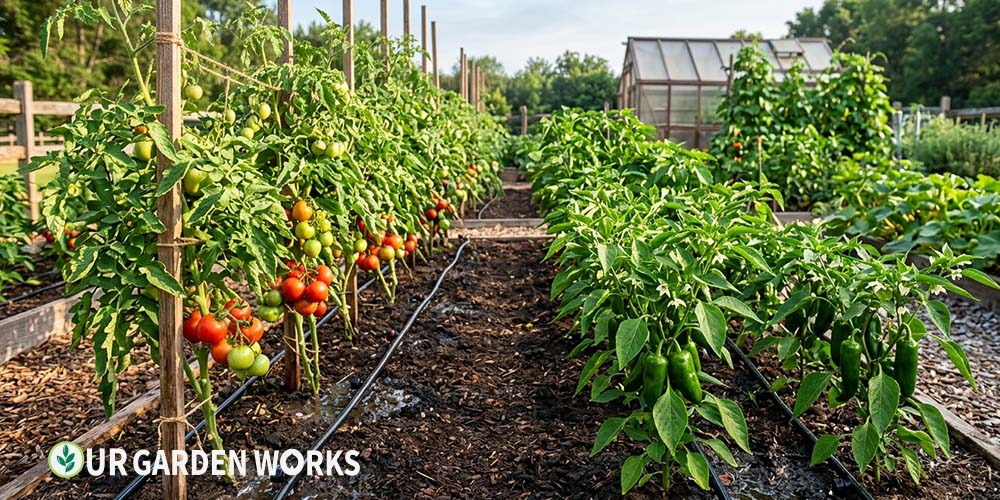
More vegetable garden problems are caused by incorrect watering than by almost anything else — including pests and disease.
Inconsistent moisture causes blossom end rot in tomatoes, tip burn in lettuce, cracked fruit, and poor germination. Overwatering causes root rot, fungal disease, and nutrient lockout from waterlogged soil.
Getting watering right in summer, when heat demand is highest and mistakes have the most impact, is one of the highest-leverage things a vegetable gardener can do.
The good news is that the underlying principles are simple even though the daily decisions can feel confusing. Once you understand how much water your specific crops need, when to apply it, and how to read the soil rather than the calendar, watering stops being a daily guessing game and becomes one of the most predictable parts of summer garden care.
How to Water a Vegetable Garden in Summer: Most vegetables need 1–1.5 inches of water per week from rain and irrigation combined, delivered consistently to the root zone. Water deeply and infrequently (2–3 times per week) rather than daily light watering — deep watering encourages deep roots that access moisture lower in the profile. Water at soil level, not overhead. Morning is best. Use a soil moisture meter or finger test to avoid both underwatering and overwatering.
The Foundational Rule: Soil Level, Not Foliage
Wet foliage in summer heat — especially late in the day — is the primary cause of fungal diseases in vegetable gardens.
Powdery mildew, leaf spot, blight — the problems our tomato blight spray guide addresses — and botrytis all spread dramatically faster on wet leaves.
Always direct water at the soil, not the plant. Drip irrigation and soaker hoses achieve this automatically. Overhead sprinklers are the least efficient and most disease-promoting method for summer vegetable irrigation.
How Much Water Each Vegetable Needs
| Crop | Weekly Need | Critical Period | Signs of Stress |
|---|---|---|---|
| Tomatoes | 1.5–2 inches | Flowering and fruit set | Blossom end rot, fruit cracking |
| Peppers | 1–1.5 inches | Fruit development | Flower and fruit drop |
| Cucumbers | 1.5–2 inches | Entire growing season | Bitter fruit, wilting |
| Zucchini/squash | 1–1.5 inches | Fruiting period | Blossom drop, blossom end rot |
| Beans | 1 inch | Flowering and pod fill | Pod drop, poor fill |
| Lettuce | 1 inch | All season — especially heat | Bolting, bitterness |
| Corn | 1.5 inches | Tasseling and silk development | Poor kernel fill |
| Pumpkins | 1.5–2 inches | Fruit development | Wilting, small fruit |
| Melons | 1–2 inches | Fruit development; reduce near harvest | Split fruit if uneven near harvest |
| Broccoli/cabbage | 1.5 inches | Head formation | Loose heads, tip burn |
| Eggplant | 1–1.5 inches | Fruit development | Bitter fruit, flower drop |
| Strawberries | 1–1.5 inches | Fruiting period | Small fruit, dry berries |
When to Water – The Timing That Changes Everything
Best: Morning Watering
Water in the morning — between 6 and 10 AM — when temperatures are low and foliage dries quickly through the day.
Any water that does splash onto leaves evaporates before creating fungal conditions. Roots have all day to take up moisture before heat stress peaks in the afternoon.
Acceptable: Evening Watering
Evening watering at soil level (drip, soaker hose) is acceptable if you are not wetting foliage. Evening overhead watering leaves wet foliage through the night — ideal conditions for fungal disease development. Never use sprinklers in the evening on vegetable gardens.
Avoid: Midday Watering in Full Sun
Contrary to popular belief, droplets on leaves in full sun do not actually cause leaf burn (that’s a myth that persists).
The real problem with midday watering is evaporation loss — 30–50% of water applied by sprinkler at midday evaporates before reaching the soil. It wastes water and creates false humidity around foliage without delivering adequate moisture to roots.
Deep vs. Shallow Watering — Why It Matters
A common watering mistake: daily light watering that wets only the top 1–2 inches of soil. Plants receiving this pattern develop shallow root systems that stay in the top soil layer, where they are most vulnerable to heat, drought, and damage.
Deep, infrequent watering — enough water to reach 6–8 inches deep, applied every 2–3 days — encourages roots to grow down into the cooler, more consistently moist lower soil profile.
These plants survive brief droughts, handle heat stress better, and produce more consistently through summer.
The Finger Test
Push your finger or a pencil into the soil beside the plant root zone. If the soil is moist at 2 inches, don’t water. If it’s dry at 2 inches, water now. This 5-second test is more accurate than any schedule and accounts for rain, temperature, and soil type variability.
Telling Overwatering and Underwatering Apart
This is where most well-intentioned gardeners go wrong in summer — a stressed, drooping plant gets read as thirsty, more water gets added, and the actual problem (which was already too much water) gets worse.
Both conditions can produce wilting leaves, which is exactly why so many people misdiagnose the cause and reach for the hose when they should be backing off instead.
| Signal | Underwatering | Overwatering |
|---|---|---|
| Leaf appearance | Dry, crispy edges; leaves curl inward | Yellowing, soft, sometimes mushy |
| Soil at 2–3 inches | Dry, crumbly, pulls away from finger | Wet, dense, smells musty or sour |
| Recovery after watering | Perks up within a few hours | No improvement, or worsens |
| Stem and base | Normal, firm | Soft, dark, possible rot at soil line |
| New growth | Stunted, small leaves | Often still vigorous despite root stress |
When in doubt, always check the soil before adding more water. A plant that’s wilting because of root rot from excess moisture will only decline further if you respond by watering more — the roots are already damaged and can’t take up what’s already there, let alone additional water.
Watering Methods Compared
| Method | Efficiency | Disease Risk | Best For |
|---|---|---|---|
| Drip irrigation | 🟢 90%+ | 🟢 Very Low | Established beds, tomatoes, peppers |
| Soaker hose | 🟢 85% | 🟢 Very Low | Row crops, raised beds |
| Hand watering at base | 🟡 70% | 🟢 Low | Small gardens, containers, spot watering |
| Oscillating sprinkler | 🔴 50–60% | 🔴 High if evening use | Lawn — not recommended for vegetables |
| Overhead sprinkler | 🔴 40–50% | 🔴 High | Not recommended for vegetable gardens |
Mulch — The Best Watering Tool You Are Not Using Enough
A 3-inch layer of mulch (straw, wood chips, shredded leaves) over the root zone of vegetable plants reduces evaporation by 50–70%, keeps soil temperatures 10–15°F cooler in summer heat, and suppresses weeds that compete for moisture.
In practical terms, mulched vegetable beds need watering half as frequently as unmulched ones during summer heat. Apply after the soil has warmed in late spring — mulching cold spring soil slows warming.
Not all mulch behaves the same way, and matching the type to the situation makes a real difference.
Straw and shredded leaves break down over a season, adding organic matter back to the soil as they decompose, which makes them well-suited to annual vegetable beds you’ll be reworking each year.
Wood chips last considerably longer and resist compaction better, making them a better fit for permanent pathways or perennial beds where you don’t want to be replenishing mulch every few months.
Whichever you choose, keep mulch pulled back an inch or two from plant stems — mulch piled directly against a stem traps moisture against it and can encourage rot, undoing much of the benefit you’re trying to create.
Adjusting Your Watering During a Heatwave
A genuine heatwave — several consecutive days above 95°F — changes the watering math enough that your normal routine often isn’t sufficient.
Plants lose water through their leaves faster than their roots can replace it, even in soil that would be perfectly adequate under normal summer conditions.
This is the period when checking soil moisture daily, rather than relying on your usual every-2-to-3-days schedule, actually matters.
If you notice consistent afternoon wilting across most of the garden during a heatwave, increasing watering frequency rather than the volume per session is usually the better fix — the goal is keeping the upper soil profile from drying out completely between waterings, not flooding the root zone.
Container plants and anything recently transplanted need the closest attention during these stretches, since they have the least reserve capacity to ride out a hot afternoon.
Once the heatwave breaks, ease back to your normal deep-and-infrequent rhythm — continuing heatwave-frequency watering after temperatures moderate is one of the more common paths into root rot.
Frequently Asked Questions
My tomatoes are wilting in the afternoon even when I water every day — why?
Afternoon wilting in tomatoes is often normal, not drought stress. When temperatures exceed 90°F, tomatoes wilt in the afternoon even with adequate soil moisture, as a mechanism to reduce water loss.
If they recover by evening, the plant is fine and no additional watering is needed. If they are still wilted the following morning, then they do need water. Watering more in response to normal afternoon wilt can lead to overwatering and root rot.
Should I water container vegetables differently than in-ground?
Yes — significantly differently. Container plants dry out 3–5 times faster than in-ground plants in summer heat because the limited soil volume heats up rapidly and the pot sides shed moisture through evaporation.
If you are also seeing holes in tomato leaves alongside wilting, check for pests before assuming drought. In a heatwave, containers may need daily or even twice-daily watering. Check container moisture every morning in summer. Self-watering planters with a reservoir dramatically reduce this maintenance burden.
If it rains, do I still need to water?
It depends entirely on how much rain actually fell, not whether it rained at all. A brief summer shower can look significant but deliver less than a quarter inch — nowhere near a typical 1–1.5 inch weekly requirement — especially if it falls on already-dry soil that sheds water rather than absorbing it.
After rain, do the finger test rather than assuming the garden is covered for the week. A rain gauge is a worthwhile five-dollar investment if you want to track this more precisely than guessing from how wet things look on the surface.
Final Thoughts
We hope this guide gives you a clear watering framework that takes the guesswork out of one of the most consequential summer garden decisions.
Consistent moisture at the root zone — not wet soil all the time, not dry soil between waterings — is the single habit that separates high-producing summer vegetable gardens from struggling ones.
For the complete vegetable growing picture, our vegetable gardening guide links to every growing guide we have published.
Seed Starting Guides:
- Garden Watering Calculator — How Much Water Your Crops Actually Need
- Mulch Calculator — How Much Mulch Do You Need?
- 22 Heat-Loving Vegetables for Summer Gardens
- When to pick tomatoes – Variety Guide
- What To Do With Your Old Mulch: Reuse or Repurpose?
- Vegetable Gardening Guide: Grow More Food with Less Frustration
Share this with a fellow gardener who has been watering their vegetable garden on a gut-feel schedule and wondering why plants look stressed — and let us know in the comments how it went for you. Happy growing!
