

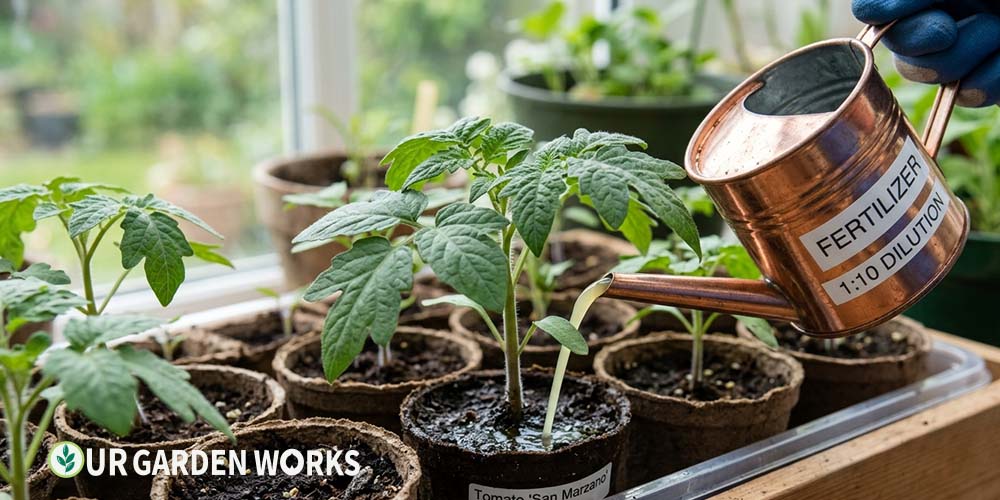
Seed-starting mix has almost no nutrients — by design. Seeds carry their own food supply for the first 2 to 3 weeks of life, and adding fertilizer before roots are ready can actually inhibit germination in some crops.
But once that built-in food runs out, seedlings growing in nutrient-poor mix hit a wall. They pale out, growth slows, and gardeners often blame the light or the mix when the real problem is hunger.
The good news: seedling fertilizing has one simple rule that covers 90% of situations. Know the rule, know the rate, and feeding your seedlings takes about two minutes per week.
Quick Answer: Start fertilizing when seedlings have their first set of true leaves — not seed leaves (cotyledons). Feed at quarter strength (¼ of the package rate) for the first two weeks, then half strength until transplanting. Use a balanced liquid fertilizer (10-10-10 or similar). Never feed before true leaves appear.
Seed Leaves vs. True Leaves — The Critical Distinction
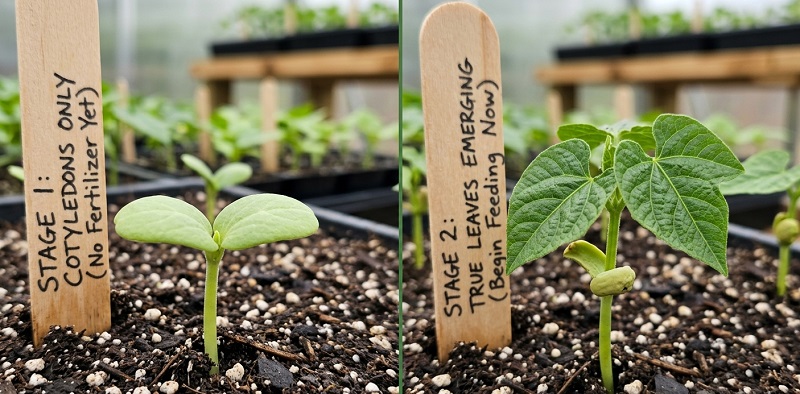
Every seedling emerges with two initial leaves called cotyledons (seed leaves). These are part of the seed itself — pre-formed food-storage organs that look identical across many different crops. Tomato cotyledons look nearly the same as pepper cotyledons. They are not the plant’s real leaves.
True leaves emerge after the cotyledons and look like miniature versions of the adult plant’s foliage. Tomato true leaves have the distinctive lobed tomato shape. Basil true leaves have the characteristic basil oval. These are when the plant’s root system is developed enough to absorb nutrients from external sources.
💡 The timing test
Hold a seedling tray at eye level and look across the tops. If all you see are the two oval seed leaves, don’t feed yet. If you see a second, distinctly different leaf pair emerging from between the cotyledons, you’re at the true leaf stage. That’s your start signal.
The Feeding Schedule — Stage by Stage
| Stage | What It Looks Like | Feed? | Rate |
|---|---|---|---|
| Germination to cotyledons only | Two rounded seed leaves, nothing else | No | — |
| First true leaves just emerging | Third and fourth leaves appearing between cotyledons | Yes — start now | ¼ strength |
| 2–3 sets of true leaves | Plant has a recognizable shape, growing actively | Yes | ½ strength |
| Ready for potting up (3–4 inches tall) | Root-filling the cell, needs bigger pot | Yes, then stop after potting up | ½ strength then pause |
| After potting up into potting mix | Now in 3–4″ pot with nutrient-rich potting mix | Pause 1–2 weeks | Resume ½ strength after pause |
| Hardening off period | Spending time outdoors, adjusting | Yes, continue | ½ strength weekly |
How to Dilute — Quarter Strength and Half Strength
Seedling roots are delicate. Full-strength fertilizer that’s safe for established garden plants burns the tender root systems of seedlings — you’ll see brown leaf edges and curling within 24 hours of over-fertilizing. Always dilute.
Dilution Guide
- Package rate example: “Mix 1 tablespoon per gallon of water”
- Quarter strength (first 2 weeks of feeding): ¼ tablespoon (¾ teaspoon) per gallon
- Half strength (weeks 3+ until transplant): ½ tablespoon (1½ teaspoons) per gallon
For fish emulsion (typically 2 tablespoons per gallon): ½ tablespoon per gallon at quarter strength, 1 tablespoon per gallon at half strength.
How Often to Feed
Once per week is the standard interval for seedlings. Every two weeks if using a slow-release granular fertilizer. Never more than once per week with liquid fertilizer at any strength — the roots are simply too small to process more than this, and excess fertilizer salts build up in the mix and cause root burn.
Which Fertilizer to Use
Balanced Liquid Fertilizer (Best for Most Seedlings)
A balanced NPK ratio — 10-10-10, 5-5-5, or similar equal numbers — is appropriate for seedlings that are still developing their root system and haven’t entered the flowering or fruiting stage.
The equal nitrogen, phosphorus, and potassium support overall growth without pushing the plant in any specific direction.
Fish Emulsion (Best Organic Option)
Fish emulsion (typically 5-1-1 or similar) is the most widely recommended organic liquid fertilizer for seedlings. It’s gentle, fast-acting, and provides micronutrients beyond the main NPK ratio.
The smell is significant — fertilize in a well-ventilated space. Fish emulsion at ½ tablespoon per gallon (quarter strength) is ideal for the first true-leaf feeding.
Kelp Meal / Seaweed Extract
A useful supplement (not replacement) for seedlings — seaweed extract provides plant hormones (cytokinins) that stimulate root development. Mix with a balanced fertilizer at half the recommended rate of each rather than using seaweed alone, which is very low in NPK.
What NOT to Use on Seedlings
- Granular slow-release fertilizers mixed into seed-starting mix: Release too unpredictably for seedlings. Fine for potting mix once seedlings are potted up, not for germination trays.
- Full-strength anything: Even “gentle” fertilizers at full strength burn seedling roots.
- High-nitrogen formulations (30-10-10 type): Push leafy green growth at the expense of root development. Not appropriate during the seedling stage.
Signs Your Seedlings Need More (or Less) Fertilizer
| Symptom | Likely Cause | Action |
|---|---|---|
| Pale yellow-green leaves, slow growth | Nitrogen deficiency — needs more fertilizer | Begin or increase feeding frequency |
| Purple-tinted leaves (especially undersides) | Phosphorus deficiency OR cold soil | Check soil temperature first — cold locks out phosphorus. If temperature is fine, switch to a P-richer fertilizer. |
| Brown leaf edges, curling tips | Fertilizer burn (too strong or too frequent) | Flush tray with plain water, reduce concentration, increase interval |
| Dark green, compact, healthy growth | Good — nutrition is right | Continue current schedule |
| White crusty deposits on soil surface | Fertilizer salt buildup | Flush tray with plain water, switch to bottom watering |
Frequently Asked Questions
My seedlings were fertilized and the leaf tips turned brown — what happened?
Fertilizer burn from too high a concentration. Flush the tray by watering heavily with plain water until it drains freely from the bottom — this washes excess fertilizer salts out of the mix. Resume feeding at half your previous concentration. Brown tips from fertilizer burn won’t recover but new growth should be healthy once you dial back the rate.
Do I need to fertilize if I'm using a potting mix with fertilizer already in it?
For the first few weeks after potting up, no — the fertilizer in potting mix is sufficient. After 4–6 weeks in the same pot, the added fertilizer is depleted and you should begin liquid feeding. Note: seed-starting mix has essentially no fertilizer — begin feeding at the true leaf stage regardless of what the mix says on the bag.
Can I continue fertilizing during hardening off?
Yes — continue weekly half-strength feeding during the hardening off period. Feeding stops only after transplanting into garden soil (which has its own nutrient supply) or into potting mix in a container (which has starter fertilizer that lasts 4–6 weeks). Don’t withhold food during hardening off — the plant is under stress from new outdoor conditions and needs nutrition to adapt.
What's the best fertilizer for tomato seedlings specifically?
During the seedling stage, a balanced fertilizer (5-5-5 or 10-10-10) is correct — tomatoes don’t need the high-phosphorus “tomato fertilizer” until they’re in the ground and approaching flowering. Save the specialized tomato fertilizer for the garden. During indoor growing, treat tomato seedlings the same as any other vegetable seedling: balanced NPK at quarter then half strength from first true leaves onward.
Related Articles in Our Seed Starting Guide:
- Seed Starting Guide – Everything You Need to Start Seeds Indoors
- How to Germinate Seeds Fast — Paper Towel Method, Pre-Soaking & Heat Tricks
- How to Start Seeds Indoors: Complete Step-by-Step Guide (2026)
- Seed Starting Mix vs. Potting Mix — What’s the Difference and When to Use Each
- When to Start Seeds Indoors — Region-by-Region Schedule (2026)
- How to Harden Off Seedlings Without Shocking Them (7-Day Schedule)
- Free Frost Dates by ZIP code tool
- Vegetable Gardening Guide
Final Thoughts
We hope the true leaf rule sticks with you — it’s one of those simple, specific pieces of information that makes seedling growing noticeably more successful once you know it. Quarter strength at first true leaves, half strength from week three onward, never before cotyledons only.
Everything else adjusts from there based on what your plants are telling you. For the full seed starting journey from planning through transplanting, our Seed Starting Guide hub links to every stage.
Share this post with a fellow gardener who’s ready to get growing — and let us know in the comments what fertilizer you’re using for your seedlings and what stage they’re at right now. Happy growing!
