

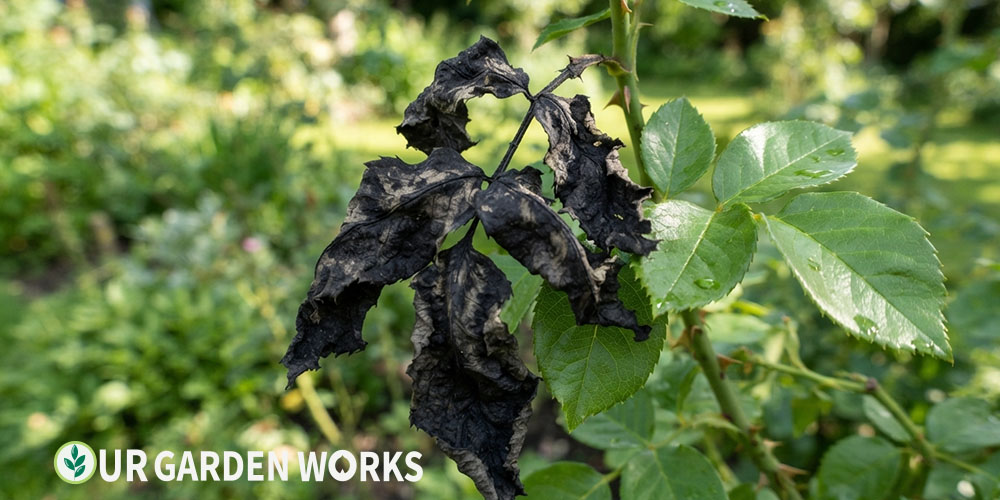
Leaves that have gone fully black, rather than showing the more common dark spots or yellowing covered elsewhere in our rose guides, point to a smaller, more specific set of causes — and a couple of them are genuinely more serious than the typical black spot disease most rose growers eventually encounter.
This guide focuses specifically on full leaf blackening rather than spotted or partial discoloration, since that distinction matters for getting the diagnosis right.
Quick Answer: Leaves turning fully black on roses are most often advanced, untreated black spot disease (started as spots, progressed to full blackening), frost or cold damage (sudden, following a cold night, often affects new growth most severely), or fireblight (a more serious bacterial disease, often with a “shepherd’s crook” curl at branch tips). Check whether the blackening progressed from spots or appeared suddenly to narrow down the cause.
Cause 1 — Advanced Black Spot Disease
Black spot, covered in detail in our dedicated black spot guide, typically starts as the classic round, feathered-edge dark spots, but in severe, untreated infections, those spots can expand and merge until much or all of an individual leaf appears black. This represents the advanced end of the same disease process rather than a separate condition.
How to confirm it’s advanced black spot:
- You can identify the classic feathered-edge spot pattern at the edges of the blackened areas, or on less severely affected nearby leaves
- Yellowing is often present surrounding the blackened tissue
- Progression has been gradual over the season rather than appearing suddenly overnight
- Lower leaves are typically more severely affected than upper growth
Fix: Remove severely affected leaves and follow the complete black spot treatment protocol — fungicide application, soil-level watering, improved airflow, and thorough fall cleanup to prevent recurrence the following season.
Cause 2 — Frost or Cold Damage
A sudden cold snap, particularly an unexpected late spring frost after new growth has already emerged, can cause that tender new foliage to blacken and die back within just a day or two of the cold exposure. This is a physiological injury rather than a disease, and it has a distinctly different onset pattern than black spot’s gradual progression.
How to confirm it’s frost damage:
- Blackening appeared suddenly, coinciding with a recent unexpected cold night
- New, tender growth is affected most severely, while more mature, hardened foliage may be unaffected or less severely damaged
- No feathered-edge spot pattern present — the blackening is more uniform across affected tissue
Fix: No treatment reverses existing frost damage — simply prune away the dead, blackened growth once you can clearly see where healthy tissue begins. The plant typically pushes new growth to replace what was lost once warmer weather returns reliably.
Cause 3 — Fireblight (Less Common but More Serious)
Fireblight is a bacterial disease more commonly associated with apple and pear trees but capable of affecting roses as well, producing blackened, scorched-looking leaves and stems, often with a distinctive curling at branch tips sometimes called a “shepherd’s crook.”
This is considerably more serious than black spot and can kill affected canes or even entire plants if not addressed.
How to confirm it’s fireblight:
- Branch tips show a distinctive downward curl, resembling a shepherd’s crook
- Blackened tissue has a scorched, almost burned appearance rather than the more uniform dead-tissue look of frost damage
- May ooze a bacterial discharge in humid conditions
- Spreads along stems and branches, not just confined to leaves
Fix: Prune affected canes well below the visible damage, into clearly healthy wood, disinfecting pruning tools between cuts to avoid spreading the bacteria further. Severely affected plants may need to be removed entirely if the infection has progressed extensively through the main structure.
⚠️ Fireblight requires more aggressive intervention than black spot
Unlike black spot, which is primarily a cosmetic and vigor issue, fireblight can genuinely kill rose canes and spread aggressively through a plant’s vascular system.
If you suspect fireblight based on the shepherd’s crook pattern, prune affected material promptly and disinfect tools thoroughly between cuts to limit spread to unaffected parts of the same plant or nearby roses.
Telling the Three Causes Apart at a Glance
| Cause | Onset | Pattern | Severity |
|---|---|---|---|
| Advanced black spot | Gradual, over the season | Spots merging into black areas | Cosmetic, manageable |
| Frost damage | Sudden, after a cold night | Uniform blackening, new growth | Affects only exposed tissue |
| Fireblight | Can spread quickly | Shepherd’s crook, scorched look | Can be serious, plant-threatening |
Inspecting Canes and Stems, Not Just Leaves
Since fireblight specifically affects woody tissue and can spread well beyond the leaves themselves, a thorough inspection for any of these three causes should extend to canes and stems, not stop at the leaf symptoms alone.
Black spot occasionally produces minor lesions on younger green canes in severe infections, though this is far less prominent than the leaf symptoms and rarely the primary concern.
Frost damage can affect stem tips in addition to leaves, particularly tender new growth that hadn’t yet hardened off before an unexpected cold snap, sometimes showing as blackened, collapsed stem tissue alongside the leaf blackening.
Fireblight is where stem inspection matters most critically, since the bacteria travel through the plant’s vascular system, and checking how far down a cane the blackened, scorched appearance extends tells you exactly how far back you need to prune to reach genuinely healthy, unaffected wood.
Cutting into a cane at a suspected boundary between healthy and affected tissue, and checking whether the internal wood shows any discoloration, helps confirm you’ve pruned back far enough — healthy rose cane interior should show clean, uniform coloring rather than any streaking or darkening that would suggest the infection extends further than the external appearance alone indicated.
Regional Fireblight Risk and Nearby Fruit Trees
Fireblight risk on roses correlates fairly directly with the presence of susceptible fruit trees nearby, since apple, pear, and certain ornamental relatives like crabapple serve as more common and more severe hosts for the bacteria, with roses sometimes becoming secondarily infected when conditions favor the disease’s spread in the surrounding area.
If you garden near orchards, have fruit trees on your own property, or know that fireblight has been reported in fruit trees in your region recently, this raises the baseline likelihood that blackened rose leaves and stems are fireblight rather than the more common black spot or simple frost damage.
Conversely, if you don’t have any fireblight-susceptible fruit trees nearby and aren’t aware of regional fireblight pressure, advanced black spot remains the statistically far more likely explanation for blackened rose foliage, especially if the gradual, spot-to-black progression pattern is present.
This regional context, combined with the shepherd’s crook and scorched-appearance clues covered earlier, gives a fairly reliable basis for distinguishing between these possibilities even without lab confirmation.
Why Catching This Early Matters More Than With Some Other Rose Problems
Unlike many of the cosmetic rose issues covered elsewhere in this series, two of the three causes here — advanced black spot and especially fireblight — benefit significantly from early intervention rather than a wait-and-see approach.
Black spot that’s allowed to progress to full leaf blackening represents a more advanced, harder-to-control infection than one caught at the early spotting stage, and fireblight specifically can spread through a plant’s vascular tissue quickly enough that delayed action genuinely risks losing canes or the entire plant.
This is one situation in this series where we’d encourage erring toward faster action rather than extended observation, particularly if the shepherd’s crook pattern or any bacterial ooze is present, since these specific signs point toward the more serious fireblight diagnosis rather than the more common and more manageable black spot or frost damage explanations.
Frequently Asked Questions
Can a rose bush recover after losing leaves to blackening?
Yes, in most cases, especially for black spot and frost damage, where the plant typically pushes new, healthy growth once the underlying issue is addressed or weather conditions improve.
Fireblight recovery depends heavily on how much of the plant’s structure was affected before treatment began — minor cane infections caught early generally allow good recovery, while extensive infection may require removing the entire plant.
Is fireblight common on roses, or is black spot the more likely explanation?
Black spot is considerably more common on roses than fireblight, which more typically affects apple, pear, and related fruit trees, occasionally spreading to roses growing nearby or under favorable conditions for the bacteria.
If you don’t have fruit trees nearby and don’t see the distinctive shepherd’s crook pattern, advanced black spot remains the more statistically likely explanation for blackened rose leaves.
Should I remove an entire rose bush if I find fireblight?
Not necessarily as a first step — pruning affected canes well into healthy wood, with proper tool disinfection between cuts, often controls fireblight successfully if caught while still localized to a portion of the plant.
Complete removal becomes necessary only if the infection has progressed extensively through the main stem or root crown, which a local extension service or experienced rose grower can help you assess if you’re uncertain about the severity.
Can I prevent frost damage to roses if I know cold weather is coming?
Yes, covering plants with a frost cloth, old sheet, or similar lightweight material overnight when an unexpected late-season frost is forecast can protect tender new growth from the worst of the cold exposure.
This is most worth doing for new growth that’s already emerged in early spring, since fully dormant canes tolerate cold far better than the soft, actively growing tissue most vulnerable to sudden frost.
Related Articles in Our Rose Leaf Problems Guide
- Black Spots on Rose Leaves — Complete Treatment Guide
- Rust Spots on Rose Leaves – Identification and Treatment
- Holes in Rose Leaves — Causes, Identification, Treatment
- 10 Best Insecticides For Roses – Reviews & Top Picks (2026)
- 10 Best Rose Fertilizers – (Reviews & Top Picks for 2026)
- What Causes Yellow Leaves On Knockout Roses And How To Avoid Them
- Why Aren’t My Roses Blooming?: Top 9 Reasons And How To Resolve Them
- Plant Care Guide (Hub)
Final Thoughts
We hope this guide has helped you distinguish between a manageable, cosmetic issue and one that genuinely deserves faster attention — getting that distinction right is the most important thing this particular symptom can tell you.
Share this post with a fellow rose grower who’s troubleshooting blackened leaves — and let us know in the comments which cause matched what you found. Happy growing!
