

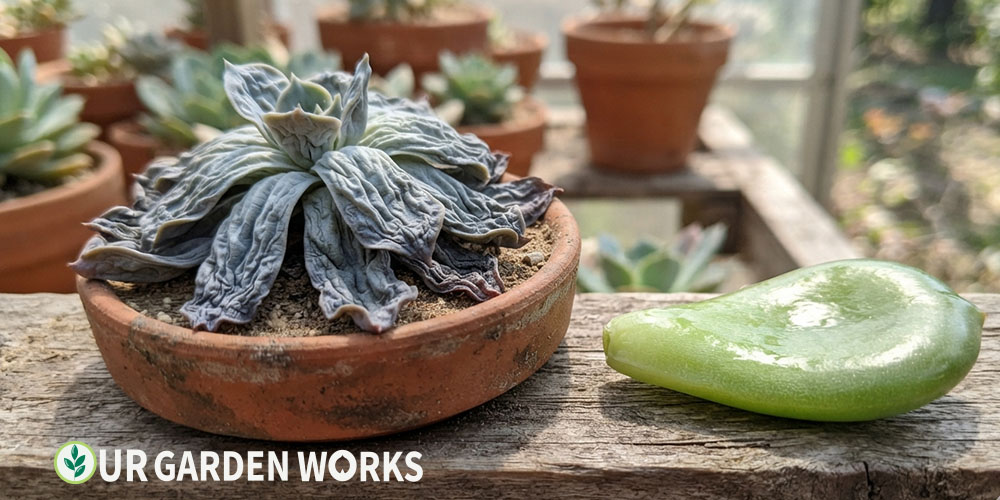
Wrinkled succulent leaves are one of the more useful visual cues in plant care, since succulents store water directly in their leaf tissue and that tissue visibly deflates as reserves are used up.
Most of the time this points clearly to underwatering, but a couple of less obvious causes are worth ruling out, especially if your watering habits already seem reasonable.
We’ll cover the dominant cause first, then the alternatives that produce a similar wrinkled appearance for different underlying reasons.
Quick Answer: Wrinkled, puckered succulent leaves most often mean underwatering — the plant has used its stored water reserves and the leaves deflate slightly as a result. Other causes include root rot from previous overwatering (roots can no longer absorb water even when present), root-bound plants in too-small pots, and natural lower leaf aging. Check soil moisture and root health first, since these explain the vast majority of cases.
Cause 1 — Underwatering (Most Common, Most Easily Fixed)
Succulents store water in their thick, fleshy leaves specifically to survive periods of drought in their native arid habitats, and that stored water is what gives healthy leaves their characteristic plump, taut appearance.
As the plant draws down this reserve between waterings, leaves gradually lose some of that fullness, developing a wrinkled, slightly deflated look that becomes more pronounced the longer watering is delayed.
How to confirm it’s underwatering:
- Soil is dry, often for an extended period since the last watering
- Wrinkling is fairly uniform across the plant rather than concentrated on specific leaves
- Leaves plump back up noticeably within a day or two after watering
- No signs of dark, mushy, or discolored tissue at the base
Fix: Water thoroughly, allowing water to flow through the drainage hole and soak the entire root zone, then allow the soil to dry out significantly before watering again. This is the single most reliable fix for the majority of wrinkled succulent cases, and most plants plump back up visibly within 24-48 hours of a good watering.
💡 Succulents recover from underwatering far more reliably than overwatering
If you’re ever uncertain whether a succulent needs more or less water, erring toward underwatering is almost always the safer mistake.
A succulent that’s gone too long without water and wrinkled will plump back up readily once watered, while a succulent suffering from root rot due to overwatering often can’t be saved without significant intervention.
Try our free tool: Garden Watering Calculator — How Much Water Your Crops Actually Need
Cause 2 — Root Rot From Previous Overwatering
This is the cause that confuses people most, since the visible symptom — wrinkled, somewhat deflated leaves — looks similar to simple underwatering, even though the underlying problem and the fix are completely different.
If roots have been damaged by prolonged waterlogged conditions, they lose the ability to absorb water effectively even when soil moisture is present, producing the same dehydrated leaf appearance as genuine drought stress.
How to confirm it’s root rot rather than simple underwatering:
- Soil has actually been kept consistently moist or watered frequently, not dry
- Wrinkling persists or worsens despite watering, rather than improving
- The base of the plant or lower leaves may show dark, soft, or mushy tissue
- A slightly unpleasant, rotting odor may be present at the soil line
Fix: Remove the plant from its pot and inspect the roots — healthy succulent roots are firm and pale, while rotted roots are dark, soft, and mushy. Trim away all affected roots with a clean blade, allow the remaining healthy tissue to dry and callus for a day or two, then repot into fresh, well-draining succulent-specific soil and resume watering only once new root growth is established.
⚠️ Don’t water more if wrinkling persists despite moist soil
This is the critical decision point that trips up many succulent owners — if leaves stay wrinkled despite soil that’s already moist, adding more water makes root rot worse, not better. Check the roots before adding any additional water in this specific situation.
Cause 3 — Root-Bound Plant in a Too-Small Pot
A succulent that’s outgrown its container, with roots densely filling and circling the available soil space, struggles to take up adequate water even with regular watering, simply because there’s no longer enough soil volume to hold sufficient moisture between waterings.
This produces a similar wrinkled appearance to simple underwatering but stems from a structural pot-size problem rather than a watering schedule issue.
How to confirm it’s root-bound:
- Plant has been in the same pot for a long time without repotting
- Roots are visible emerging from drainage holes or circling densely when you check by removing the plant from its pot
- Wrinkling persists despite what seems like adequate watering frequency
- Overall plant growth has slowed or stalled
Fix: Repot into a container one size larger, using fresh, well-draining succulent soil, and resume a normal watering schedule. The increased soil volume gives roots more room to access and hold adequate moisture between waterings.
Cause 4 — Natural Lower Leaf Aging
Many succulents naturally shed or show some wrinkling and softening in their oldest, lowest leaves as part of normal growth, even when overall care is appropriate. This is the least concerning cause on this list and generally doesn’t warrant any intervention.
How to confirm it’s natural aging:
- Only the lowest, oldest leaves show wrinkling
- Rest of the plant looks plump and healthy with vigorous new growth at the center or growing tip
- Wrinkled leaves may eventually dry out completely and can be gently removed
Fix: None needed — simply remove the oldest leaves once fully dried if desired, for tidiness.
Telling the Four Causes Apart at a Glance
| Cause | Soil Moisture | Response to Watering | Other Signs |
|---|---|---|---|
| Underwatering | Dry | Plumps up within days | None |
| Root rot | Moist/wet | No improvement, may worsen | Dark, mushy base; odor |
| Root-bound | Variable | Limited improvement | Roots visible at drainage holes |
| Natural aging | Normal | N/A — lowest leaves only | Rest of plant vigorous |
Indoor vs. Outdoor Succulents — Does Growing Location Change the Diagnosis?
Indoor succulents face a somewhat different risk balance than outdoor ones when it comes to these four causes.
Indoor plants, kept in a controlled environment without natural rainfall, are entirely dependent on you for water, which means underwatering and overwatering are both purely a function of your own watering habits rather than weather variability — making consistent attention to soil moisture checks especially important indoors.
Outdoor succulents in regions with regular rainfall face a different challenge: unexpected wet stretches can push soil moisture higher than intended even without any deliberate overwatering on your part, which is part of why well-draining soil and appropriate drainage matter even more for outdoor plantings where you can’t fully control incoming moisture.
If an outdoor succulent shows wrinkled leaves following an unusually wet period, root rot deserves more immediate consideration than it might for an indoor plant with the same symptom, simply because the wet-soil cause is more likely to have occurred without your direct awareness.
Root-bound issues and natural leaf aging apply equally regardless of indoor or outdoor growing location, since both relate to the plant’s own growth and pot situation rather than ambient weather conditions.
Whichever environment you’re growing in, the core diagnostic approach — checking soil moisture, then roots if moisture alone doesn’t explain the symptom — remains the same.
The Right Watering Rhythm for Succulents Generally
Since both underwatering and overwatering can ultimately lead to the same wrinkled leaf symptom, getting the overall watering rhythm right matters more for succulents than for almost any other common houseplant category.
The general principle — water thoroughly, then allow soil to dry out completely before watering again — sounds simple but trips up many new succulent owners who default to the more frequent, lighter watering habits that suit typical houseplants but actively harm succulents over time.
Checking soil moisture by inserting a finger an inch or two into the soil, or using a moisture meter for more precision, removes the guesswork from this rhythm far more reliably than watering on a fixed calendar schedule.
Succulents in smaller pots and warmer, sunnier locations typically need this check more frequently than larger pots in cooler, lower-light spots, since pot size and environmental conditions both significantly affect how quickly soil dries out between waterings.
Frequently Asked Questions
How quickly should wrinkled leaves improve after watering if it's simple underwatering?
Most succulents show visible plumping within 24-48 hours of a thorough watering if underwatering was genuinely the cause, with full recovery to normal leaf fullness often complete within a week.
If you don’t see any improvement within several days after watering, it’s worth reconsidering whether root rot or a root-bound pot might be the actual explanation instead.
Can wrinkled leaves ever plump back up to their original size, or is the change permanent?
Existing wrinkled leaves generally do plump back up substantially once properly watered, since the underlying leaf structure is still intact and simply needs to refill with water.
In cases of severe, prolonged dehydration, some leaves may not fully return to their original plumpness and could eventually be replaced by new growth, but mild to moderate wrinkling typically resolves well with proper watering.
Do all succulent types wrinkle the same way when underwatered?
The general pattern is similar across most common succulent types, though the visual severity can vary — thinner-leafed varieties sometimes show more dramatic wrinkling than thicker-leafed types holding proportionally larger water reserves relative to their surface area.
Regardless of variety, the underlying cause-and-effect relationship between water reserves and leaf plumpness remains the same across virtually all true succulents.
Related Articles in Our Plant Care Guide
Final Thoughts
We hope this guide has given you a clear, confident way to diagnose wrinkled succulent leaves — and reassured you that the most common cause is also the easiest one to fix.
Checking the roots before assuming you simply need to water more protects against the one mistake that genuinely matters to avoid here.
Share this post with a fellow gardener who’s troubleshooting their succulents — and let us know in the comments which cause matched what you found. Happy growing!
