

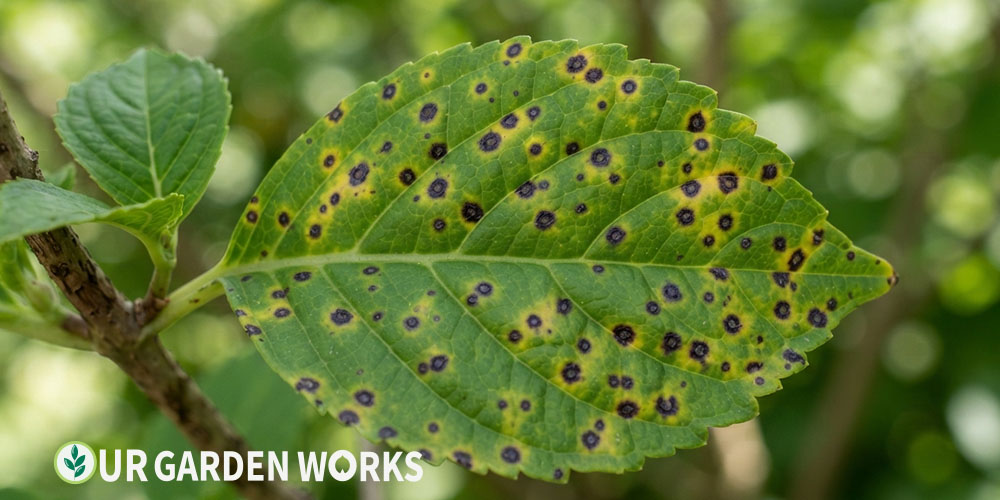
Black spots on hydrangea leaves are common enough that most gardeners growing this plant for more than a couple of seasons will encounter them eventually.
The good news is that the most likely cause is one of the more manageable fungal diseases out there, and a clear pattern of habits prevents it from becoming a chronic, worsening problem.
We’ll cover the leading cause in detail, plus the less common possibilities worth ruling out if the classic pattern doesn’t quite match what you’re seeing.
Quick Answer: Black spots on hydrangea leaves are most often Cercospora leaf spot — small purple-brown to black circular spots, often with yellowing around them, starting on lower leaves. Anthracnose, producing larger, more irregular dark blotches, is a less common alternative. Remove affected leaves, improve airflow, switch to soil-level watering, and apply a fungicide if the infection is significant.
Cause 1 — Cercospora Leaf Spot (Most Common)
Cercospora leaf spot produces small, roughly circular spots in shades of purple-brown to black, typically a quarter inch or smaller, often surrounded by a yellow halo as the surrounding tissue reacts to the infection. It characteristically starts on the lower, older leaves of the plant and works its way upward as the season progresses, very similar in pattern to several of the fungal diseases covered elsewhere in this series for other plants.
How to confirm it’s Cercospora leaf spot:
- Spots are small, round, and dark purple-brown to black
- Yellow halo often surrounds individual spots
- Lower leaves affected first and most severely
- Worse in warm, humid conditions, especially late summer
Fix: Remove affected leaves and dispose of them rather than composting. Switch to soil-level watering if you’ve been watering overhead, and improve airflow through proper spacing and selective pruning. A fungicide labeled for leaf spot diseases helps manage more significant infections.
💡 This disease rarely threatens the plant seriously
Cercospora leaf spot is mostly a cosmetic and vigor issue rather than a genuinely dangerous disease for an established hydrangea. Even a fairly significant infection in one season rarely kills the plant outright, though it’s still worth managing to protect overall plant health and appearance.
Cause 2 — Anthracnose
Anthracnose produces larger, more irregular dark brown to black blotches than the small, round spots of Cercospora, sometimes with a slightly sunken or water-soaked appearance, and can affect both leaves and flower bracts in more severe cases.
It’s less commonly seen on hydrangeas than Cercospora but worth distinguishing since severe anthracnose can be more damaging to overall plant vigor.
How to confirm it’s anthracnose:
- Spots or blotches are larger and more irregular than Cercospora’s small round spots
- May show a slightly sunken, water-soaked texture
- Can appear on flower bracts in addition to leaves
- Worse in warm, wet conditions, similar to Cercospora’s preferred environment
Fix: Same general approach as Cercospora — remove affected material, improve airflow, switch to soil-level watering, and apply an appropriate fungicide for more significant infections.
Telling Cercospora Apart From Anthracnose
| Disease | Spot Size | Shape | Yellow Halo |
|---|---|---|---|
| Cercospora leaf spot | Small (¼” or less) | Round, defined | Common |
| Anthracnose | Larger, irregular | Blotchy, may be sunken | Less common |
In practice, the treatment approach is similar enough between the two that precise identification matters less for home gardeners than confirming a fungal cause is present at all and responding with the consistent habits that manage both.
Why Watering Method Matters So Much for Hydrangea Disease Prevention
Both diseases covered in this guide depend on water sitting on leaf surfaces for extended periods to germinate and spread, which makes watering method one of the single highest-leverage prevention habits available.
Overhead watering, whether from a sprinkler or simply watering with a hose held above the foliage, wets leaves directly and creates exactly the conditions these fungi need.
Switching to soil-level watering — a soaker hose, drip irrigation, or simply directing a hose nozzle at the base of the plant rather than over the top — keeps foliage dry and dramatically reduces infection risk regardless of which specific fungal disease you’re trying to prevent.
This single change often does more preventive work than any fungicide applied reactively after symptoms have already appeared.
Seasonal Cleanup and Long-Term Management
Both Cercospora and anthracnose can overwinter in fallen leaves and plant debris, creating the same kind of reinfection cycle covered for other fungal diseases throughout this series.
Thorough fall cleanup — removing and disposing of all fallen hydrangea leaves rather than letting them decompose in place around the base of the plant — meaningfully reduces the fungal spore load available to reinfect the plant the following spring.
For hydrangeas with a persistent, multi-year history of leaf spot disease despite good watering habits and cleanup, a preventive fungicide application in early spring, before symptoms typically appear, can break a cycle that’s become established in the surrounding soil and garden environment over several seasons.
This proactive approach generally outperforms waiting for visible symptoms each year before beginning treatment.
How Mulch and Soil Health Support Disease Resistance
Beyond direct watering and cleanup habits, the overall health and vigor of a hydrangea plays a meaningful supporting role in how well it resists and recovers from fungal leaf spot pressure.
A stressed plant — whether from inconsistent watering, nutrient deficiency, or poor soil conditions — typically shows more severe disease symptoms than a vigorous, well-cared-for plant exposed to the same fungal spore load in the same environment.
A consistent mulch layer, 2-3 inches deep and extending toward the plant’s drip line, supports this overall vigor by moderating soil moisture and temperature swings, while also providing a small physical barrier that reduces how easily fungal spores in soil splash up onto the lowest leaves during watering or rain.
This is a similar mechanism to the splash-prevention benefit mulch provides for several of the vegetable garden diseases covered elsewhere in this series, applied here to an ornamental shrub instead.
Avoiding both over-fertilizing and under-fertilizing also matters, since a hydrangea pushed into excessive, lush growth from too much nitrogen can develop denser, more humidity-trapping foliage that actually increases disease pressure, while a nutrient-starved plant simply lacks the vigor to resist infection effectively.
A balanced, moderate feeding approach throughout the growing season supports the kind of steady, resilient growth that handles incidental fungal exposure without developing severe symptoms.
Are Container Hydrangeas More or Less Susceptible?
Container-grown hydrangeas can go either way on leaf spot susceptibility depending on how they’re sited and watered. On one hand, containers typically offer better airflow around an individual plant than a densely planted in-ground bed, which works in the plant’s favor against fungal diseases that favor stagnant, humid air.
On the other hand, container watering habits sometimes lean toward more frequent, lighter watering sessions that can inadvertently wet foliage more often than a single deep in-ground watering would.
The same core prevention principle applies regardless of growing method: keep water at the soil level and off the foliage as consistently as possible.
For container hydrangeas specifically, a simple drip emitter or even just careful hand-watering directed at the soil surface rather than using an overhead watering can achieves this just as effectively as it does for an in-ground planting.
Frequently Asked Questions
Will black spots affect my hydrangea's blooms?
Cercospora leaf spot typically doesn’t affect blooms directly, focusing its damage on foliage. Anthracnose can occasionally affect flower bracts in more severe infections, though this is less common than leaf-only symptoms.
In either case, significant leaf loss from advanced infection can indirectly reduce bloom size and quantity by limiting the plant’s overall photosynthetic capacity.
Can black spots on hydrangeas spread to other plants nearby?
These specific fungal pathogens are generally specific to hydrangeas and won’t typically infect unrelated garden plants, though they can spread readily between different hydrangea plants growing near each other.
If you have multiple hydrangeas in the same area, treating and cleaning up around all of them, not just the most visibly affected plant, helps limit spread within that planting.
Are some hydrangea varieties more resistant to leaf spot diseases?
Resistance varies somewhat by variety, though leaf spot susceptibility isn’t as heavily marketed or labeled on hydrangea plant tags as it is for some other ornamentals.
Panicle hydrangeas generally show somewhat better disease resistance overall compared to bigleaf varieties, which face more leaf spot pressure partly due to their larger, more humidity-trapping foliage.
How long does it take to see improvement after switching to soil-level watering?
Existing spots won’t reverse regardless of watering changes, but you should see meaningfully reduced new spot development within a couple of weeks of consistently keeping foliage dry, assuming weather conditions cooperate as well.
Full recovery in terms of new, clean growth typically follows over the subsequent few weeks as the plant continues producing new foliage under improved conditions.
Should I prune my hydrangea differently if it has a history of leaf spot disease?
Light, deliberate thinning of the densest interior growth, done as part of your normal seasonal pruning, improves airflow and reduces the humid microclimate that favors fungal leaf spot, which is a worthwhile adjustment if disease has been a recurring issue.
Avoid heavy, indiscriminate pruning purely in response to disease pressure, since hydrangea pruning timing and technique vary by type and incorrect pruning can reduce next season’s blooms regardless of any disease management benefit.
Related Articles in Our Hydrangea Care Guide
- Yellow Leaves on Hydrangeas — 7 Causes + Fixes
- Brown Edges on Hydrangea Leaves – 4 Causes + Fixes
- 10 Best Fungicides For Hydrangeas in 2026
- Common Hydrangea Problems: Why Is My Hydrangea Not Growing?
- 5 Easy Ways to Fix Hydrangea Leaves Wilting Or Drooping
- (Free tool) Garden Watering Calculator — How Much Water Your Crops Actually Need
Final Thoughts
We hope this guide has helped you identify exactly what’s causing the black spots on your hydrangea — and reassured you that this is a manageable, rarely serious problem once you adjust your watering habits and stay on top of fall cleanup.
For more hydrangea care guidance, our plant care guides cover everything from planting to pest and disease management.
Share this post with a fellow gardener who’s troubleshooting their hydrangea — and let us know in the comments what’s worked for your garden. Happy growing!
