

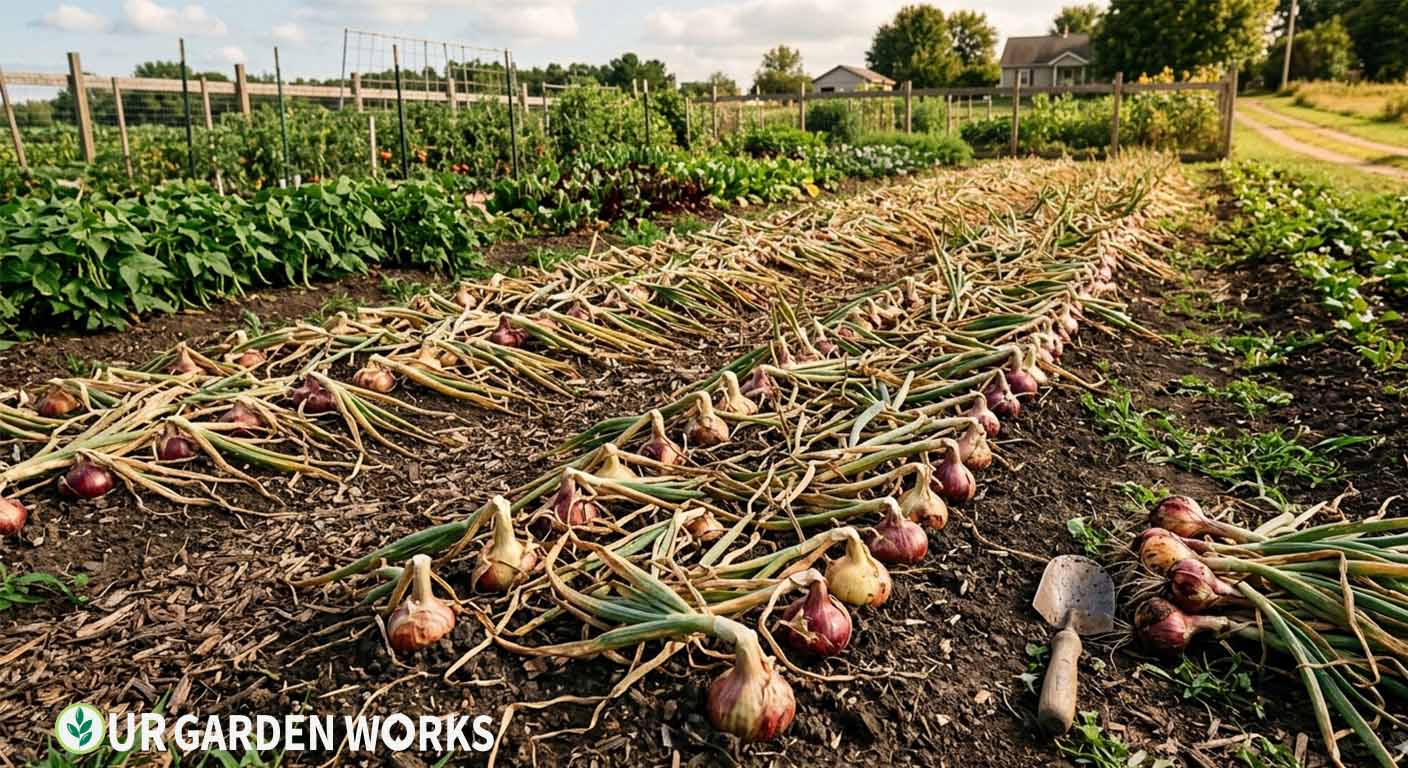
Onions are one of the most self-announcing vegetables in the garden. When they’re ready, they tell you: the green tops that have been standing upright all season simply fall over. It’s not subtle. It’s the plant’s way of saying the work is done — pull us up.
Getting the timing right (and the post-harvest curing right) is what separates onions that store for 6 months from ones that go soft in 3 weeks.
When to Harvest Onions – Quick Answer: Harvest onions when 50–80% of the tops have fallen over naturally. Once tops fall, stop watering and leave in the ground for 2–3 more days if conditions are dry. Then pull, and cure for 2–4 weeks in a warm, dry, well-ventilated location before storage.
Why Onion Tops Fall Over on Their Own Schedule
The neck of an onion — the narrow point connecting the leaves to the bulb — is made of the same fleshy tissue as the rest of the plant early in the season, firm enough to hold the leaves upright.
As the bulb finishes its development and the plant shifts from active growth into a kind of internal “shutdown” mode, the cells in that neck region naturally soften and begin to collapse, since the plant is no longer investing resources in keeping that structure rigid.
This isn’t damage or disease — it’s the plant’s own signal that it has finished the job. Trying to force this process earlier than the plant is ready for, whether by bending tops manually or by withholding water too aggressively before the bulb has actually matured, doesn’t speed up real bulb development.
It just stresses the plant and risks an undersized harvest. The fall of the tops is genuinely the most reliable, plant-generated signal available, which is exactly why this guide leans on it so heavily rather than trying to predict readiness purely from a calendar date or a generic days-to-maturity figure that can’t account for your specific season’s weather.
The Reliable Harvest Signals
- Tops falling over (the main signal): When 50–80% of the tops in your bed have collapsed, it’s harvest time. Don’t wait for 100% — a few green tops still standing is fine.
- Necks thinning: The neck of the onion (just above the bulb) narrows and softens as the plant diverts resources from the top into the bulb.
- Outer skin papery: Brush away surface soil and check — the outer layer should be dry and papery, not green or moist.
- Size: The bulb has reached its expected size for the variety. If in doubt, pull one test onion and check.
Weather in the days leading up to this point matters more than most gardeners expect.
A stretch of unusually hot, dry weather right as the bulbs finish sizing up can accelerate the top-falling process by several days compared to a cooler, more typical season, while an unseasonably cool or wet stretch can delay it.
This means watching the actual plants, rather than relying purely on the days-to-maturity number on a seed packet, gives you a more accurate harvest signal than calendar math alone — the packet number is a useful starting estimate, not a guarantee.
Our harvest countdown calendar gives you that starting estimate based on your planting date, which is still worth checking against even though the falling tops remain the final word.
⚠️ Don’t bend the tops manually
Some older guides recommend bending the tops over by hand to “force” maturation. Don’t do this — it damages the neck and creates an entry point for disease. Let the tops fall on their own timeline.
How to Harvest and Cure Onions
Directions
- Stop watering completely once 50% of tops have fallen. Dry soil at harvest means drier, better-storing onions.
- On a dry day, use a garden fork to loosen soil, then pull onions by the tops. Handle gently — bruised onions rot faster in storage.
- Lay onions in a single layer in a warm, shaded, well-ventilated spot — a covered porch, barn, or greenhouse bench works well. Never cure in direct sun — it bleaches and damages the outer skin.
- Cure for 2–4 weeks until necks are completely dry and brittle and outer skins are papery and crinkly.
- Braid softneck varieties for hanging storage. For hardneck varieties, trim tops to 1 inch and roots to ½ inch. Store in a mesh bag or open crate in a cool (32–40°F), dry location.
Sort onions before storage by size and condition rather than mixing everything together indiscriminately.
Smaller bulbs and any with even minor bruising or soft spots tend to spoil first, so setting these aside to use within the next few weeks, while reserving only the largest, firmest, most thoroughly cured bulbs for true long-term storage, gets you more total value from the harvest than treating every onion identically.
Properly cured storage onions last 6–9 months. Sweet onions (like Vidalia-type) have higher sugar and water content — they store only 1–2 months and should be used first. For planting guidance, see our how to grow onions guide.
What Curing Actually Does to an Onion
Curing isn’t just drying for its own sake — it’s a specific transformation of the outer layers of the bulb. As an onion cures, several of its outermost layers dry into thin, papery, brittle sheets that form a protective shell, while the layers beneath stay fleshy and intact.
This papery shell does double duty: it’s a physical barrier against the fungi and bacteria that cause rot, and it dramatically slows the rate at which the inner bulb loses moisture to the surrounding air.
An onion pulled and used immediately without curing has none of this protection. Its outer layer is still soft and moist, offering no real barrier to rot organisms, which is exactly why uncured onions spoil so much faster than cured ones even when stored under otherwise identical conditions.
The 2–4 week curing window exists because that’s roughly how long it takes for this papery transformation to complete across the entire bulb, not just the very outermost layer — cutting curing short leaves the deeper layers still vulnerable even if the surface looks dry.
Why Pungency and Storage Life Are Connected
It’s not a coincidence that the strongest-tasting, most pungent onion varieties also tend to be the best long-term keepers, while sweet, mild varieties spoil fastest.
The sulfur compounds responsible for an onion’s sharp flavor and tear-inducing bite are the same compounds that act as natural antimicrobial defenses within the bulb, helping fend off the organisms that would otherwise cause rot.
Sweet varieties have been bred specifically to minimize these sulfur compounds in favor of higher sugar content and a milder taste — a desirable trade for fresh eating, but one that comes directly at the expense of the bulb’s natural chemical defenses.
This is why a pungent storage onion like Copra can sit in a cool pantry for the better part of a year, while a Vidalia-type sweet onion, delicious as it is, needs to be eaten within a matter of weeks regardless of how carefully it was cured.
Knowing this tradeoff helps you plan which varieties to grow more of if long-term storage matters to you, versus which to treat as a fresh, near-term harvest — many gardeners end up growing both, dedicating most of the bed to a reliable storage variety while planting just a row or two of something sweeter purely for fresh summer eating.
Frequently Asked Questions
Can I harvest onions before the tops fall over?
Yes — pull them as “green onions” or scallions at any size before the bulb matures. For storage onions, early harvest means underdeveloped bulbs that won’t cure well. Wait for the tops to fall for maximum bulb size and storage life.
My onions are sending up flower stalks — what do I do?
Flowering (bolting) means the plant is going to seed. Harvest these onions immediately — bolted onions don’t store. The flower stalk creates a hollow center in the bulb that leads to rapid rot. Use bolted onions fresh within a few weeks.
Bolting is usually triggered by a cold spell during early growth followed by warming, which tricks the plant into behaving as though it’s already been through a full winter and should reproduce.
How long does onion curing take?
2–4 weeks depending on humidity and temperature. In hot, dry conditions, 2 weeks is sufficient. In humid climates, 4 weeks or more may be needed.
The test: the neck should be completely dry and crinkly, with no moisture when you squeeze it.
Can I speed up curing with a fan?
Yes — a fan providing gentle, continuous airflow over the curing onions noticeably speeds the process, especially in humid climates where still air can let moisture linger near the bulbs.
Avoid pointing a fan directly and forcefully at onions, which can dry the outer layer too fast relative to the interior and create a misleadingly “done” appearance before the bulb is actually ready.
Does the curing process differ for onions grown in a humid climate versus a dry one?
The underlying process is the same, but humid-climate growers need to be more deliberate about airflow and may need the full 4 weeks or longer, since ambient moisture in the air slows the drying that curing depends on.
Dry-climate growers often find their onions cure adequately in closer to 2 weeks under the same basic setup, simply because the surrounding air is already pulling moisture away more efficiently.
🥬 Related Articles in Our Vegetable Gardening Guide
- How to Grow Onions: Sets, Seeds & Transplants Explained (2026)
- 8 Best Fertilizers For Onions – Reviews & Top Picks in 2026
- When to Harvest Garlic – How to Tell It’s Ready and How to Cure It
- How to Grow Garlic: Complete Guide from Planting to Curing
- How To Preserve Carrots & Extend Their Shelf Life
- Vegetable Gardening Guide
Free Tools to Time Your Harvest
Final Thoughts
We hope this guide takes all the confusion out of onion harvest timing. The falling-top signal is reliable and clear — trust it, cure properly, and you’ll have homegrown onions on the shelf well into winter. For all our vegetable growing guides, our vegetable gardening guide is the place to start.
Share this post with a fellow gardener who’s ready to get growing — and let us know in the comments which onion variety you grew and how long yours stored. Happy growing!
