

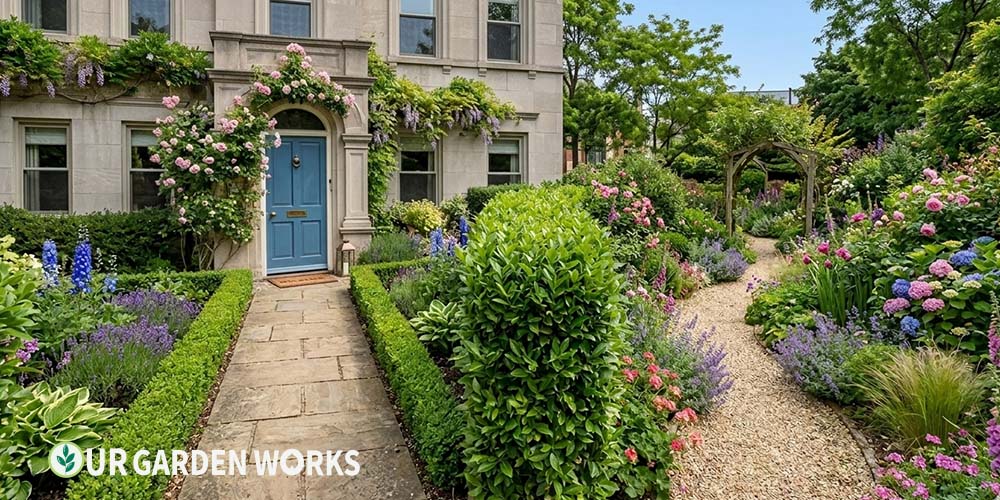
The shape of a path is one of the most powerful and most overlooked design decisions in a garden. The same materials, the same plants, the same yard — laid out as a straight line versus a gentle curve — produce two genuinely different emotional experiences for anyone walking through. This isn’t a minor stylistic preference; it changes how a space feels to move through.
We get this question often enough from readers planning a new path that it deserves its own focused guide, separate from the material and construction questions we cover elsewhere.
The right shape depends on the path’s purpose, your yard’s size and style, and a few practical design rules that keep a curved path from looking accidental rather than intentional.
Curved vs. Straight Garden Path – Which one is the best? Straight paths suit functional, direct routes (front door, garage, mailbox) and formal garden styles — they feel efficient and read as purposeful. Curved paths suit secondary, exploratory routes through informal or cottage gardens — they slow the pace of walking and make a space feel larger and more layered. Curves should always have a visual reason (a tree, a bed, a view) rather than curving for no apparent purpose.
What a Straight Path Communicates
A straight path is the visual equivalent of a direct sentence — it gets to the point. Walking a straight path from the street to a front door, or from a patio to a garden shed, feels efficient and purposeful, because the layout itself signals “this route has a destination, go there directly.”
This makes straight paths the obvious choice for primary, functional routes where efficiency matters more than atmosphere.
Straight paths also suit formal garden styles — symmetrical layouts, clipped hedges, classical proportions — where the geometric precision of a straight line reinforces the overall design language of the space.
A meandering curve dropped into an otherwise formal, symmetrical garden tends to look like a mistake rather than a deliberate choice.
What a Curved Path Communicates
A curved path does the opposite — it slows things down and invites exploration rather than efficient arrival. Walking a curve, you can’t see the full destination from the start, which creates a sense of discovery as each bend reveals something new.
This is exactly why curved paths feel larger than their actual footprint; the visual mystery of what’s around the next curve makes a small garden feel like it has more to explore than a straight line through the same space ever could.
Curved paths suit informal, cottage, and naturalistic garden styles particularly well, echoing the organic shapes found in nature rather than the straight lines of architecture.
They’re also the better choice for secondary, exploratory paths — through a flower bed, around a water feature, connecting different “rooms” within a larger garden — where the journey itself is part of the appeal rather than simply a means of getting somewhere.
The Rule That Makes Curves Work — Give Every Curve a Reason
This is the single most important design principle for curved paths, and it’s the one most amateur designs get wrong.
A curve needs a visual justification — something the path is curving around or toward — or it reads as arbitrary and unintentional, even if the curve itself is graceful.
- Curve around an existing feature: a mature tree, a large shrub, a boulder, a garden bed. The obstacle gives the curve an obvious “why.”
- Curve toward a destination or view: a path that bends to reveal a bench, a water feature, or a particularly nice view as you round the curve rewards the detour with payoff.
- Curve to follow natural contours: a slope, a low spot, or the natural edge of a planting bed all give a curve a sense of following the land rather than fighting it.
⚠️ Avoid “decorative” curves with no purpose
A path that wiggles back and forth across open lawn for no apparent reason — sometimes called a “lazy S” or “snake path” in landscape design circles — is one of the most common amateur design mistakes. Without something to curve around or toward, the wiggle looks indecisive rather than intentional. If you can’t point to a reason for a specific curve, straighten that section out.
Curves and Walking Comfort
Beyond aesthetics, curves have a practical dimension worth understanding: how gentle or tight a curve is affects how comfortable it actually is to walk.
A curve with too tight a radius forces an awkward, mincing stride as people navigate it, while a gentle, sweeping curve accommodates a natural walking gait without anyone needing to think about their footing.
As a practical guideline, avoid curve radius tighter than about 3–4 feet for a path meant for casual walking — anything tighter starts to feel like a hairpin turn rather than a graceful bend.
If you’re using stepping stones rather than a continuous surface, our guide to stepping stone spacing covers how stride length should influence stone placement specifically through curved sections, where the outer edge of a curve needs slightly more spacing than the inner edge to keep the stride comfortable.
Which Suits Small vs. Large Yards?
Yard size genuinely changes the calculus here, and it’s worth being honest about the tradeoffs rather than assuming curves are always more visually interesting regardless of context.
In a small yard, a long, lazy curve can actually waste valuable space and make a small area feel cramped, since curves inherently use more path length to cover the same point-to-point distance than a straight line would.
For small or narrow yards, a straight path — or a curve so gentle it’s barely perceptible — usually makes better use of limited space, while a few well-placed plants or a single curved accent path elsewhere can still introduce some informal character without sacrificing usable yard space.
Larger yards have more room to let a curved path wander meaningfully, with enough distance for the curve to feel like a genuine journey rather than a token gesture squeezed into a tight area.
Mixing Both in One Garden
Many of the most successful garden layouts use both shapes deliberately rather than committing to one design language throughout the entire property.
A straight, efficient path might run from the driveway to the front door — the functional route that gets used daily regardless of mood or weather — while a separate curved path winds through a side yard or backyard flower garden, purely for the pleasure of a slower walk on a nice evening.
This combination lets each path do the job it’s actually suited for: straight where directness matters, curved where atmosphere matters.
It’s a far more common approach in well-designed gardens than forcing a single path shape to serve every purpose in the yard.
Frequently Asked Questions
Are curved paths more expensive to install than straight ones?
Slightly, in most cases, curves take more time to lay out accurately, and flexible materials like gravel or stepping stones accommodate curves more easily than long, rigid units like poured concrete sections. The cost difference is usually modest rather than dramatic, and is more about labor time than material cost.
Can I add curves to an existing straight path?
Generally not without significant rework, since a straight path’s base and edging are built for that specific layout. It’s usually more practical to add a separate curved path elsewhere in the garden than to retrofit curves into an existing straight installation.
How do I decide on the right curve radius for my path?
Walk the proposed route with a garden hose laid out as a guide before committing to anything permanent, adjusting the curve until it feels comfortable to walk and visually makes sense relative to whatever feature it’s curving around.
There’s no single correct measurement — the hose-and-walk-through test is more reliable than any formula for getting a curve that feels right in your specific space.
Does the path shape affect which material I should choose?
Somewhat — gravel and stepping stones adapt to curves more naturally than large rigid pavers or poured sections, which need to be cut or specially shaped to follow a bend cleanly.
If you already know you want a strongly curving path, factor that into material selection early using our gravel vs flagstone comparison, since some materials simply require more cutting, fitting, and labor to execute a curve well than others.
Related Articles in Our Garden Paths Guide:
Final Thoughts
We hope this guide has given you a clearer sense of how much the shape of a path shapes the entire feeling of walking through your garden — it’s a decision worth making deliberately rather than as an afterthought.
For all our backyard and landscaping guides, our backyard design guide hub links to everything in this series.
Share this post with a fellow gardener who’s ready to start their own path project — and let us know in the comments whether your new path is curving or running straight. Happy growing!
