

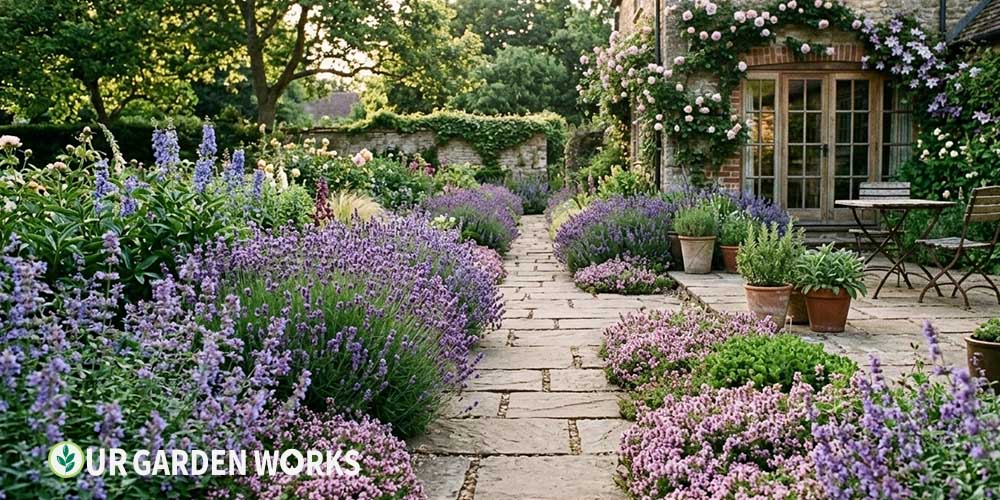
The plants along a path do more work than almost any other planting in the garden, because they’re the ones brushed past, stepped near, and seen up close every single time someone walks the route.
A path lined with the wrong plants — thorny, sprawling, or aggressively spreading — turns a pleasant walk into an obstacle course. The right plants turn a simple walkway into the best-loved part of the whole garden.
We’ve organized this list by purpose, because “best plants for a path” really depends on what you want that path to do. Some readers want fragrance with every step. Others want low groundcover that can take light foot traffic. Others are working with deep shade and just want something, anything, that survives.
This guide covers all of it, organized so you can jump straight to the category that matches your specific situation rather than reading through plants that don’t apply to your conditions at all.
What are the best plants for a garden path? For fragrance, plant lavender, catmint, or rosemary along path edges where brushing releases scent. For groundcover that tolerates light foot traffic, use creeping thyme, Irish moss, or dwarf mondo grass between stepping stones. For shaded paths, hostas, ferns, and heuchera perform reliably. Avoid thorny, aggressively spreading, or top-heavy plants that flop into the walkway.
Fragrant Border Plants — Scent With Every Step
#1 Lavender
Lavender is the classic path-side plant for good reason — brushing past it releases its scent instantly, it tolerates poor soil and drought once established, and its silvery foliage looks attractive even out of bloom. Plant it where afternoon sun reaches it for the strongest fragrance and best flowering.
#2 Catmint (Nepeta)
Catmint produces a long season of soft purple-blue blooms and a similarly aromatic foliage to lavender, but tolerates a wider range of soil conditions and partial shade better. It also sprawls a bit more, softening a hard path edge nicely without becoming unruly.
#3 Creeping Rosemary
A trailing form of rosemary spills attractively over path edges or low walls, releasing its sharp, resinous scent when brushed. In colder climates it’s grown as an annual or brought indoors for winter, but it’s a worthwhile seasonal addition for the fragrance alone.
#4 Sweet Alyssum
This low, mounding annual produces clusters of tiny, honey-scented flowers nearly nonstop through the growing season. It self-seeds readily, often returning on its own the following year along the same path edge once established.
#5 Garden Phlox
Taller than most other entries on this list, garden phlox produces a sweet, carrying fragrance and works well set slightly back from the immediate path edge where its height won’t crowd walkers but its scent still reaches them.
Walkable Groundcover — Plants That Tolerate Foot Traffic
#6 Creeping Thyme
Among the most popular plants for filling gaps between stepping stones, creeping thyme tolerates occasional light foot traffic and releases a pleasant herbal scent when stepped on. It needs good drainage and full sun to thrive — soggy or shaded spots cause it to thin out and fail.
#7 Irish Moss
Despite the name, Irish moss is actually a low, dense flowering plant rather than a true moss, forming a soft, bright green carpet that handles light stepping surprisingly well. It prefers consistent moisture and partial shade, making it a good complement to creeping thyme in a path that has both sunny and shaded stretches.
#8 Dwarf Mondo Grass
An extremely tough, fine-textured grass-like plant that tolerates both foot traffic and a wide range of light conditions, dwarf mondo grass is a favorite for Japanese-style gardens and modern stepping stone paths alike. It spreads slowly, which means less maintenance but also a longer wait for full coverage.
#9 Blue Star Creeper
A delicate-looking but surprisingly resilient groundcover, blue star creeper produces tiny pale blue flowers nearly continuously through the growing season and fills gaps between pavers quickly. It handles light foot traffic well but can struggle in extreme heat without consistent moisture.
#10 Elfin Thyme
An even lower, denser variety than standard creeping thyme, elfin thyme forms a tight mat that handles slightly more foot traffic than its taller cousin. It’s a good choice specifically for the narrow gaps between closely spaced stepping stones.
Plants for Shaded Paths
#11 Hosta
Few shade plants offer the leaf size, color variety, and reliability of hosta along a shaded path. Varieties range from compact, path-edge-appropriate sizes to large, dramatic specimens better suited a few feet back from the actual walkway.
#12 Ferns (Japanese Painted, Maidenhair)
Ferns bring texture and movement to a shaded path that flowering plants often can’t match in low light. Japanese painted fern’s silvery-green fronds catch what little light reaches a deeply shaded path particularly well.
#13 Heuchera (Coral Bells)
Heuchera offers some of the widest foliage color range of any shade perennial — burgundy, lime, amber, near-black — making it a strong choice for adding color to a path that gets too little sun for most flowering plants.
#14 Lily of the Valley
This classic shade groundcover spreads readily once established and produces small, intensely fragrant white bell flowers each spring. Note that all parts of the plant are toxic if ingested, so keep this in mind near paths frequented by small children or pets prone to chewing on plants.
#15 Astilbe
Astilbe’s feathery plume-like flowers add height and softness to a shaded path border, blooming in shades of pink, red, or white depending on variety. It prefers consistently moist soil, making it a good match for paths near downspouts or naturally damp garden corners.
Low-Maintenance Border Plants
#16 Liriope (Lily Turf)
Liriope forms tidy, grass-like clumps that stay attractive with almost no care, tolerating sun, shade, drought, and poor soil with equal indifference. It’s a reliable choice for anyone who wants defined path edges without ongoing maintenance demands.
#17 Daylily
Daylilies are about as forgiving as flowering perennials get, tolerating neglect, varied soil, and a wide range of light conditions while still producing a long bloom season. Choose compact varieties for path edges rather than the largest cultivars, which can flop into the walkway after rain.
#18 Sedum (Stonecrop)
Low, succulent sedum varieties handle drought and poor soil better than almost any other path-side plant, making them ideal for hot, sunny, exposed walkways where other plants struggle. Many varieties also provide good late-season color as they shift hue heading into fall.
#19 Ornamental Grasses (Dwarf Varieties)
Compact ornamental grasses add movement and texture with minimal care, swaying gently with every breeze in a way that static border plants can’t replicate. Stick to genuinely dwarf varieties for path edges — many ornamental grasses look small as young plants but grow considerably larger than expected by their second or third season.
#20 Catmint Walker’s Low
A specific, especially well-behaved cultivar of catmint, ‘Walker’s Low’ stays more compact and tidy than the species generally, making it a popular low-maintenance choice for formal as well as informal path borders.
Plants to Avoid Near Garden Paths
Just as important as knowing what to plant is knowing what to avoid, since the wrong plant near a path creates an ongoing annoyance or even a hazard rather than a design feature.
- Thorny or spiny plants (roses with aggressive thorns, barberry, certain hollies) — even set back slightly from the edge, these catch clothing and skin as plants mature and branches extend over time.
- Aggressively spreading groundcovers (English ivy, mint, bishop’s weed) — these don’t stay where you plant them and will invade the path material itself, working into joints and cracking pavers over years.
- Top-heavy or floppy perennials (large peonies, tall ornamental grasses without staking) — these flop into the walkway after rain or wind, creating both an obstruction and a tripping hazard.
- Plants with messy drop (some flowering trees, certain berry-producing shrubs) — fruit, sap, or heavy flower drop onto a path creates slip hazards and staining, especially on light-colored stone or concrete.
- Bee-magnet plants directly at ankle height — not a reason to avoid pollinator plants generally, but placing intensely bee-attracting low bloomers (some clovers, certain sedums in full bloom) right where bare feet or sandals contact them increases sting risk for households with bee allergies.
⚠️ Check toxicity if children or pets use the path
Several attractive, popular path-side plants — lily of the valley, foxglove, oleander, and others — are toxic if ingested. This doesn’t necessarily rule them out, but it’s worth a quick check on any plant you’re considering if young children or pets that chew on greenery will regularly be near the path.
Spacing and Placement Tips
Plant placement along a path matters almost as much as plant choice, since even a well-chosen plant causes problems if it’s positioned wrong relative to the actual walking surface.
Leave at least 12–18 inches of clearance between the path edge and any plant expected to reach more than knee height at maturity — this prevents the lean-and-flop problem that affects so many path borders within just a few seasons of growth.
For lower groundcover and edging plants meant to spill slightly over the path edge, a closer planting distance of 4–8 inches from the edge is fine and often looks more intentional than a stiff, formal gap.
Stagger plant heights with the tallest furthest from the path and the lowest right at the edge, which creates a layered look and ensures sightlines along the path stay open rather than obstructed.
If your path curves, planting slightly more densely on the outer edge of each curve and leaving more breathing room on the inner edge helps emphasize the path’s shape rather than fighting against it.
Our guide to curved versus straight path design covers more on how planting choices interact with path geometry.
Matching Plants to Your Path Material
The path surface itself influences which plants look and perform best alongside it, a detail that’s easy to overlook when shopping for plants in isolation from the hardscaping.
Gravel paths pair beautifully with drought-tolerant, sun-loving plants like lavender, sedum, and catmint, since the reflective heat off light-colored gravel suits plants that actually prefer hot, dry conditions rather than fighting against that environment.
Flagstone and stepping stone paths, especially those with wider joints, are the best candidates for groundcover meant to grow directly in the gaps — creeping thyme, Irish moss, and blue star creeper all thrive in this in-between zone where soil, light, and moisture conditions differ slightly from the open bed beside the path.
A solid poured or mortared path surface, by contrast, has no joints for planting at all, which puts the full visual job onto border plants set just outside the hard edge.
Shaded paths under tree canopy face a different consideration entirely — root competition.
Large shade trees often make heavy demands on soil moisture and nutrients, which is part of why shade-tolerant plants that also handle some root competition (hosta and many ferns among them) consistently outperform more delicate shade perennials in this specific situation.
Choosing Plants by Climate Zone
Several plants on this list perform very differently depending on where you garden, and it’s worth flagging the biggest regional considerations before you commit to a full path-length planting.
Lavender, for instance, is a reliable, nearly carefree perennial in Zones 5–9 with good drainage, but in colder zones it often needs winter protection or replacement as an annual, and in very humid southern climates it can struggle with fungal issues that don’t trouble it in drier regions.
Creeping thyme and other low Mediterranean herbs generally want the same thing — full sun and sharp drainage — which makes them excellent choices in naturally dry climates and considerably more demanding in consistently wet or humid ones, where root rot becomes a real risk without deliberate soil amendment.
If you garden in the Pacific Northwest, the Gulf Coast, or anywhere with regular summer humidity, lean toward the shade and moisture-tolerant end of this list (hosta, astilbe, ferns, Irish moss) even for paths in full sun, since these plants simply handle ambient humidity better regardless of direct light exposure.
Gardeners in hot, arid regions — much of the Southwest and interior California — should prioritize the drought-tolerant entries (sedum, lavender, catmint, dwarf ornamental grasses) and expect that even shade-tolerant plants like hosta will need more supplemental water than their reputation as “low maintenance” might suggest in cooler, wetter climates.
Matching a plant’s native growing conditions to your actual climate, rather than just its common reputation for toughness, prevents most of the disappointing path-side plantings we hear about from readers.
A Simple Seasonal Maintenance Calendar
Path-side plants benefit from a predictable seasonal rhythm of care, and having a rough calendar in mind makes the difference between a border that looks intentional year after year and one that gradually looks neglected.
In early spring, cut back any perennial foliage left standing over winter (ornamental grasses, sedum, astilbe), and this is also the ideal time to divide overgrown clumps of liriope, daylily, or hosta that have outgrown their space along the edge.
Through late spring and into summer, the main task is trimming back groundcover that’s begun spilling too far into the actual walking surface — creeping thyme and blue star creeper in particular can grow several inches into a path within a single growing season if left unchecked.
This is also when most fragrant border plants hit peak bloom, so it’s worth walking the path regularly during this window simply to enjoy what the planning paid off into.
By late summer and into fall, deadheading spent blooms on daylilies and phlox keeps the border looking tidy as growth naturally slows, and it’s a good time to assess whether any plants struggled through summer heat and need repositioning or replacement before the next season.
Going into winter, a light mulch layer over the crowns of perennials like astilbe and heuchera protects against hard freezes in colder zones, while evergreen border plants like liriope and dwarf mondo grass need essentially no winter-specific care at all.
Frequently Asked Questions
What's the best low-growing plant to fill gaps between stepping stones?
Creeping thyme is the most popular choice for sunny spots due to its fragrance and light foot-traffic tolerance, while Irish moss handles the same role better in shadier or consistently moist conditions.
Choose based on the specific light and moisture conditions along your path rather than picking one option for the entire route if conditions vary.
Can I plant vegetables or herbs along a garden path?
Yes — culinary herbs in particular work beautifully along paths, since brushing past releases their scent just like ornamental fragrant plants do. Low-growing herbs like thyme, oregano, and chamomile tolerate light foot traffic, while taller herbs like rosemary and sage are best planted slightly back from the immediate edge.
How do I keep path-side plants from spreading into the walkway itself?
Choose naturally well-behaved, clumping plants (liriope, daylily, sedum) over aggressive spreaders for the main border, and plan on periodic trimming for anything that does spread, even moderately.
A physical edge — even a simple buried plastic or metal strip — between the planting bed and path material also helps contain root spread for plants that creep underground.
What plants work well for a path that gets partial sun and partial shade through the day?
Heuchera, astilbe, and many hosta varieties handle this in-between light condition well, as does catmint in milder climates.
When in doubt, choose plants labeled for “partial shade” rather than full sun or full shade specifically, since these are bred or selected to tolerate exactly the kind of mixed light a path running east-west or near partial tree cover typically receives.
Should I plant in a single row or layer multiple plant heights along the path?
Layering generally produces a more polished, professionally designed look than a single row of identical plants, even though a single-species row is simpler to plan and maintain.
A common and effective approach is a low groundcover or edging plant directly at the path line, a mid-height perennial or shrub set back 12–18 inches, and an occasional taller accent plant or small ornamental tree further back still — this creates visual depth without any single layer overwhelming the others.
Do I need to amend the soil along a path differently than the rest of my garden beds?
Often yes, particularly near hardscaped paths made of concrete, stone, or gravel, since these materials can affect soil pH (concrete in particular can leach alkaline compounds into adjacent soil over years) and drainage differently than open garden soil.
Testing soil pH along an established hardscape path before planting, especially for pH-sensitive plants like hydrangeas or azaleas, can save you from a planting that mysteriously underperforms despite seemingly ideal light and water conditions.
A simple home soil pH test kit, run on soil taken from within a foot of the path edge versus soil from elsewhere in the yard, is usually enough to reveal whether amendment is actually needed before you invest in plants that may struggle there.
Related Articles in Our Garden Paths Guide
Final Thoughts
We hope this guide has given you a clear starting point for planting along your own path — the right choice really comes down to matching the plant to your light conditions, your foot traffic, and the feeling you want walking through your garden to have.
For all our backyard and landscaping guides, our backyard design guide hub links to everything in this series.
Share this post with a fellow gardener who’s ready to start their own path project — and let us know in the comments which plants you’re choosing for your path. Happy growing!
