
Plant diseases are harder to identify than pests — there is no insect to find and photograph.
What you have are symptoms: color changes, spots, patterns, textures. Learning to read those symptoms systematically is the skill that separates gardeners who can diagnose and treat disease early from those who notice it when it’s too late.
This tool guides you through the symptom pattern and narrows to the most likely disease for your plant and conditions. Each diagnosis includes a treatment protocol and the prevention steps that stop recurrence next season.
Editor’s Note: The 3 most common vegetable garden diseases and their signature symptoms: powdery mildew (white powder on upper leaf surface — fungal, poor air circulation), early blight on tomatoes (dark brown spots with yellow halos, lower leaves first — fungal, wet foliage), blossom end rot on tomatoes and peppers (black leathery spot at blossom end — not a disease, calcium deficiency from inconsistent watering). Each requires a different response.
Symptom Key — Disease vs. Deficiency vs. Pest
Before treating for disease, rule out nutrient deficiency and pest damage — both can look similar to disease at first.
The key diagnostic questions: Is the pattern on the leaf uniform or irregular? Does it spread from plant to plant over days? Is it worse on older leaves or newer leaves? Is there any physical substance on the leaf surface (powder, mould, slime)?
| Symptom | Most Likely Cause | Key Distinguishing Feature |
|---|---|---|
| White powder on upper leaf surface | Powdery mildew (fungal) | Wipes off; worse in dry weather with poor air circulation |
| Brown/black spots with yellow halos, lower leaves first | Early blight (Alternaria) | Concentric ring pattern; moves upward through plant |
| Water-soaked lesions turning brown, then black | Late blight (Phytophthora) | Fast-spreading; white sporulation visible in humid conditions |
| Grey fuzzy mould on flowers and fruit | Botrytis (grey mould) | Fuzzy grey spores; triggered by cool, humid conditions |
| Black leathery spot at blossom end of fruit | Blossom end rot (not disease) | Calcium deficiency from inconsistent watering — not contagious |
| Yellow leaves from bottom up, plant wilts | Fusarium or Verticillium wilt | Cut stem — brown discolouration in vascular tissue |
| Mosaic pattern on leaves (light and dark green) | Mosaic virus (TMV, CMV) | Spread by aphids; no treatment — remove affected plants |
| Uniform yellowing of new growth | Nutrient deficiency (iron, manganese) | Not contagious; check soil pH — deficiency likely at high pH |
| Purple or red tinting on tomato leaves | Phosphorus deficiency | Not contagious; common in cold soil in spring |
The Most Common Garden Diseases — Treatment and Prevention
Powdery Mildew
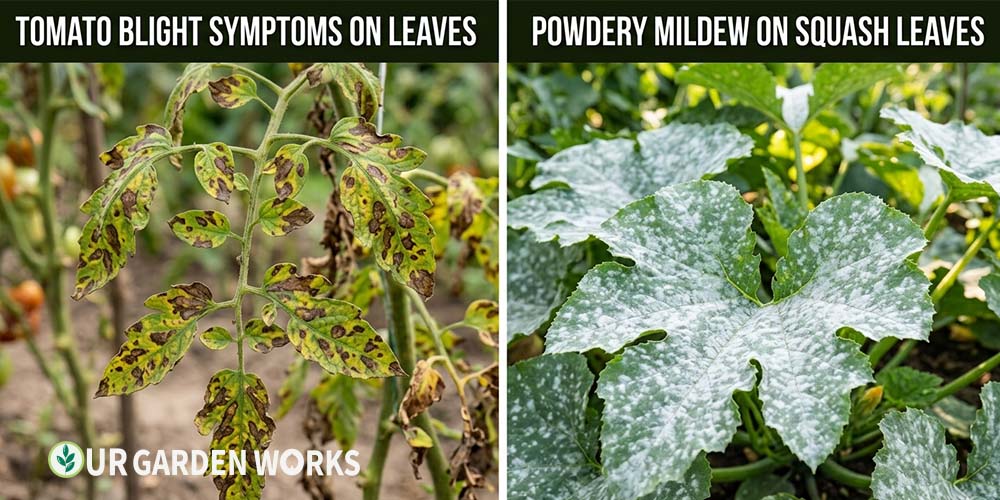
The most widespread garden disease affects squash, cucumbers, roses, phlox, and many others. White powder on upper leaf surfaces (not undersides).
Caused by multiple fungal species; contrary to popular belief, it thrives in warm, dry days with cool nights, not wet conditions.
Treatment: baking soda spray (1 tbsp per quart water + drop of dish soap), potassium bicarbonate, or neem oil. Prevention: air circulation, resistant varieties, avoid overhead watering. For rose-specific fungal treatment, our best fungicide for hydrangeas and ornamentals guide covers the product options.
Early Blight (Tomatoes)
Brown spots with concentric rings and yellow halos on lower tomato leaves, progressing upward. Alternaria fungus — survives in soil and on plant debris. Triggered by wet foliage.
Treatment: copper fungicide or chlorothalonil-based products, remove affected lower leaves. Prevention: mulch to prevent soil splash (the primary infection route), water at soil level, stake and prune for air circulation. Our best fungicide for tomatoes guide covers product options in detail.
Blossom End Rot
Not a disease — a physiological disorder caused by calcium deficiency at the developing fruit, almost always from inconsistent soil moisture (not calcium-poor soil). The calcium is typically present in the soil; inconsistent watering prevents uptake.
Treatment: consistent watering, calcium foliar spray for immediate support. Prevention: consistent deep watering and mulch. See our complete summer vegetable garden watering guide for the watering consistency method that prevents this.
Frequently Asked Questions
My tomato plant looks sick — is it blight or something else?
The key distinction between early blight, late blight, and other tomato diseases is the pattern and speed: Early blight appears as brown spots with concentric rings on lower leaves and moves slowly upward over weeks.
Late blight appears as water-soaked grey-green lesions that can collapse an entire plant in days — it is a serious disease that requires immediate action including removing the plant. Septoria leaf spot produces small, round spots with white centres and dark borders on lower leaves. Use the symptom table above and our best tomato blight spray recipes guide for specific treatments.
Should I remove a diseased plant or try to treat it?
Remove without attempting treatment: plants with viral diseases (mosaic virus, tomato spotted wilt), plants with late blight in wet conditions (the spores spread rapidly), and plants where more than 50% of the foliage is affected by any disease.
Treat and keep: plants with early-stage fungal disease where less than 30% of foliage is affected, plants with blossom end rot (which is not contagious and responds to management), and plants with localised bacterial spots. When removing diseased plants, bag them — do not compost diseases that can recycle through your garden.
Free Tools & Guides:
- 10 Best Fungicides for Tomatoes — Organic & Chemical Options (2026)
- 9 Best Tomato Blight Spray Recipes That Actually Work (2026)
- 10 Best Fungicides For Hydrangeas in 2026 – (Reviews & Top Picks)
- Unleash Your Garden’s Potential: 10 Best Neem Oil Picks for 2026
- Vegetable Gardening Guide: Grow More Food with Less Frustration
Final Thoughts
We hope this tool helps you get ahead of plant disease before it becomes a crisis. Early identification and action are genuinely the difference between a manageable fungal issue and a lost plant.
For the complete library of disease and pest treatment guides, our garden pest control guide and plant care guide link to every article we have published.
Share this free tool with a fellow gardener who has watched a plant deteriorate all season without knowing whether it was disease, pests, or something else entirely — and tell us in the comments how it helped. Happy growing!
