
(Enter your crop type, bed size in square feet, soil type, and your average daytime temperature — the calculator shows your weekly water requirement in gallons and the optimal irrigation frequency.)
Watering by feel is one of the most common causes of garden underperformance. Not because gardeners water too little — most home gardeners overwater rather than underwater — but because sporadic watering produces inconsistent soil moisture, and inconsistent moisture is what causes blossom end rot in tomatoes, bitter cucumbers, cracked fruit, and poor germination.
This calculator takes your specific crops, bed size, soil type, and current temperature and gives you a concrete number: how many gallons per week your garden needs. Not a vague range — a specific figure you can hit with your hose, drip system, or sprinkler.
Editor’s Note: Most vegetables need 1–1.5 inches of water per week, which equals roughly 0.6 gallons per square foot per week. A 4×8 raised bed (32 sq ft) planted with tomatoes needs approximately 19 gallons per week in moderate temperatures — more in heat above 85°F, less if you have had meaningful rainfall. Deep watering 2–3 times per week is more effective than daily shallow watering.
How to Convert Inches to Gallons — The Math Behind the Calculator
Water requirements are stated in inches per week — a universal measurement that works regardless of bed size. One inch of water equals 0.623 gallons per square foot. For a standard 4×8 raised bed (32 sq ft) needing 1 inch per week: 32 × 0.623 = 19.9 gallons per week.
Temperature adjusts this baseline significantly. Evapotranspiration — the rate at which water leaves the soil and plant surfaces — roughly doubles for every 18°F increase in temperature. A garden that needs 1 inch at 65°F needs approximately 1.5 inches at 85°F and 2 inches at 95°F+ during a heat wave.
| Crop | Weekly Need (inches) | Critical Period | Consequence of Inconsistency |
|---|---|---|---|
| Tomatoes | 1.5–2 inches | Fruit set through ripening | Blossom end rot, fruit cracking |
| Peppers | 1–1.5 inches | Flowering through harvest | Flower and fruit drop |
| Cucumbers | 1.5–2 inches | Entire season | Bitter fruit, poor yield |
| Beans | 1 inch | Flowering through pod fill | Poor pod set |
| Lettuce | 1–1.5 inches | Entire season — critical in heat | Bolting, bitterness |
| Corn | 1.5 inches | Tasseling through silk | Poor kernel fill |
| Carrots | 1 inch | Germination + root development | Forked, bitter roots |
| Garlic/Onions | 1 inch | Bulb sizing — stop 2 wks before harvest | Small bulbs, rot if overwatered late |
Deep Watering vs Daily Shallow Watering — Why It Matters
Daily light watering that wets only the top 1–2 inches of soil trains plant roots to stay shallow — in the layer most vulnerable to heat, drought, and damage. Deep watering 2–3 times per week — enough water to reach 6–8 inches down — encourages roots to grow downward into cooler, more consistently moist soil. These deep-rooted plants tolerate drought, handle heat stress, and produce more consistently all season.
To check if you are watering deeply enough: 1 hour after watering, push a long screwdriver or your finger into the soil. It should be moist to at least 6 inches. If it is dry below 2–3 inches, you are not applying enough water per session — water longer, not more often.
💡 Mulch cuts your watering requirement in half
A 3-inch layer of straw, shredded leaves, or wood chips reduces evaporation from the soil surface by 50–70%. A mulched bed may only need watering once every 4–5 days at moderate temperatures rather than every 2–3. Apply mulch after the soil has warmed in spring — mulching cold soil keeps it cold. See our complete summer vegetable garden watering guide for the full system including timing and irrigation method comparisons.
Irrigation Methods Compared
How you apply water matters as much as how much you apply. Overhead watering in the evening leaves wet foliage through the night — ideal conditions for fungal disease including blight, powdery mildew, and botrytis. The best methods deliver water directly to the soil, where roots can use it, not to the foliage.
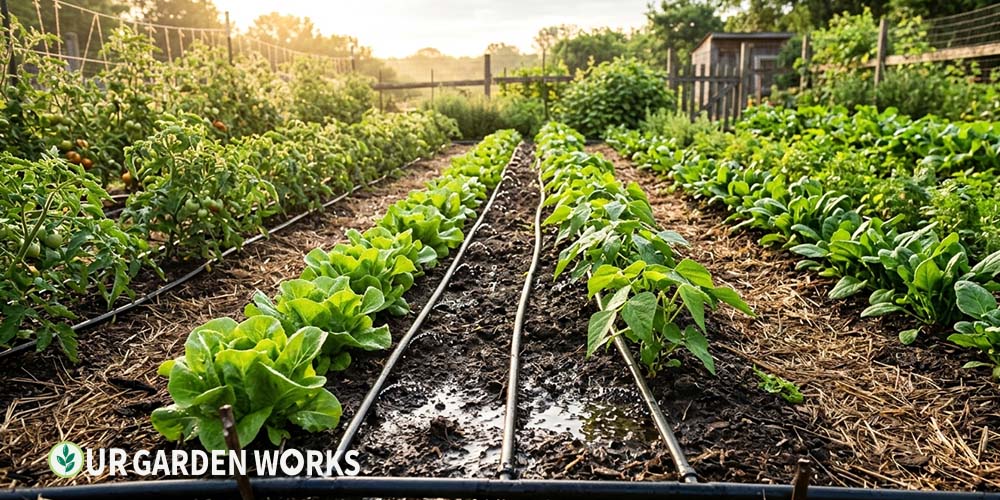
- Drip irrigation: Most efficient (90%+ of water reaches roots), lowest disease risk, easiest to automate. Best investment for any serious vegetable garden.
- Soaker hose: 85% efficiency, simple to install, works well in row arrangements and raised beds. Our recommendation for beginner and intermediate gardens.
- Hand watering at soil level: Effective when done carefully — direct water to the base of plants, never overhead. Time-consuming for large gardens.
- Overhead sprinkler: 40–60% efficiency, high disease risk if used in evenings. Acceptable for lawns; avoid for vegetable beds.
For watering equipment recommendations matched to your garden size and water pressure, see our guide to the best lawn sprinkler for low water pressure — many vegetable garden irrigation systems face the same pressure limitations as lawn sprinklers.
Frequently Asked Questions
How do I know if I'm overwatering vs underwatering?
Overwatering and underwatering can look identical above ground — both cause wilting, yellowing, and poor growth. The distinction is in the soil: push your finger 2 inches into the soil beside the plant. Moist and cool = adequate moisture. Wet and cold = overwatering. Dry and warm = underwatering. Root rot from overwatering is the more common problem in raised beds and containers, where drainage can be restricted.
Should I water every day in summer heat?
In most cases, no. Daily watering trains shallow roots and keeps the soil surface constantly damp, which promotes fungal disease. Exceptions: containers in full sun heat up and dry out faster and may need daily watering in extreme heat. In-ground and raised bed gardens generally do better with deep watering every 2–3 days than with daily light watering, even in temperatures above 90°F.
Why do my tomatoes wilt in the afternoon even when I water daily?
Afternoon wilting in temperatures above 90°F is normal physiological response — tomatoes close their stomata to reduce water loss during peak heat. If they recover by evening without watering, they are fine. Only intervene if they are still wilted the following morning. This is one of the most misread signals in vegetable gardening — watering in response to normal afternoon wilt leads to the overwatering problems described above. See our complete when to pick tomatoes guide for more on tomato management through the growing season.
Free Tools & Guides:
Final Thoughts
We hope this calculator gives you the confidence to water based on your plants actual needs rather than anxiety and guesswork.
Consistent, appropriate moisture is one of the highest-leverage habits in vegetable gardening — everything performs better when water is right. For the full watering guide with timing and method comparisons, our summer vegetable garden watering guide has every detail.
Share this free tool with a fellow gardener who has been watering on a gut-feel schedule and wondering why plants look stressed even when they water consistently — and leave a comment below with your results. Happy growing!
