
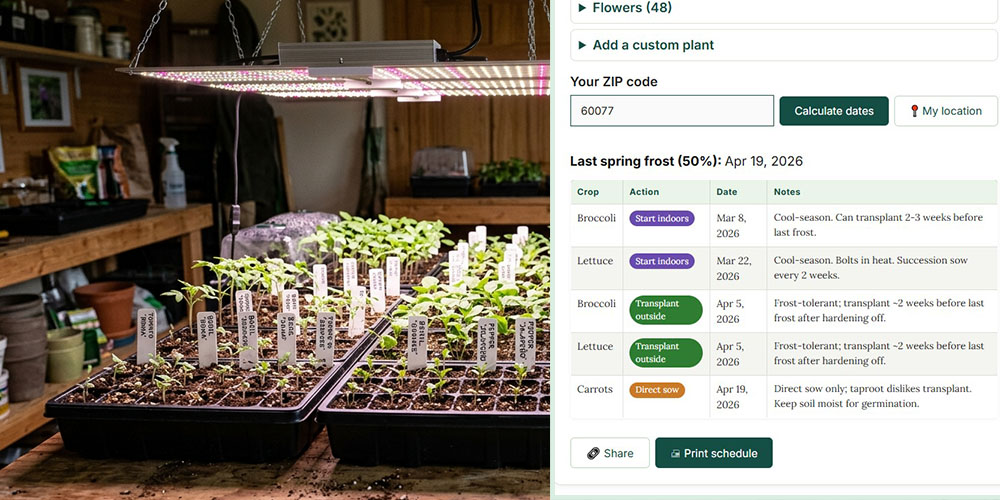
Seed starting timing is one of those things that sounds simple — start seeds 6–8 weeks before last frost — until you realize you’re growing 12 different crops, each with different timing, different germination needs, and different transplant windows.
Keeping track of it all in your head leads to the most common seed-starting mistake: everything going in at the same time, some of it 4 weeks too early, some of it 2 weeks too late.
The calculator above does the math for you. Enter your ZIP code and select your crops, and it tells you exactly when to start each one indoors, when to transplant outdoors, and the dates for every step in between. Below, we’ll walk through how to get the most out of it — and the seed-starting principles that the timing is built on.
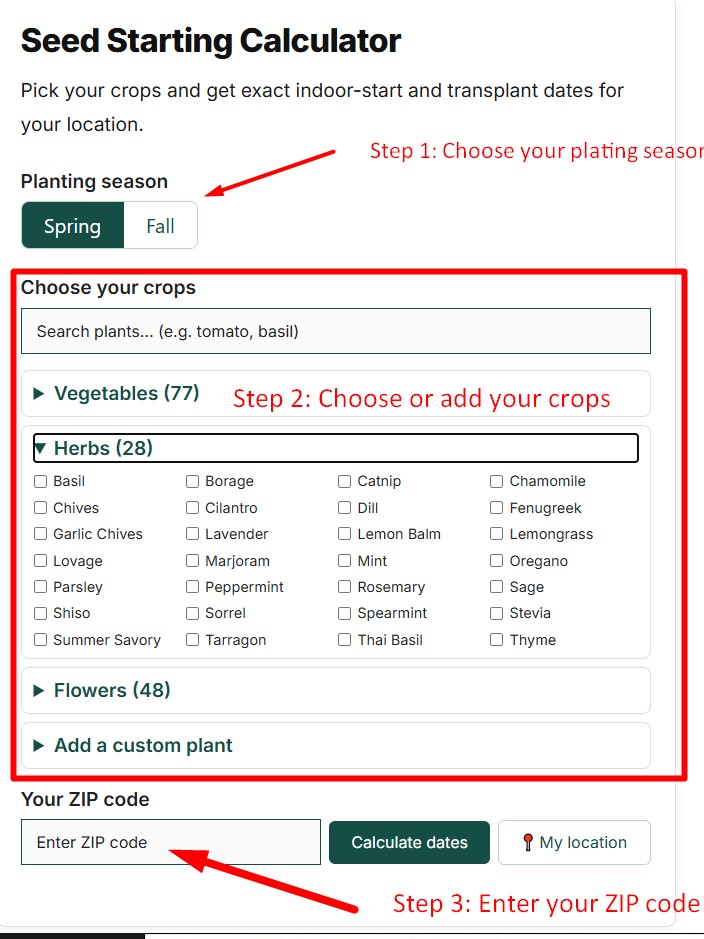
How To use OGW Seed Starting Calculator: (1) Select Planting season, (2) select from our list or add the crops you’re growing then (3) Enter your ZIP code, and the calculator gives you precise indoor start dates and outdoor transplant dates for each one — automatically accounting for your local frost dates and each crop’s specific timing requirements. Use the results to build your seed-starting schedule.
How the Calculator Works
The calculator takes two pieces of information: your location (via ZIP code) and your crop selections.
From your ZIP, it retrieves your last spring frost date and first fall frost date from NOAA climate data — the same data our frost dates tool uses.
It then applies crop-specific timing rules to calculate:
- Indoor start date: How many weeks before last frost each crop should be started inside
- Transplant date: When each crop can safely go outdoors — either before last frost (cool-season crops) or after (warm-season crops)
- Direct sow date: For crops that shouldn’t be started indoors at all
- Fall planting dates: For crops planted in late summer for fall harvest
The Crops That Need the Longest Head Start
These are the crops most beginners start too late. If any of these are on your list, they go in first — sometimes weeks before anything else:
| Crop | Weeks Before Last Frost | Why So Early |
|---|---|---|
| Celery | 10–12 weeks | Extremely slow growth, needs a long head start |
| Onions & Leeks | 10–12 weeks | Slow to establish; thin grass-like seedlings for weeks |
| Peppers & Eggplant | 8–10 weeks | Slower than tomatoes; need full heat before outdoor growth |
| Tomatoes | 6–8 weeks | The standard — most referenced timing in seed starting |
| Basil | 6 weeks | Fast-growing once established but cold-sensitive at transplant |
⚠️ Peppers always go in before tomatoes
The most consistent seed-starting mistake we see: starting peppers and tomatoes on the same day. Peppers are significantly slower to establish and mature than tomatoes. Start peppers 2 weeks before tomatoes — even if that feels counterintuitive. A pepper started 2 weeks later will be noticeably behind at transplant time and produce less through the season.
The Crops You Should NOT Start Indoors
Starting these crops indoors wastes your seed-starting space and produces inferior results compared to direct sowing. The calculator will tell you when to direct sow these instead of giving you an indoor start date:
- Beans: Fast-growing, root-sensitive; direct sow when soil hits 60°F after last frost
- Carrots: Taproot crops cannot be transplanted; sow directly 4–6 weeks before last frost
- Beets: Same as carrots — direct sow only
- Radishes: 25-day crop; faster to just direct sow. No head start advantage.
- Corn: Doesn’t transplant; always direct sow into warm soil
- Peas: Direct sow 4–6 weeks before last frost into cool soil — they prefer it cold
For the complete regional timing chart covering every crop, see our when to start seeds indoors guide.
How to Use Your Calculator Results
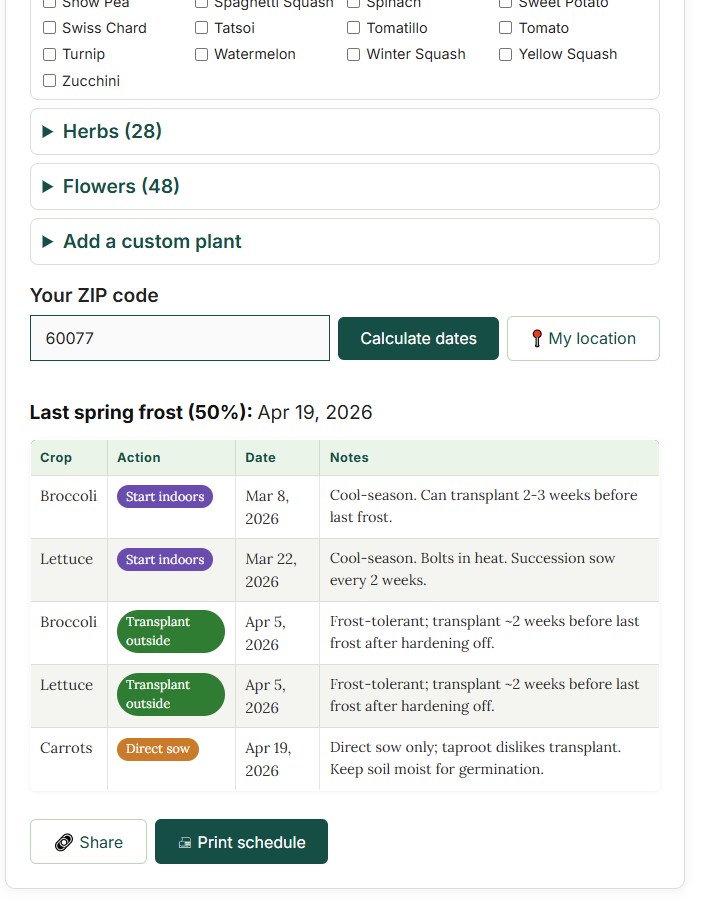
Once the calculator gives you dates, here’s how to turn those dates into an actual action plan:
From Calculator Results to Real Schedule
- Print or screenshot your results. Tape them somewhere visible — inside a cabinet door, on the refrigerator, in your garden journal. Dates you can see are dates you’ll actually follow.
- Set calendar reminders. Add the indoor start date for each crop to your phone calendar 1 week early. That gives you time to gather supplies before the actual date.
- Work backwards from the first start date. The earliest date in your results tells you when you need your seed-starting setup ready — lights on, trays cleaned, seed-starting mix on hand.
- Group crops with similar start dates. Rather than starting seeds every week, group crops whose start dates fall within 1–2 weeks of each other into the same sowing session. This reduces the number of setup and cleanup sessions significantly.
- Plan tray space. Count how many cells or pots you’ll need for your total crop selection. A standard 72-cell tray holds 72 seedlings — plan how many trays you’ll need under your grow light at peak capacity.
What Happens After Germination — The Steps the Calculator Can’t Do for You
The calculator gives you start and transplant dates. Here’s what happens in between:
Light — The Most Common Indoor Growing Mistake
The moment seeds germinate, they need intense light — 14–16 hours per day under a grow light positioned 2–4 inches above the seedling tops, or a strong south-facing window.
Without adequate light, seedlings become leggy and weak before they ever reach the garden. A basic LED grow light ($$) is the most impactful seed-starting investment. For the full setup guide, see our how to start seeds indoors guide.
Hardening Off
Your calculator’s transplant date assumes hardened-off seedlings — plants that have been gradually introduced to outdoor conditions over 7–10 days.
Start hardening off 10 days before your transplant date. Skipping this step causes transplant shock even in healthy, well-grown seedlings.
Soil Temperature at Transplanting
The transplant date is the earliest reasonable date, not the guaranteed date. Warm-season crops (tomatoes, peppers, cucumbers) need soil temperature above 60°F (65°F for peppers).
If your transplant date arrives but the soil is still cold from a late spring, wait for the soil temperature — not the calendar. A soil thermometer tells you when the soil is actually ready.
Frequently Asked Questions
Can I start all my seeds on the same day to simplify the schedule?
You can, but the results won’t be as good. Crops started at the wrong time — especially too early — become root-bound, stressed, and hard to establish outdoors.
A pepper started 12 weeks before last frost (instead of 8–10) will be a visibly different plant at transplant than one started on time. The calculator dates are specific because they’re built on the biology of each crop, not convenience.
What if I missed my indoor start date?
Start anyway if you’re within 2–3 weeks of the ideal date. A late-started seedling that goes into warm outdoor soil at a smaller size will often catch up faster than you expect.
If you’re more than 3 weeks late for tomatoes or peppers, buying transplants from a garden center is a better option than trying to rush a seedling to transplant size in time.
What's the difference between the seed starting calculator and the planting calendar?
The seed starting calculator focuses on indoor seed starting — it tells you when to start seeds inside and when to transplant them outside, covering the full indoor-to-outdoor process.
The planting calendar gives you a month-by-month view of all garden tasks for your location — including direct sowing dates, transplant windows, and fall planting. They’re complementary tools that together give you a complete seasonal planning picture.
Does the calculator account for my specific microclimate?
It uses ZIP-level frost date data, which is the best approximation available without a personal weather station. If you know your specific garden runs colder or warmer than the regional average (a frost pocket, a south-facing raised bed, proximity to a large lake), adjust your transplant dates by 1–2 weeks accordingly. Your own multi-year observations are valuable data that no tool can replicate.
Final Thoughts
We hope the calculator takes the arithmetic stress out of seed starting and lets you focus on the actual gardening.
Getting your timing right is one of the highest-leverage things you can do in the entire growing season — the difference between well-timed transplants and rushed or root-bound ones shows up in harvest yields for months.
For the complete setup guide for your indoor growing space, our how to start seeds indoors guide covers everything from lights to trays to hardening off.
Share the calculator with a fellow gardener who’s been winging their seed-starting dates — and let us know in the comments which crops you’re starting this season. Happy growing!

1 thought on “Seed Starting Calculator — When to Start Every Crop Indoors”