

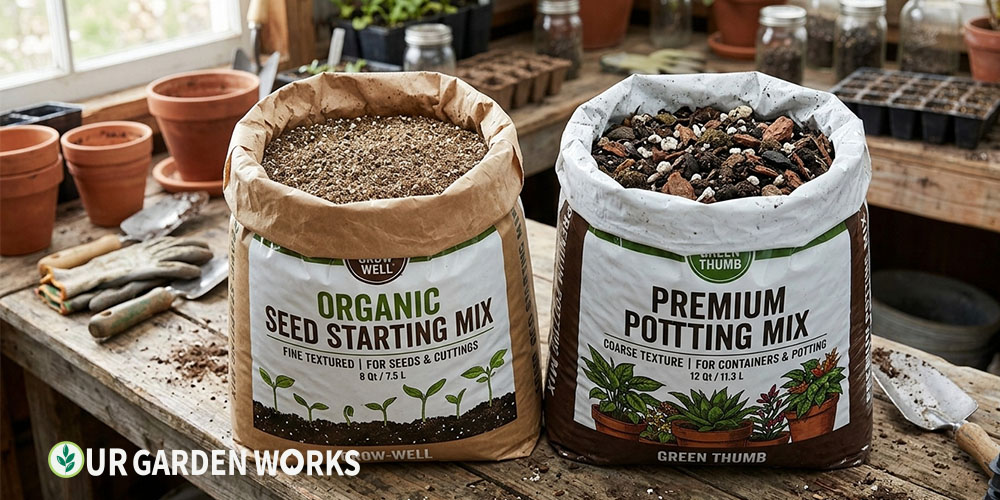
They’re both brown. They’re both sold in bags at the garden center. They look almost identical. But using potting mix to start seeds — or seed-starting mix in your containers — causes specific, predictable problems that beginners spend entire seasons troubleshooting without knowing why.
This guide explains exactly what each product is, what makes them different, and when to use which one — so you never have to guess again.
Quick Answer: Use seed-starting mix for germination and seedling growth up to transplanting. Switch to potting mix when transplanting into larger containers or raised beds. Never use garden soil in containers. Never use seed-starting mix for long-term container growing — it has no nutrients and breaks down too quickly.
What Is Seed-Starting Mix?
Seed-starting mix is a fine-textured, lightweight, sterile growing medium specifically formulated for germination and early seedling development. Its key characteristics:
- Fine texture: Small particles allow tiny roots to push through easily and small seeds to make good contact with the medium
- Sterile: Free of pathogens, weed seeds, and competing organisms — critical for preventing damping off in delicate seedlings
- Low or zero nutrients: Seeds contain all the nutrients they need for initial germination. Adding nutrients before seedlings develop roots can actually inhibit germination.
- Excellent moisture retention: Holds moisture consistently without waterlogging — the right balance for germinating seeds
- Typical ingredients: Peat moss or coir, perlite or vermiculite, sometimes a wetting agent
⚠️ Seed-starting mix has no long-term nutrients
Once seedlings develop true leaves, they need nutrients — and seed-starting mix doesn’t provide them. Start liquid feeding at quarter-strength within 2 weeks of germination. Don’t expect the medium itself to feed your seedlings beyond the earliest stages.
What Is Potting Mix?
Potting mix is a larger-particle, nutrient-enriched growing medium for established plants in containers. Its key characteristics:
- Coarser texture: Larger particles allow better drainage and aeration for established root systems — but too coarse for small seeds to make good contact
- Contains fertilizer: Most commercial potting mixes include slow-release fertilizer that feeds plants for several months
- Not sterile: May contain composted bark, wood fines, or other organic materials that introduce biological activity — beneficial for established plants, potentially problematic for germinating seeds
- Heavier: Provides more structural support for larger plants with established root systems
- Typical ingredients: Peat or coir, perlite, bark fines, slow-release fertilizer, limestone
Can You Use Potting Mix to Start Seeds?
Technically yes — seeds will germinate in potting mix. But you’ll typically see lower germination rates, more leggy seedlings, and higher rates of damping off compared to proper seed-starting mix. Here’s why:
- The coarser texture means smaller seeds may not make good soil contact — essential for germination
- Pre-added fertilizer in some potting mixes can actually inhibit germination in sensitive seeds
- Non-sterile potting mix may harbor damping off fungi that destroy seedlings at the soil line
- Potting mix tends to compact more in small cells, restricting early root growth
For occasional or low-stakes seed starting, potting mix will work adequately. For reliable, high-germination-rate seed starting — especially for expensive or rare seeds — use proper seed-starting mix.
Can You Use Seed-Starting Mix in Containers?
For short-term growing (seedlings waiting to transplant): yes. For long-term container growing of established plants: no. Seed-starting mix:
- Has insufficient nutrients for established plants
- Breaks down and compacts much faster than potting mix, eventually restricting roots
- Doesn’t provide the structural support larger plants need
Always transplant seedlings into potting mix (or raised bed soil) once they move to their permanent growing location.
What About Garden Soil?
Never use garden soil in containers or seed-starting trays. Garden soil:
- Compacts in containers, creating a dense block that suffocates roots
- May contain weed seeds, disease pathogens, and pest eggs
- Doesn’t drain properly in a container environment
- Has unpredictable nutrient composition
Garden soil belongs in garden beds. Use formulated mixes for all container and seed-starting applications.
Frequently Asked Questions
Is coir-based seed-starting mix better than peat-based?
Both work well. Coir (coconut fiber) is a renewable byproduct of coconut processing and is considered the more sustainable choice. Peat is harvested from peat bogs, which are slow to regenerate. Coir holds moisture slightly differently — it drains a little faster than peat. Either produces excellent germination results.
Can I make my own seed-starting mix?
Yes: mix 2 parts peat or coir, 1 part perlite, and 1 part fine vermiculite. This produces a sterile, well-draining mix with excellent moisture retention. It’s cheaper per volume than commercial mix when buying ingredients in bulk.
When should I switch from seed-starting mix to potting mix?
When you pot seedlings up into 3–4 inch pots or larger. Keep seedlings in seed-starting mix in their small cells, then transition to potting mix when they move to bigger containers. At this point they need the nutrients and structural support potting mix provides.
🥬 Related Articles in Our Seed Starting Guide:
- Seed Starting Guide – Everything You Need to Start Seeds Indoors
- How to Start Seeds Indoors: Complete Step-by-Step Guide (2026)
- Best Seed Starting Trays — 72-Cell, 50-Cell, Self-Watering & What to Actually Buy
- 15 Seed Starting Mistakes That Kill Seedlings (And How to Avoid Them)
- How to Grow Tomatoes From Seed to Harvest (Complete 2026 Guide)
- Vegetable Gardening Guide
Final Thoughts
We hope this guide clears up the seed-starting mix vs potting mix question once and for all. The right medium for the right stage makes a bigger difference than most gardeners realise.
For all our vegetable growing guides, our vegetable gardening guide links to everything.
Share this post with a fellow gardener who’s ready to get growing — and let us know in the comments which mix you’ve been using and whether you’ve noticed a difference. Happy growing!
