

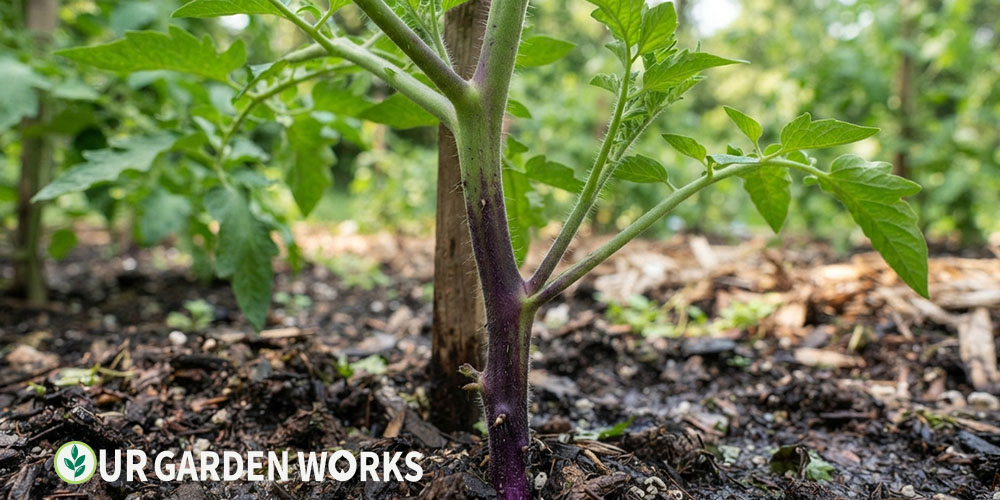
Purple stems on a tomato plant often appear alongside the purple leaf coloring covered in our dedicated leaf guide, since both stem from the same underlying causes.
But stems specifically add one more wrinkle worth addressing: for some tomato varieties, purple stem coloring is simply a normal genetic trait rather than any sign of stress at all.
We’ll cover how to tell a normal varietal trait apart from the same phosphorus-and-cold-stress mechanism behind purple leaves, since this distinction matters more for stems than it typically does for foliage.
Quick Answer: Purple tomato stems are usually caused by phosphorus deficiency or cold stress, the same connected causes behind purple leaves. However, some tomato varieties — particularly certain heirlooms and dark-fruited types — naturally show purple-tinted stems as a genetic trait unrelated to any stress or deficiency. Check whether the purple coloring is new or has been present since the plant was young, and whether leaves show similar purpling.
Cause 1 — Genetic Varietal Trait (Often Overlooked)
Several tomato varieties, including many heirloom types and some varieties bred for dark or “black” fruit coloring, carry elevated anthocyanin pigment production as a normal genetic characteristic, which can show up as purple tinting in stems (and sometimes leaf veins) even on a perfectly healthy, unstressed plant.
This is the cause most likely to be mistaken for a problem, simply because it looks identical to the stress-related purple coloring covered next.
How to confirm it’s a varietal trait:
- Purple stem coloring has been present consistently since the plant was young, not something that newly appeared
- Plant shows vigorous, healthy growth with no other stress signs
- Variety is a known heirloom or dark-fruited type, or the seed packet/plant tag mentions distinctive coloring
Fix: None needed — this is simply how the variety naturally looks.
Cause 2 — Phosphorus Deficiency
Just as with leaves, phosphorus deficiency triggers anthocyanin pigment buildup that shows up as purple coloring, in this case concentrated in the stem rather than (or in addition to) the leaves. This typically develops gradually rather than being present from the seedling stage, distinguishing it from the genetic trait cause above.
How to confirm it’s phosphorus deficiency:
- Purple coloring developed or intensified over time, rather than being present from the start
- Often accompanied by similar purple tinting in leaves, especially leaf undersides
- Plant growth may seem slower than expected
Fix: Apply a phosphorus-rich fertilizer following label rates. See our purple leaves on tomato plants guide for the complete treatment approach, since the fix is identical regardless of whether purpling shows primarily in stems, leaves, or both.
Cause 3 — Cold Stress
Cold soil temperatures impair phosphorus uptake regardless of how much phosphorus is actually present, producing the identical purple symptom as true deficiency. This is especially common on young transplants set out before soil has fully warmed in spring, and it typically resolves on its own as temperatures rise.
How to confirm it’s cold-related:
- Purple stem coloring appeared shortly after a recent cold spell or early transplanting
- Most pronounced on younger plants or recent transplants specifically
Fix: Patience — this resolves as soil warms, without needing fertilizer intervention. Adding phosphorus fertilizer doesn’t speed up recovery if cold soil uptake impairment, rather than true deficiency, is the actual cause.
Telling the Three Causes Apart at a Glance
| Cause | Timing | Leaf Involvement | Resolves With |
|---|---|---|---|
| Genetic/varietal trait | Present from seedling stage | Sometimes, consistently | No fix needed |
| Phosphorus deficiency | Develops gradually over time | Often, especially leaf undersides | Phosphorus fertilizer |
| Cold stress | Following cold spells, early transplants | Sometimes | Soil warming, patience |
Common Tomato Varieties Known for Purple Stem Coloring
Knowing which specific varieties commonly display this genetic trait can help resolve the diagnosis quickly if you happen to be growing one of them.
Many “black” or dark-fruited tomato varieties — including popular heirlooms often marketed with names referencing their dark coloring — carry elevated anthocyanin production throughout the plant, not just in the fruit, which frequently extends to visible purple tinting in stems and sometimes leaf veins from a young age.
Certain other heirloom varieties, even ones that don’t produce notably dark fruit, can still show some degree of naturally purple-tinted stems as part of their specific genetic background, since anthocyanin production and fruit color aren’t perfectly linked traits.
If you purchased transplants or seeds without detailed variety information, a quick search for your specific variety name alongside terms like “purple stem” or “anthocyanin” often quickly confirms whether this is a documented characteristic of that particular tomato, removing much of the remaining uncertainty.
Modern hybrid varieties bred primarily for disease resistance and uniform commercial production tend to show this trait less frequently than heirlooms, simply because breeding programs for these more standardized varieties haven’t typically selected for or against anthocyanin expression the way some heirloom lines have incidentally retained or emphasized it over generations of seed-saving.
Should You Get a Soil Test If You’re Still Unsure?
If you’ve checked your variety’s known characteristics, considered the timing of when purple coloring appeared, and you’re still genuinely uncertain whether you’re looking at a genetic trait or true phosphorus deficiency, a basic soil phosphorus test removes the remaining ambiguity more definitively than visual assessment alone ever can.
This is a reasonably priced, widely available test that gives you a concrete answer rather than continuing to guess based on appearance.
A soil test showing adequate phosphorus levels, combined with stem coloring that’s remained stable rather than progressively worsening, supports the genetic trait explanation with much more confidence than visual inspection alone provides.
Conversely, a test confirming genuinely low phosphorus justifies moving forward with correction regardless of what variety you’re growing, since even a variety with some natural tendency toward purple coloring can still experience a true, additional deficiency on top of its baseline genetic trait.
Why Checking Plant History Matters More for Stems Than Leaves
Since purple stems can represent a harmless genetic trait in a way that purple leaves more rarely do, the question of timing — was this purple coloring present from the very beginning, or did it develop later — carries more diagnostic weight here than it typically does when assessing leaf symptoms alone.
A gardener who’s grown the same heirloom variety for several seasons and recalls it always having some purple stem tint has effectively already answered the question, while someone noticing new purple coloring on a previously all-green-stemmed plant is looking at a genuine change worth investigating further.
If you didn’t start the plant from seed yourself and don’t have this history (common with nursery-purchased transplants), checking the variety name against general descriptions, or simply observing whether new growth continues showing the same purple tint consistently over the following weeks, helps distinguish a stable genetic trait from an active, ongoing stress response that would be expected to resolve or worsen depending on whether the underlying cause is addressed.
Frequently Asked Questions
Will purple stems affect my tomato harvest?
Genetic varietal purple stems have no effect on harvest at all, since the plant is perfectly healthy. True phosphorus deficiency, if left unaddressed for an extended period, can reduce flowering and fruit set since phosphorus plays a direct role in reproductive development, making correction worthwhile if this turns out to be the actual cause rather than a harmless trait.
Can I tell genetic purple stems apart from deficiency just by color intensity?
Not reliably — color intensity varies considerably within both categories, with some varietal traits producing quite vivid purple coloring and some mild deficiency cases producing only subtle tinting.
Timing and pattern (consistent from the start versus newly developing, and whether it resolves with warmer weather or fertilizing) are more reliable diagnostic clues than color intensity alone.
Should I avoid buying tomato varieties known for purple stem coloring if I want to avoid confusion later?
Not necessarily — many excellent, flavorful heirloom and specialty varieties carry this trait, and avoiding them solely to sidestep future diagnostic confusion would mean missing out on some genuinely great tomatoes.
Simply noting at planting time whether your specific variety is known for this trait, and keeping that context in mind if purple coloring appears later, resolves the potential confusion without needing to avoid these varieties.
Does purple stem coloring ever indicate a disease rather than a nutrient or genetic cause?
True disease-related purple stem discoloration is uncommon compared to the three causes covered in this guide, though some plant stress from disease can occasionally produce secondary purpling as one symptom among several others.
If purple stems are accompanied by wilting, lesions, unusual stem texture, or other clear disease signs, it’s worth checking our wilting tomato plants guide for the more serious vascular disease possibilities rather than assuming a simple nutrient or genetic explanation applies.
Related Articles in Our Tomato Growing Guide
Final Thoughts
We hope this guide has helped you figure out whether your tomato’s purple stems are simply its natural look or a sign of something to address — checking when the coloring first appeared really does answer most of the question.
For all our tomato and vegetable guides, our vegetable gardening guide links to everything.
Share this post with a fellow gardener who’s noticed purple stems on their tomatoes — and let us know in the comments which cause matched what you found. Happy growing!
