

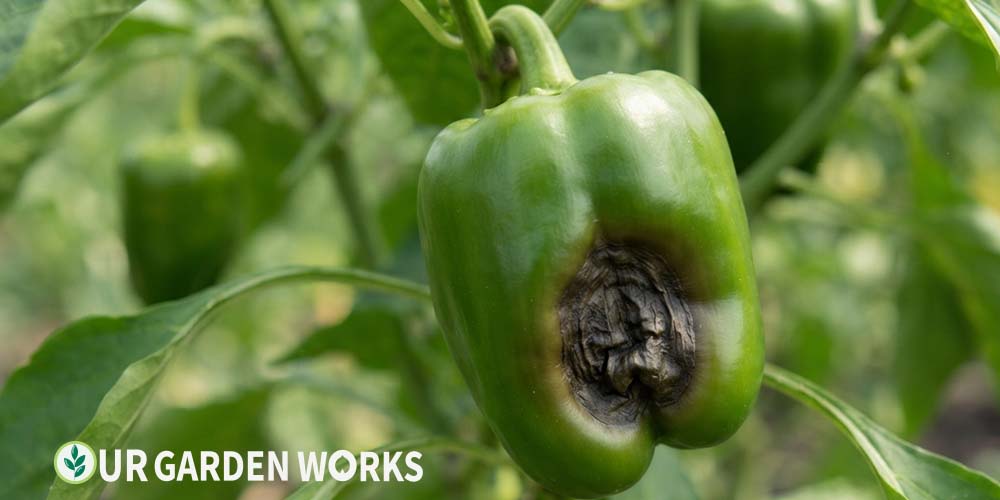
Blossom end rot on peppers looks identical in concept to the same condition on tomatoes — a sunken, dark, leathery patch at the bottom of the fruit, opposite the stem — and it shares the same widely misunderstood underlying cause.
Most gardeners reach for calcium supplements first, when the actual problem is almost always about water delivery, not the soil’s calcium supply.
We’ll walk through why this happens and the fix that actually addresses the real mechanism, rather than the calcium myth that persists in a lot of general gardening advice.
Quick Answer: Blossom end rot on peppers is caused by inconsistent water delivery to developing fruit, not usually a lack of calcium in the soil — most garden soils have adequate calcium, but calcium can only move through the plant via water, so inconsistent watering interrupts its delivery to the fruit specifically. Water consistently and deeply, mulch to buffer soil moisture, and avoid letting soil dry out completely between waterings.
Try our free tool: Garden Watering Calculator — How Much Water Your Crops Actually Need
Why “Add Calcium” Is the Wrong First Response
Calcium moves through a plant exclusively dissolved in water, transported via the xylem along with everything else the plant draws up from its roots.
This means that even when soil calcium levels are perfectly adequate, inconsistent watering — alternating between dry stretches and heavy watering — interrupts the steady water flow calcium needs to actually reach developing fruit at the rate required during rapid growth.
Most garden soils, especially anything that’s been reasonably maintained with organic matter over time, already contain enough calcium to meet a pepper plant’s needs.
Adding more calcium to soil that already has adequate levels doesn’t address the actual delivery problem, which is why calcium supplements alone so often fail to resolve blossom end rot despite being the most commonly recommended fix.
💡 A soil test settles the calcium question definitively
If you want certainty rather than assumption, a basic soil test checking calcium levels removes the guesswork. In the rare case where soil calcium genuinely is deficient, amending with garden lime or gypsum makes sense; in the much more common case of adequate calcium, your effort is better spent on watering consistency instead.
The Real Mechanism — Why Inconsistent Watering Causes This Specific Symptom
Developing pepper fruit needs a steady calcium supply during its most rapid growth phase to properly build healthy cell walls throughout the fruit tissue.
When watering is inconsistent, the plant’s water (and calcium) delivery to fruit gets interrupted at exactly the wrong moments, and the blossom end — the part of the fruit furthest from the stem and the last point water reaches — is where this calcium shortfall shows up first and most severely.
This explains why blossom end rot often appears on a plant that otherwise looks completely healthy with no other visible nutrient deficiency symptoms — the problem isn’t a general plant health issue, but a specific, localized consequence of uneven water delivery during one particular fruit’s critical development window.
Fixing Blossom End Rot — What Actually Works
Directions
- Water deeply and consistently, aiming for even soil moisture rather than allowing dry-out periods between waterings.
- Apply a 2-3 inch mulch layer around the base of plants to buffer soil moisture swings between waterings, especially during hot weather when soil dries faster.
- For container-grown peppers specifically, check soil moisture more frequently than you would for in-ground plants, since containers dry out considerably faster.
- If a soil test confirms genuine calcium deficiency (less common but possible), amend with garden lime or gypsum according to test recommendations.
Existing affected fruit won’t recover, but consistent watering going forward typically prevents the condition from affecting subsequent fruit on the same plant within just a couple of weeks of establishing better watering habits.
Peppers and tomatoes are both nightshade family members with broadly similar fruit development biology, which is exactly why both crops experience blossom end rot through the identical water-delivery mechanism rather than two unrelated conditions that happen to look similar.
If you’re growing both crops and one shows blossom end rot, it’s worth checking the other for the same symptom, since whatever watering inconsistency affected one is quite likely affecting the other as well if they’re in the same bed or receiving the same watering schedule.
This shared mechanism also means the same fix — consistent watering and mulching — addresses both crops simultaneously without needing a different approach for each, which simplifies garden-wide management if blossom end rot is showing up across multiple plant types at once.
Are Some Pepper Varieties More Prone Than Others?
Bell peppers and other larger-fruited sweet pepper varieties tend to show blossom end rot somewhat more frequently and more visibly than smaller-fruited hot pepper varieties, largely because larger fruit requires more total calcium delivery during its development window, making any watering inconsistency proportionally more impactful.
This doesn’t mean hot peppers are immune — they can absolutely develop blossom end rot under sufficiently inconsistent watering — but the larger surface area and faster growth rate of bigger bell pepper fruit creates a bigger margin for water-delivery problems to show up visibly.
This size-related vulnerability is worth keeping in mind if you’re growing both bell peppers and smaller hot peppers in the same bed under identical watering conditions and only the bell peppers are showing symptoms — this doesn’t necessarily mean your watering is fine for the hot peppers, just that the larger-fruited variety is revealing a problem that may be affecting both crops to some degree, just less visibly in the smaller fruit.
Timing Your Prevention Efforts Around Fruit Development
Blossom end rot risk is highest during a pepper fruit’s most rapid growth phase, typically in the first couple of weeks after the flower has been pollinated and the young fruit begins expanding most quickly.
This is the window where consistent watering matters most critically, even more than maintaining perfect consistency throughout the entire growing season uniformly.
If you know your watering has been somewhat inconsistent during a stretch when many fruit happen to be in this critical early development window — perhaps during a vacation, a particularly busy week, or an unexpected heat wave — that timing overlap explains why blossom end rot might appear more severely during one part of the season than another, even if your overall watering habits haven’t dramatically changed.
Paying closer attention to consistency specifically during active fruit set and early development, rather than spreading watering vigilance evenly across the entire season, is a reasonable way to prioritize your attention where it has the most direct impact on preventing this specific condition.
Container Peppers Face Elevated Risk
Container-grown peppers are particularly prone to blossom end rot specifically because container soil dries out and experiences moisture swings far more dramatically than in-ground garden soil, making the consistent watering this condition requires genuinely harder to maintain without deliberate attention.
A container that’s watered on the same schedule as an in-ground bed, without accounting for its faster drying, is a near-perfect setup for the watering inconsistency that triggers blossom end rot.
Checking container soil moisture daily during hot weather, rather than relying on a fixed schedule, and choosing a larger container size that holds more soil volume (and therefore buffers moisture swings better) both meaningfully reduce this elevated risk specific to container growing.
Frequently Asked Questions
Can I still eat peppers with blossom end rot, or just the unaffected ones?
You can cut away the affected portion and eat the remaining healthy part of the pepper, as blossom end rot is a physiological condition rather than a disease or toxin, and the rest of the fruit remains perfectly safe.
Severely affected peppers with extensive rot are better discarded simply for quality reasons rather than any safety concern.
Will blossom end rot spread from one affected pepper to others on the same plant?
No — this isn’t a contagious disease, so it won’t spread between fruit. However, since the underlying watering inconsistency typically affects the whole plant rather than just one fruit, you may see the condition appear on multiple peppers from the same plant if the watering issue isn’t corrected, which can look like spreading even though each instance develops independently from the same root cause.
Does mulching alone prevent blossom end rot, or do I still need to water consistently?
Mulch helps buffer soil moisture between waterings but doesn’t replace the need for an actual consistent watering schedule — think of mulch as extending the benefit of each watering session rather than eliminating the need for regular watering altogether.
Combining both habits provides considerably better protection than relying on either one alone.
Related Articles in Our Pepper Growing Guide
- How to Fix Blossom End Rot on Tomatoes (It’s Not What You Think)
- 6 Best Companion Plants for Peppers – Full List (2026)
- Brown Spots on Pepper Leaves – Causes and Fixes
- Yellow Leaves on Pepper Plants – Why It Happens
- Growing Peppers in Containers: Varieties, Pots & Fertilizing (2026)
- How to Grow Peppers: Sweet, Hot & Bell Peppers (Complete 2026 Guide)
- Vegetable Gardening Guide
Final Thoughts
We hope this guide has cleared up the calcium myth and given you the actual fix that works — consistent watering really is the answer here, far more often than any soil amendment.
For all our pepper and vegetable guides, our vegetable gardening guide links to everything.
Share this post with a fellow gardener who’s troubleshooting blossom end rot — and let us know in the comments how your watering adjustment worked out. Happy growing!
