

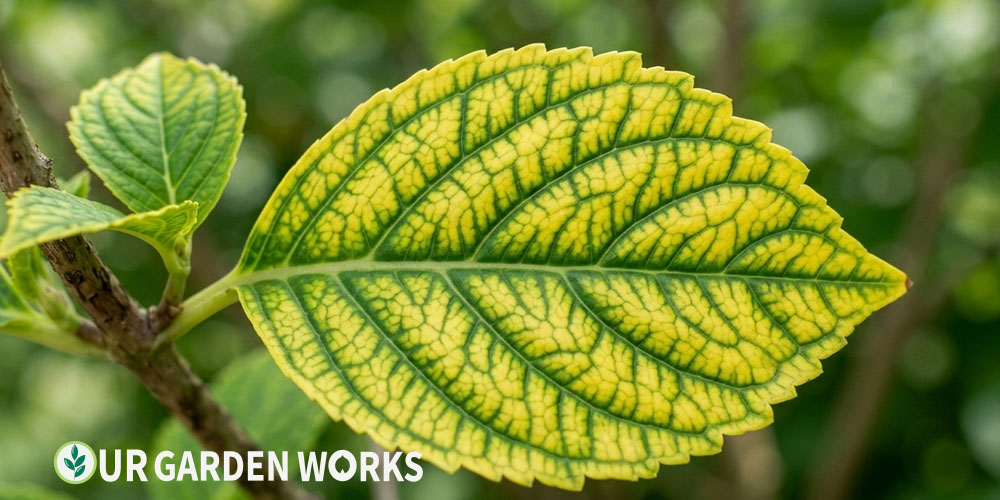
Yellow leaves on hydrangeas can mean several very different things, and the pattern of yellowing is what actually tells you which one you’re facing.
A leaf that’s uniformly pale yellow means something different than one with yellow tissue but green veins, and both mean something different than yellow leaves that are also wilting.
We’ve organized this guide by exactly that — the visual pattern first, then the cause, then the fix. Match what you’re seeing to the descriptions below before treating anything, since several of these causes have opposite fixes.
Quick Answer: Yellow leaves with green veins usually mean iron chlorosis from alkaline soil. Uniformly pale yellow leaves often point to nitrogen deficiency or overwatering. Yellow leaves with wilting suggest root rot or transplant stress. Lower-leaf-only yellowing is often natural aging. Check soil pH and moisture first — these two factors explain the majority of hydrangea yellowing cases.
Cause 1 — Iron Chlorosis (Alkaline Soil)
This is one of the most recognizable hydrangea problems once you know the pattern: leaves turn yellow while the veins stay distinctly green, creating a network or net-like appearance across the leaf.
It happens because alkaline soil (high pH) locks up iron in a form roots can’t absorb, even when iron is physically present in the soil.
How to confirm it’s iron chlorosis:
- Veins remain green while the tissue between them turns yellow
- Typically affects new growth first, then spreads to older leaves
- Soil test shows pH above 7.0
- Common after using alkaline mulch, near concrete foundations, or in regions with naturally alkaline soil
Fix: Lower soil pH with elemental sulfur or an acidifying fertilizer formulated for acid-loving plants. A chelated iron supplement provides faster, more direct relief while the slower pH adjustment takes effect over several weeks to months.
Cause 2 — Nitrogen Deficiency
Nitrogen-deficient hydrangeas show uniform pale yellowing across the entire leaf, including the veins, rather than the green-vein pattern of iron chlorosis.
This typically starts on older, lower leaves first, since the plant moves available nitrogen to support newer growth at the expense of established foliage.
How to confirm it’s nitrogen deficiency:
- Yellowing is uniform across the whole leaf, veins included
- Older, lower leaves affected first and most severely
- Overall plant growth seems slow or stunted
- No recent fertilizing, or soil naturally low in organic matter
Fix: Apply a balanced, slow-release fertilizer formulated for flowering shrubs in early spring. Avoid heavy nitrogen-only fertilizers, which can push excessive leafy growth at the expense of blooms — a balanced ratio supports both leaf color and flower production.
Cause 3 — Overwatering and Root Stress
Overwatered hydrangeas show yellowing that’s often accompanied by a slightly wilted or droopy appearance, even though the soil is clearly wet — a combination that confuses many gardeners who assume wilting always means a plant needs more water.
Roots sitting in saturated soil can’t take up oxygen or nutrients effectively, producing yellowing despite the abundant moisture.
How to confirm it’s overwatering:
- Soil is consistently wet or soggy to the touch
- Yellowing leaves may also feel slightly soft or limp
- Poor drainage is visible — water pools rather than absorbing
- Symptoms worsen rather than improve with additional watering
Fix: Reduce watering frequency immediately and check that the planting site or container drains properly. For in-ground hydrangeas in heavy clay, working organic matter into the surrounding soil over time improves drainage; for containers, repot into a mix with better drainage and ensure pots have adequate drainage holes.
Cause 4 — Underwatering and Drought Stress
On the opposite end, drought-stressed hydrangeas show yellowing combined with crispy, dry leaf edges and a generally wilted, droopy appearance during the hottest part of the day.
Hydrangeas have notoriously high water needs compared to many other shrubs, and they show stress visibly and quickly when that need isn’t met.
How to confirm it’s drought stress:
- Soil feels dry several inches down
- Leaves droop dramatically in afternoon heat, sometimes recovering somewhat overnight
- Yellowing is often accompanied by brown, crispy leaf edges
- Plant is in full sun with inconsistent watering
Fix: Water deeply and consistently, aiming for the equivalent of about an inch per week, more during heat waves. A 2-3 inch mulch layer around the base conserves soil moisture significantly between waterings.
Cause 5 — Root Rot
Root rot produces yellowing that progresses to browning and wilting that doesn’t recover even with adjusted watering, since the root system itself has been damaged by prolonged waterlogged conditions or a fungal pathogen.
This is a more serious version of the overwatering problem above, where damage has moved beyond simple oxygen deprivation into actual root tissue death.
How to confirm it’s root rot:
- Symptoms persist or worsen even after you’ve corrected watering habits
- Stems near the soil line may feel soft or appear darkened
- Plant shows an overall decline rather than just isolated yellow leaves
- Often follows an extended period of poor drainage or planting too deep
Fix: Carefully dig up the plant and inspect roots — healthy roots are firm and white to tan, while rotted roots are dark, soft, and mushy. Trim away affected roots, replant in well-draining soil or a fresh container, and reduce watering significantly while the plant recovers. Severe cases may not be salvageable.
Cause 6 — Transplant Shock
A hydrangea that’s been recently moved, divided, or transplanted often shows temporary yellowing as the root system adjusts to its new location, even when everything about the new site is perfectly suitable.
This is a normal, usually self-limiting stress response rather than a sign of ongoing care problems.
How to confirm it’s transplant shock:
- Yellowing began shortly after a recent move or planting
- No other signs of disease, pests, or watering problems
- New growth, once it appears, looks healthy and green
Fix: Patience, consistent watering, and avoiding fertilizer for the first few weeks while roots establish. Most hydrangeas recover fully from transplant shock within one growing season.
Cause 7 — Natural Lower Leaf Aging
Occasionally, a few yellow leaves near the base of an otherwise healthy, vigorous hydrangea simply reflect normal leaf aging and senescence, the same way deciduous shrubs naturally shed older foliage as the season progresses.
This is the least concerning cause on this list and requires no intervention at all.
How to confirm it’s natural aging:
- Only a small number of the oldest, lowest leaves are affected
- The rest of the plant looks vigorous, with healthy new growth
- Yellowing progresses slowly rather than appearing suddenly across many leaves
Fix: None needed. Simply remove the yellowed leaves for tidiness if desired.
Telling the Seven Causes Apart at a Glance
| Cause | Pattern | Soil Condition |
|---|---|---|
| Iron chlorosis | Yellow with green veins | Alkaline (pH 7+) |
| Nitrogen deficiency | Uniform yellow, lower leaves first | Low fertility |
| Overwatering | Yellow + soft/limp texture | Wet, poorly draining |
| Drought stress | Yellow + crispy brown edges | Dry several inches down |
| Root rot | Yellow progressing to brown, no recovery | History of waterlogging |
| Transplant shock | Yellow shortly after a move | Variable, recently disturbed |
| Natural aging | A few lower leaves only | Normal, healthy soil |
Testing Your Soil Before You Treat Anything
Given how many of these seven causes trace back to soil pH or moisture, a basic soil test is genuinely the most useful diagnostic step before reaching for any product.
A simple home pH test kit, available inexpensively at any garden center, takes the guesswork out of distinguishing iron chlorosis from nitrogen deficiency, since both can produce yellowing that looks superficially similar at a glance.
Checking soil moisture at root depth, not just the surface, similarly separates overwatering from drought stress more reliably than assumption alone.
Many gardeners are surprised to discover their soil is much wetter or much drier at a 4-6 inch depth than the surface appearance suggested, which is exactly why a quick physical check beats guessing every time.
Frequently Asked Questions
Will yellow leaves on my hydrangea turn green again once I fix the cause?
Already-yellowed leaves typically don’t reverse back to green, but new growth that emerges after the underlying problem is corrected should come in healthy and green.
This is true across nearly all seven causes — the fix prevents further yellowing rather than restoring existing yellow leaves.
Does hydrangea flower color have anything to do with leaf yellowing?
Not directly, though both flower color and leaf chlorosis are influenced by soil pH in related ways.
Acidic soil produces blue flowers on many hydrangea varieties and also supports better iron availability for healthy green leaves, while alkaline soil shifts flowers toward pink and simultaneously increases the risk of iron chlorosis yellowing.
How quickly should I expect to see improvement after treating iron chlorosis?
A chelated iron supplement often shows improvement in new growth within 1-2 weeks, since it provides iron in an immediately usable form.
The underlying soil pH adjustment with sulfur works much more slowly, typically taking several months to meaningfully shift pH, which is why combining both approaches gives faster visible results than relying on pH adjustment alone.
Can I prevent yellow leaves on hydrangeas from happening every year?
Yes, largely by addressing the underlying soil condition rather than treating symptoms reactively each season. If iron chlorosis or nitrogen deficiency has been a recurring issue, an annual soil test and proactive amendment in early spring, before symptoms appear, prevents most cases from developing in the first place.
Do potted hydrangeas yellow for different reasons than ones planted in the ground?
The same seven causes apply to both, but containers tend to swing toward overwatering, underwatering, and nitrogen deficiency more often than in-ground plants, since potting mix holds less nutrient and moisture reserve than garden soil.
Container hydrangeas typically need more frequent watering attention and more regular fertilizing than the same variety would require planted directly in a well-amended garden bed.
Related Articles in Our Hydrangea Care Guide
Final Thoughts
We hope this guide has helped you match the exact yellowing pattern on your hydrangea to its cause, since the right fix really does depend on getting that diagnosis correct first. Soil pH and watering explain the majority of cases, so starting there is almost always the right move.
For more hydrangea care guidance, our full collection of hydrangea articles in our plant care guides covers everything from blooming to disease.
Share this post with a fellow gardener who’s troubleshooting their hydrangea — and let us know in the comments which cause matched what you found. Happy growing!
