

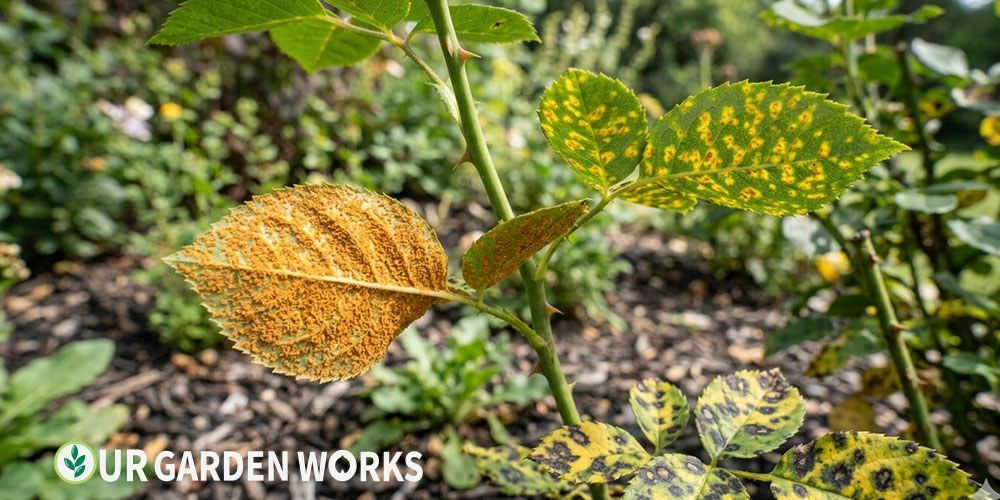
Rose rust has one of the most distinctive appearances of any rose disease, which actually makes it one of the easier diagnoses in this entire series once you know to check the right spot.
The defining clue is almost always on the underside of the leaf, not the top, which is exactly where many gardeners forget to look first.
This guide covers confirming the diagnosis, treating an active infection, and the seasonal habits that keep rust from establishing a permanent foothold in your rose garden.
Quick Answer: Rust on roses produces small, bright orange to rust-colored powdery pustules, almost always concentrated on leaf undersides, with corresponding yellow spots visible on the upper leaf surface directly above them. It thrives in cool, moist conditions, particularly in spring and fall. Remove affected leaves, apply a fungicide labeled for rust, and improve airflow to manage an active infection.
What Rose Rust Actually Looks Like
The telltale sign of rose rust is on the leaf underside: small, raised, powdery pustules in shades of orange to rust-red, often appearing in clusters.
If you rub a finger across an affected area, the powdery spores readily transfer, leaving an orange residue — a useful confirmation test if you’re unsure.
On the corresponding upper leaf surface, directly above where the pustules have formed underneath, you’ll typically see small yellow spots.
As the disease progresses, severely affected leaves yellow more broadly and drop from the plant, similar to the progression seen with black spot, though the underlying cause and appearance are distinctly different.
💡 Always check the underside first
If you’re trying to distinguish rust from black spot or another rose disease, flip the leaf over before doing anything else. Rust’s defining orange, powdery pustules are concentrated on the underside, and this single check resolves the diagnosis faster than examining the top surface alone.
Why Rose Rust Happens
Rust is caused by several related fungal species that favor cool temperatures combined with high humidity or extended leaf wetness, which is why it tends to be most active in spring and fall rather than the height of summer heat.
Like many fungal rose diseases, it spreads via spores that travel on wind and water splash, landing on healthy leaves and germinating wherever moisture allows.
The fungus overwinters on fallen leaves and sometimes on cane surfaces, creating the same kind of seasonal reinfection cycle covered in our black spot guide, where a garden that had rust one year carries elevated risk of seeing it again the following season unless that overwintering source is addressed through cleanup.
Treating an Active Rust Infection
Directions
- Remove all visibly affected leaves, including those that have already fallen, and dispose of them in the trash rather than composting.
- Apply a fungicide labeled for rust — products containing myclobutanil, propiconazole, or sulfur are all effective options against rust specifically.
- Water at the base of the plant rather than overhead, and water in the morning so any incidental leaf moisture dries quickly.
- Improve airflow by thinning dense growth and ensuring adequate spacing between rose bushes.
- Continue monitoring through cool, humid stretches of spring and fall, since these are the periods of highest rust pressure.
⚠️ Avoid overhead watering and wetting foliage in the evening
Watering in the evening, even at the soil level if some splash reaches leaves, leaves foliage wet overnight — exactly the extended moisture window rust spores need to germinate.
Morning watering gives leaves the entire day to dry before nightfall, significantly reducing infection risk.
Preventing Rust From Returning
Fall cleanup matters just as much for rust prevention as it does for black spot, since removing fallen leaves eliminates the fungus’s primary overwintering location around your roses.
This single habit, more than any in-season treatment, determines how much rust pressure your garden faces the following spring.
Choosing rust-resistant rose varieties is increasingly straightforward, since many modern shrub roses and disease-resistant hybrids are bred with meaningfully better rust tolerance than older varieties.
If rust has been a persistent, significant problem despite good cleanup and treatment habits, transitioning some plantings to these more resistant types reduces the disease burden considerably going forward.
Spacing roses generously and pruning for good airflow addresses rust the same way it addresses black spot, since both diseases favor the same humid, stagnant-air conditions that dense, crowded plantings create.
A preventive fungicide schedule, started in early spring before the cool, humid conditions that favor rust really take hold, outperforms waiting for visible symptoms in gardens with a known history of rust pressure.
Why Rust Is More Complex Than It First Appears
Rust fungi have an unusually complicated life cycle compared to many other plant diseases, sometimes requiring a different host plant entirely to complete part of their reproductive cycle before returning to infect roses again.
This complexity is part of why rust can seem to appear seemingly out of nowhere in a garden that’s never had it before, since the fungus may have been quietly present on a different host plant nearby for some time before conditions favored a jump back to roses.
For practical management purposes, this biological detail matters less than you might expect — the same fundamental approach of removing infected material, treating with appropriate fungicide, and improving growing conditions works regardless of the specific rust species or its full life cycle complexity.
Understanding that the disease can have origins beyond just your rose bushes themselves, though, helps explain why rust sometimes persists despite seemingly thorough rose-specific cleanup and treatment.
Regional Risk — Where Rust Is Most Common
Rose rust pressure varies considerably by region, generally favoring areas with mild, humid springs and falls over regions with hot, dry summers and harsh winters.
The Pacific Northwest, parts of the Southeast, and similar climates with extended cool, damp periods tend to see more consistent rust pressure than arid Southwest or extreme continental climates where rapid temperature swings disrupt the fungus’s preferred conditions more reliably.
If you’ve recently moved to a new region or are establishing roses in an unfamiliar climate, checking with a local extension office or experienced regional rose growers about typical rust pressure in your specific area helps calibrate how aggressively you should plan preventive measures from the start.
Gardeners in consistently high-pressure regions often find that resistant variety selection becomes nearly essential rather than simply a nice-to-have, given how reliably the disease returns each cool, humid season otherwise.
Rust vs. Other Rose Diseases
| Disease | Color | Location | Texture |
|---|---|---|---|
| Rust | Orange to rust-red | Leaf underside (pustules) | Powdery, transfers when touched |
| Black spot | Black to dark brown | Either surface | Flat, feathered edges |
| Powdery mildew | White to gray | Either surface, often new growth | Powdery coating |
If your symptoms don’t match the orange, powdery, underside-concentrated pattern described here, our black spot treatment guide covers the most likely alternative diagnosis, since the two diseases are commonly confused at a quick glance.
Frequently Asked Questions
Will rose rust kill my rose bush?
Rarely outright, but severe, repeated infections across multiple seasons without treatment can significantly weaken a plant, reducing bloom production and overall vigor due to lost photosynthetic leaf surface. Most established roses survive rust even when poorly managed, but they perform considerably better with consistent prevention and treatment.
Can rose rust spread to other plants in my garden?
Rose rust fungi are generally specific to roses and won’t infect unrelated garden plants. It can spread readily between different rose bushes growing near each other, however, which is why treating and cleaning up around all roses in an affected area matters, not just the most visibly symptomatic plant.
Why does rust seem worse in spring and fall but better in summer?
Rust fungi favor cool temperatures combined with humidity, conditions that summer heat typically disrupts even in humid climates.
This seasonal pattern is normal and expected — don’t mistake a quiet summer for the disease being fully resolved if cleanup and prevention habits haven’t actually been addressed, since it often returns predictably as cooler weather arrives again.
Is it safe to compost rose leaves with rust on them?
It’s safer to avoid composting rust-affected leaves, since most home compost piles don’t reach the sustained high temperatures needed to reliably kill fungal spores, and using that compost later could reintroduce the disease elsewhere in the garden.
Bagging and disposing of affected leaves in household trash is the more reliable approach for fully removing the fungal source from your property.
Can I treat rust with the same products I use for black spot?
Some fungicides, particularly broader-spectrum products containing myclobutanil or certain copper formulations, are labeled for both diseases and can be used interchangeably if you’re managing both at once.
Always check the specific product label to confirm it lists rust among its targeted diseases, since not every black spot treatment is formulated or labeled effectively against rust specifically.
Related Articles in Our Plant Care Guide
Final Thoughts
We hope this guide has made rust one of the easier rose diagnoses to confirm with real confidence — that telltale orange powder on the leaf underside leaves little room for doubt once you check the right spot. Fall cleanup and good spacing do most of the prevention work going forward.
For more rose care guidance, our plant care guides cover everything from planting to pest and disease management.
Share this post with a fellow rose grower who’s troubleshooting rust this season — and let us know in the comments what’s worked for your garden. Happy growing!
