

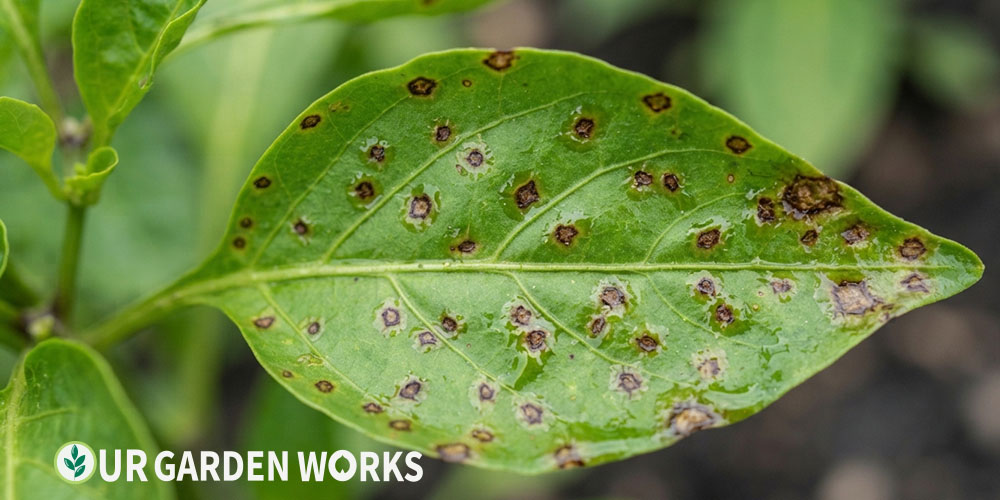
Brown spots on pepper leaves cover a slightly different set of likely causes than the same symptom on tomatoes, even though the two plants are close relatives and share some disease susceptibility.
We’ll walk through what’s actually most common on peppers specifically, with the details that separate one cause from another.
Texture, border definition, and recent weather conditions all play a role in narrowing down which of these explanations fits what’s on your plant.
Quick Answer: Brown spots on pepper leaves are most often bacterial spot (small spots with water-soaked margins, can also appear on fruit), Cercospora leaf spot (round spots with a distinct tan center and dark border, sometimes called “frogeye”), or sunscald (irregular bleached-brown patches following sun exposure). Check texture and border definition first — water-soaked suggests bacterial, while a defined ring pattern suggests Cercospora.
Cause 1 — Bacterial Spot (Most Common)
Bacterial spot produces small, dark brown to black spots, often with a slightly raised, greasy, or water-soaked appearance at the margins rather than the dry, papery texture of fungal spots.
It can affect leaves, stems, and fruit, with fruit lesions appearing as small raised, scabby marks distinct from the flatter leaf spots.
How to confirm it’s bacterial spot:
- Spots have a greasy or water-soaked appearance, especially at the margins
- May appear on fruit as well as leaves
- Spreads rapidly following rain or overhead watering
- No defined ring pattern or fungal fruiting structures visible
Fix: Apply a copper-based bactericide and shift to soil-level watering if you’ve been watering overhead. Avoid working among wet plants, since handling damp foliage spreads bacteria between leaves and plants on hands and tools.
Cause 2 — Cercospora Leaf Spot (“Frogeye”)
Cercospora leaf spot on peppers produces a distinctive appearance sometimes called “frogeye” — round spots with a light tan to gray center surrounded by a darker brown to reddish-brown border, creating a ring pattern that resembles an eye.
This is a fungal disease distinct from the bacterial spot above, with a notably more defined, patterned appearance.
How to confirm it’s Cercospora (“frogeye”):
- Spots show a clear ring pattern — pale center, darker defined border
- Texture is dry and papery rather than greasy or water-soaked
- Worse in warm, humid conditions, similar to many fungal leaf spot diseases
- Typically starts on older, lower leaves first
Fix: Remove affected leaves, improve airflow through proper spacing, and apply a fungicide labeled for leaf spot diseases if the infection is significant. Switching to soil-level watering reduces the humid leaf-surface conditions this fungus favors.
Cause 3 — Sunscald
Sunscald produces irregular, bleached to brown patches with no defined border, typically on leaves recently exposed to more intense direct sun than they’re accustomed to — often following a pruning session that removed surrounding shade, or a sudden shift from cloudy to intensely sunny weather. This is a physiological response rather than a disease.
How to confirm it’s sunscald:
- Damage correlates with recent sun exposure change rather than plant age or position alone
- Patches are irregular and papery, with no ring pattern or water-soaked texture
- No spread to other leaves beyond the initially affected, newly sun-exposed ones
Fix: No treatment reverses existing scald damage. Avoid removing more than 20-25% of foliage in a single pruning session, and provide temporary shade cloth if a sudden, intense heat wave is forecast for plants that haven’t acclimated.
Telling the Three Causes Apart at a Glance
| Cause | Border Pattern | Texture | Affects Fruit? |
|---|---|---|---|
| Bacterial spot | No defined ring | Greasy, water-soaked | Yes, sometimes |
| Cercospora (“frogeye”) | Clear ring, pale center/dark border | Dry, papery | Rarely |
| Sunscald | No defined border, irregular | Bleached, papery | No (different mechanism) |
Why Container Peppers Face Different Disease Pressure
Container-grown peppers experience these three causes somewhat differently than in-ground plants, which is worth understanding if you’re trying to diagnose a container pepper specifically.
Bacterial spot pressure can actually be lower in containers compared to densely planted in-ground beds, since the physical isolation between individual containers reduces the water-splash transmission that spreads bacteria between closely spaced in-ground plants.
Sunscald, on the other hand, tends to be more common in containers, particularly for plants that have been moved between different light conditions — say, from a partially shaded nursery greenhouse to a full-sun patio — without a gradual acclimation period.
Container peppers also dry out and heat up faster than in-ground plants, which can compound sunscald risk if a plant is already somewhat stressed from inconsistent watering when intense sun exposure hits.
Cercospora leaf spot can develop in containers just as readily as in-ground plantings if humidity and leaf wetness conditions are similar, making the same airflow and soil-level watering prevention principles apply regardless of growing method.
The main container-specific adjustment is being more attentive to gradual acclimation when moving plants to sunnier locations, which directly addresses the sunscald risk that’s elevated in this growing environment.
Does Fertilizing Practice Affect Susceptibility to These Diseases?
Fertilizing habits play an indirect but real role in how susceptible pepper plants are to both bacterial spot and Cercospora leaf spot, primarily through their effect on overall plant vigor and the density of new growth.
Excessive nitrogen fertilization pushes rapid, lush, tender new growth that’s generally more vulnerable to both bacterial and fungal infection than the firmer, more mature growth a balanced feeding program produces.
This is one more reason the fertilizing progression covered in our general pepper growing guidance — balanced feeding early, then shifting toward lower-nitrogen, higher-potassium formulas once flowering begins — supports disease resistance as a secondary benefit beyond its primary role in supporting fruit development.
A plant that’s neither over-fertilized into excessive tender growth nor under-fertilized into general weakness handles incidental disease exposure better than one at either extreme.
Why Peppers Show These Specific Diseases More Than Other Spots
Peppers share a meaningful amount of disease susceptibility with tomatoes, since both belong to the nightshade family, but Cercospora leaf spot in particular shows up more distinctively and more commonly on peppers than the early blight pattern that dominates tomato brown-spot cases.
This difference is worth keeping in mind if you’re comparing symptoms across both crops growing in the same garden, since matching the wrong reference pattern between the two plants can lead to a mistaken diagnosis.
Bacterial spot, by contrast, affects both crops in a very similar way and is one of the more directly comparable diseases between peppers and tomatoes, including its tendency to appear on fruit as well as foliage in both plants.
If you’re seeing bacterial spot on peppers, it’s worth checking nearby tomatoes for similar symptoms, since the same wet-weather conditions and water-splash transmission affect both crops simultaneously.
Reducing Disease Pressure Through Garden Layout
Beyond the specific treatments covered above, a few layout decisions made before disease even appears reduce overall pressure across an entire pepper planting.
Spacing plants generously rather than maximizing the number squeezed into a bed improves airflow and helps foliage dry faster after rain or watering, directly working against both bacterial spot and Cercospora’s preferred humid conditions.
Rotating peppers to a different bed location each year, rather than replanting in the same spot repeatedly, reduces the buildup of both bacterial and fungal pathogens that can persist in soil and plant debris across seasons.
Combined with thorough fall cleanup of all pepper plant debris, this rotation habit addresses the underlying disease pressure at its source rather than just managing symptoms reactively each growing season.
Try our free tool: Plant Spacing Calculator — Exactly How Many Plants Fit in Your Bed
Frequently Asked Questions
Can I still eat peppers from a plant with brown spots on the leaves?
Yes, as long as the fruit itself looks normal and healthy, since these diseases primarily affect leaves and any fruit lesions from bacterial spot specifically are usually visible and easy to identify and cut away. The leaf disease itself doesn’t make unaffected fruit unsafe to eat.
Will brown spots on my peppers spread to my tomatoes nearby?
Bacterial spot can affect both crops, since they share similar susceptibility to this particular pathogen, making it worth monitoring tomatoes if peppers nearby show bacterial spot symptoms. Cercospora leaf spot is less likely to cross over significantly between the two crops, tending to show more specifically on peppers in most home garden situations.
Are some pepper varieties more resistant to bacterial spot or Cercospora?
Resistance varies by variety, and some modern hybrid peppers are bred with improved tolerance to bacterial spot specifically, often noted on seed packets for gardeners in regions where this disease is a known recurring problem. If these diseases have been persistent issues in your garden, researching resistant varieties before your next planting season is a worthwhile long-term investment.
How quickly does bacterial spot spread once it appears on a pepper plant?
Spread can be quite rapid under favorable conditions — warm temperatures combined with frequent rain or overhead watering can take a few isolated spots to widespread leaf coverage within a week or two.
This is exactly why switching to soil-level watering and removing the earliest affected leaves promptly makes such a meaningful difference in limiting how far an outbreak progresses across the rest of the plant.
Related Articles in Our Pepper Leaf Problems Guide
- Yellow Leaves on Pepper Plants — Why It Happens
- Holes in Pepper Leaves — Diagnosis Guide
- Brown Spots on Pepper Leaves — Causes and Fixes
- White Spots on Pepper Leaves – Identification Guide
- Why Are Pepper Leaves Curling? 6 Causes and How to Fix Each One
- How to Grow Peppers (Bell & Hot) — Complete Guide
- 6 Best Companion Plants for Peppers – Full List (2026)
- Growing Peppers in Containers: Varieties, Pots & Fertilizing (2026)
- Brown Spots on Tomato Leaves – What’s Causing It
Final Thoughts
We hope this guide has helped you match the exact spot pattern on your pepper leaves to the right cause, since border texture and shape really do tell most of the story here.
For all our pepper and vegetable growing guides, our vegetable gardening guide links to everything.
Share this post with a fellow gardener who’s troubleshooting their pepper plants — and let us know in the comments which cause matched what you found. Happy growing!
