

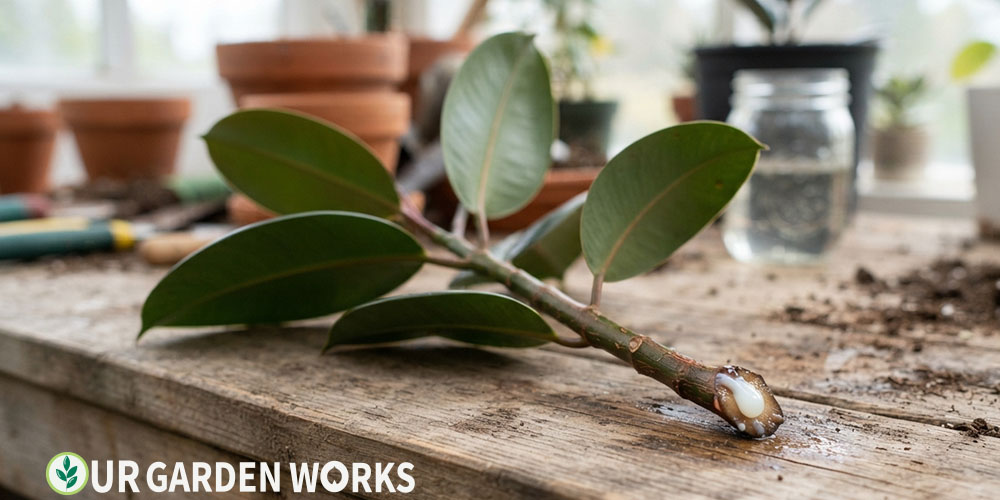
Rubber plant (Ficus elastica) propagates from stem cuttings reliably enough, but it has one quirk that trips up a lot of first-time propagators: the milky white sap it releases when cut, which needs to be managed correctly or it can interfere with rooting.
Quick Guide: Cut a 4–6 inch stem section with at least one node and 2–3 leaves, let the cut end dry until the sap stops flowing (usually 30–60 minutes), then root in water or moist soil. Rooting takes 4–8 weeks — noticeably slower than many other common houseplant cuttings.
Why the Sap Matters and How to Handle It
Ficus species, including rubber plant, produce a milky latex sap as a natural defense mechanism — in the wild, this sap deters browsing animals and can help seal wounds against pathogens.
When you take a cutting, that same sap flows freely from the fresh cut for the first hour or so, and if you place the cutting into water or soil while sap is still actively flowing, it can clog the cut surface and interfere with the cells that would otherwise develop into roots.
The fix is simple: after cutting, set the stem aside in the open air and let the sap flow stop naturally before doing anything else. This usually takes 30 minutes to an hour, occasionally longer for a particularly large cutting. Once the cut surface looks dry rather than glistening, you’re ready to proceed.
⚠️ The sap can irritate skin
Ficus sap is a mild skin irritant for some people and can cause minor irritation if it contacts eyes. Wash hands after handling cuttings, and consider wearing gloves if you know you’re sensitive to plant latex.
Why Rubber Plant Roots So Much Slower Than Pothos or Monstera
It’s worth understanding why rubber plant consistently takes longer to root than many other common houseplant cuttings, since the explanation ties directly back to that same latex sap.
The sap-producing cells along a Ficus stem are part of the plant’s broader defensive chemistry, and this same chemistry appears to compete, at least partially, with the metabolic processes that would otherwise be redirected toward generating new root tissue immediately after cutting.
Vining aroids like pothos and Monstera evolved under different pressures — rapid opportunistic rooting after accidental stem damage — and simply don’t carry this same sap-based defense system, which is reflected directly in how much faster their cuttings typically root.
Rubber plant’s slower timeline isn’t a sign anything is being done wrong; it’s a genuine, species-level difference in how the plant allocates its resources after being cut.
This is also worth keeping in mind when comparing notes with other gardeners about propagation timelines — someone reporting roots on a pothos cutting within two weeks isn’t evidence that your rubber plant cutting is failing simply because it hasn’t matched that pace.
Different species genuinely operate on different internal schedules, and rubber plant’s schedule is simply longer.
Method 1: Water Propagation
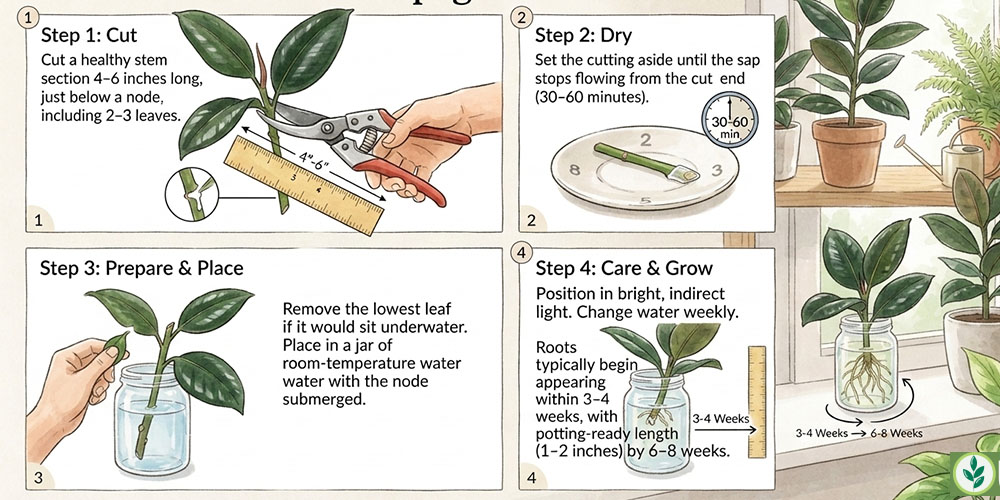
Directions
- Cut a healthy stem section 4–6 inches long, just below a node, including 2–3 leaves.
- Set the cutting aside until the sap stops flowing from the cut end (30–60 minutes).
- Remove the lowest leaf if it would sit underwater.
- Place in a jar of room-temperature water with the node submerged. Position in bright, indirect light.
- Change water weekly. Roots typically begin appearing within 3–4 weeks, with potting-ready length (1–2 inches) by 6–8 weeks.
The water itself can sometimes turn slightly cloudy as residual sap continues releasing in trace amounts even after the initial flow has stopped — this is normal in the first week or so and isn’t a sign of rot, though it’s still worth changing the water on schedule rather than letting it sit longer than recommended.
Method 2: Soil Propagation
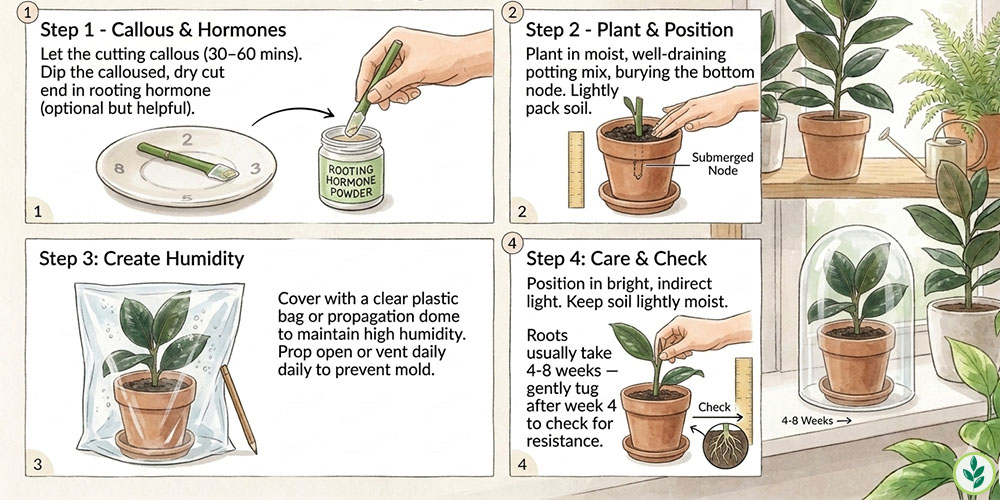
Directions
- Prepare the cutting the same way, letting the sap dry before proceeding.
- Dip the calloused, dry cut end in rooting hormone (optional but helpful, given how slow rubber plant cuttings can be to root).
- Plant in moist, well-draining potting mix, burying the bottom node.
- Cover with a plastic bag or propagation dome to maintain humidity while roots establish, venting daily to prevent mold.
- Keep soil lightly moist. Roots usually take 4–8 weeks — gently tug after week 4 to check for resistance.
Method 3: Air Layering (Best for Large, Established Plants)
Air layering is a less commonly discussed but genuinely effective method for rubber plant, particularly useful when you want to propagate from a thick, woody stem section that would struggle to root as a standalone cutting.
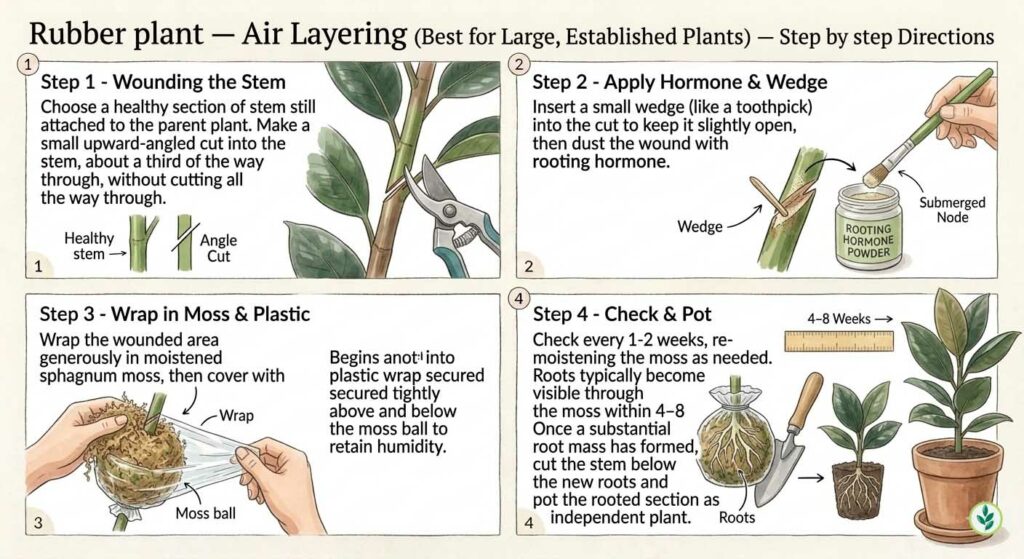
Directions
- Choose a healthy section of stem still attached to the parent plant. Make a small upward-angled cut into the stem, about a third of the way through, without cutting all the way through.
- Insert a small wedge (like a toothpick) into the cut to keep it slightly open, then dust the wound with rooting hormone.
- Wrap the wounded area generously in moistened sphagnum moss, then cover with plastic wrap secured tightly above and below the moss ball to retain humidity.
- Check every 1–2 weeks, re-moistening the moss as needed. Roots typically become visible through the moss within 4–8 weeks.
- Once a substantial root mass has formed, cut the stem below the new roots and pot the rooted section as an independent plant.
The advantage of air layering is that the new growth continues receiving water and nutrients from the parent plant throughout the entire rooting process, rather than relying solely on whatever energy was stored in a cutting at the moment it was separated.
This generally produces a sturdier, faster-establishing new plant once it is finally separated, at the cost of a more involved setup than a simple cutting.
Frequently Asked Questions
My cutting has been in water for 8 weeks with no roots — should I give up?
Rubber plant is genuinely one of the slower houseplants to root, so 8 weeks without visible roots isn’t necessarily a failure yet. Check that the cutting still looks firm and green; if so, give it another 2–3 weeks before concluding it won’t root. If it’s gone soft or dark, start a fresh cutting instead.
Should I wipe off the sap immediately after cutting?
You can gently blot excess sap with a clean cloth, but let the cut continue to air-dry rather than rinsing it with water, which can reintroduce moisture right when you’re trying to let the wound dry and seal.
Can I propagate rubber plant from a single leaf without a stem section?
No — like most ficus and aroid relatives, rubber plant needs an intact node to root. A leaf alone has no growth point and will not develop into a new plant regardless of how long it’s kept in water.
Should I remove all the leaves from a cutting to reduce stress on it while rooting?
No — leaves are how a cutting continues photosynthesizing and generating the energy needed to fuel root development. Keeping 2–3 leaves on the cutting is generally the right balance, providing enough photosynthetic capacity to support rooting without so much leaf area that the cutting loses excessive water through transpiration before roots exist to replace it.
Is variegated rubber plant harder to propagate than the solid green variety?
Slightly, yes. Variegated rubber plant (Ficus elastica ‘Tineke’ or ‘Ruby’) tends to root somewhat more slowly and with a lower overall success rate than solid green varieties, likely related to the reduced chlorophyll content in variegated tissue limiting the energy available to fuel root development.
The same core technique applies, but expect to budget extra patience and perhaps take a couple of backup cuttings to improve your odds.
How to Tell If Your Cutting Is Actually Progressing
Because rubber plant roots so much more slowly than many other houseplants, it’s easy to assume a cutting has failed simply because nothing visible has happened after a few weeks — exactly the point at which a pothos or Monstera cutting would already be showing roots.
A cutting that’s still progressing normally, even without visible roots yet, should have a firm, green stem with no soft spots, mushiness, or blackening at the cut end. Leaves should remain reasonably firm rather than going limp or dropping entirely. As long as those signs hold, it’s worth continuing to wait through the full 6–8 week window before concluding the cutting hasn’t taken.
A genuinely failed cutting usually shows clear signs well before the 8-week mark — a soft, darkened stem, a foul smell from the cut end, or complete leaf drop are all reasonable indicators that rot has set in rather than normal slow rooting simply taking its time.
Caring for a Newly Rooted Rubber Plant
Once your cutting has rooted and is potted in its own container, treat it gently for the first month or two while it establishes. Bright, indirect light suits a young rubber plant well — full, intense direct sun can stress a plant that’s still building its root system, even though mature rubber plants often tolerate considerably more direct light once established.
Water when the top inch or two of soil feels dry, and hold off on fertilizing for at least 4–6 weeks after potting, giving the still-developing root system time to mature before asking it to process additional nutrients.
Related Articles in Our Plant Care Guide
Final Thoughts
We hope this guide takes the mystery out of rubber plant’s one tricky quirk — once you know to let that sap dry before rooting, the rest of the process is genuinely straightforward, even if it asks for a bit more patience than some other houseplants. For care of the parent plant, our plant care guides cover the rest.
If you’ve already had a rubber plant cutting fail in the past, it’s well worth trying again with the sap-drying step specifically in mind, since this single detail accounts for a disproportionate share of failed attempts.
Once you’ve successfully rooted one cutting, subsequent ones tend to go more smoothly simply from knowing what to expect at each stage of this slower, but reliable, timeline.
Give it the time it asks for, and it rarely disappoints — rubber plant’s slower pace is simply part of the deal, not a sign that something has gone wrong along the way, and the wait is well worth it once that first new leaf finally unfurls.
Share this post with a fellow gardener who’s ready to get growing — and let us know in the comments how long your cutting took to root. Happy growing!
