

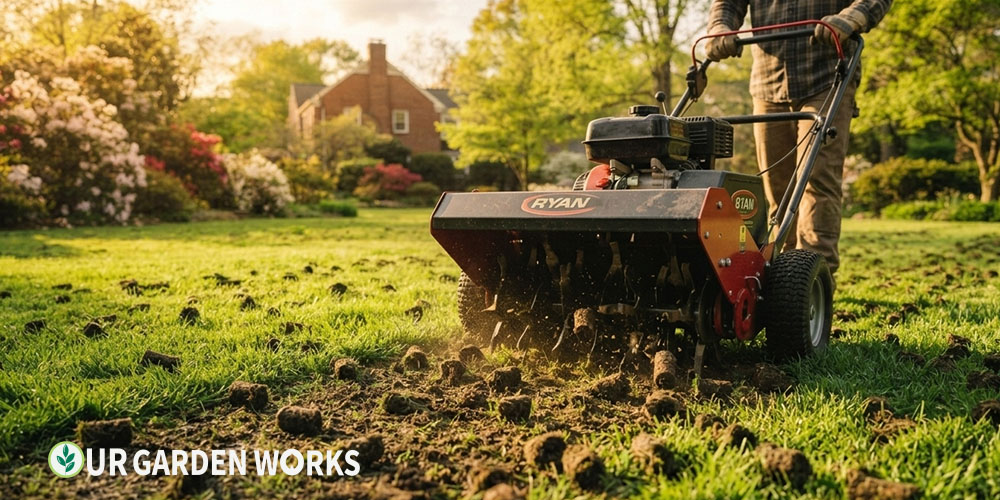
Grass roots need air and water to reach 6–8 inches deep, but foot traffic and rainfall gradually compact the soil until roots cannot penetrate past 2–3 inches. Shallow roots mean a lawn that browns in drought, struggles in heat, and invites weeds. Aeration breaks that compaction cycle.
How to Aerate Your Lawn in Spring – Quick Guide: Aerate cool-season grasses (bluegrass, fescue, ryegrass) in early spring or fall. Aerate warm-season grasses (Bermuda, zoysia, St. Augustine) in late spring after full green-up. Always use a core/plug aerator — never spike aeration. Leave the plugs on the surface; they break down in two weeks.
Does Your Lawn Need Aeration?
Do the screwdriver test: push a screwdriver into your lawn. If it slides to 6 inches easily, no aeration needed this year. If it stops at 2–3 inches, compaction is limiting your grass and aeration will make a visible difference.
Lawns that reliably benefit from annual aeration: heavy foot traffic, clay soil, sod-established lawns, lawns that dry out fast despite regular watering, and lawns with more than half an inch of thatch.
Why Compaction Builds Up — Even in Lawns You Don’t Walk On Much
Most homeowners assume compaction only happens in high-traffic areas, but soil compaction builds gradually from multiple sources. Rain itself compacts bare soil. Mowing compacts the surface repeatedly with every pass of the machine. Even the weight of thatch pressing down on the soil over months contributes.
Clay soil compounds the problem because its particles are flat and plate-like, stacking together far more tightly than the rounded particles in sandy soil.
A single wet winter followed by a dry spring can compact clay soil significantly without any foot traffic at all — the repeated wet-dry cycles cause clay particles to shift and press together more densely each cycle.
This is why new lawns established from sod almost always benefit from aeration in their second or third year, even if lightly used. The sod-laying process itself compresses the soil interface between the sod and the native soil below, creating a compaction layer at exactly the root depth where it does the most damage.
You might also like: How To Improve Clay Soil For Lawns and Yards
Timing by Grass Type
| Grass Type | Aerate in Spring? | Best Window |
|---|---|---|
| Kentucky bluegrass | Yes (secondary) | Early spring, soil 50–65°F |
| Tall fescue | Yes (secondary) | Early spring |
| Perennial ryegrass | Yes | Early spring |
| Bermuda grass | Wait — late May | After full green-up only |
| Zoysia grass | Wait — late May | After full green-up only |
| St. Augustine | Wait — late spring | Fully established and growing |
| Centipede grass | Skip or rarely | Infrequent only |
⚠️ Aerate BEFORE pre-emergent — never after
If you plan to apply pre-emergent herbicide, aerate first. Aeration punches holes through the pre-emergent barrier, allowing weed seeds in. Aerate first, apply pre-emergent 24–48 hours later.
Core Aeration vs Spike Aeration
Only core aeration relieves compaction. Core aerators remove actual plugs of soil 2–4 inches deep — physically creating space for roots, air, and water.
Spike aerators push spikes into soil without removing anything; in clay they can worsen compaction by compressing soil sideways. Use a core aerator. Rental runs $60–80/day at most equipment centers.
How to Aerate — Step by Step
Before
- Mow at your normal height 2–3 days before.
- Water 1–2 days before if soil is dry. Moist soil allows plugs to reach 2–4 inches depth. Dry soil limits plugs to 1 inch — not effective.
- Mark sprinkler heads and shallow irrigation lines with flags.
During
- Make one pass in straight rows across the entire lawn.
- Make a second pass perpendicular to the first — creates a grid of holes 3 inches apart.
- Go over heavily trafficked areas (paths, play areas) a third time.
After
- Leave the plugs on the surface — do not rake them up. They break down in 2 weeks and return organic matter to the soil.
- Overseed immediately if you have thin patches — seed falls into the holes and germinates far better than on solid soil.
- Apply fertiliser within 48 hours of aeration. Our guide on applying pre-emergent herbicide explains how to time pre-emergent correctly after aeration.
- Water 1 inch the day of aeration, then half an inch daily for 2 weeks if overseeding.
Aeration + Overseeding: The Best Spring Combination
If your lawn has thin patches, bare areas, or a threadbare appearance from winter, combine spring aeration with overseeding in the same session.
The aeration holes provide direct seed-to-soil contact — germination rates in aeration holes are 3–4 times higher than seed cast on an un-aerated lawn surface.
For cool-season lawns: broadcast grass seed immediately after aerating, then apply a starter fertilizer (high phosphorus) to support germination. Keep moist with light daily watering for 2–3 weeks. For warm-season lawns: do not overseed in spring — they are not compatible with overseeding at this time of year.
Matching Seed to Your Existing Lawn
Use seed that matches or complements your existing grass. Adding a different species without consideration creates a patchy lawn that looks inconsistent.
If you are unsure what grass type you have, take a handful to a local extension office or garden centre for identification before buying seed.
Post-Aeration Care Timeline
| Time After Aerating | What to Do |
|---|---|
| Day 0 (same day) | Broadcast seed if overseeding; water 1 inch; apply topdressing if using |
| Days 1–3 | Plugs on surface — ignore them, do not rake; water daily if overseeding |
| Days 3–5 | Apply fertiliser or pre-emergent (if not overseeding) once plugs begin breaking down |
| Week 2 | Plugs mostly broken down; first signs of new grass visible if overseeding |
| Weeks 3–4 | Holes filling in; avoid heavy traffic while new grass establishes |
| 6 weeks | Full recovery — lawn visibly thicker, better colour, drought tolerance improved |
Renting an Aerator vs Hiring a Service
For most home lawns under 5,000 square feet, renting a core aerator from a hardware store or equipment rental centre is the better value. Rental runs $60–80 for a full day — enough time to do your lawn twice in perpendicular passes, plus a neighbour’s lawn if you want to split the cost.
For lawns over 10,000 square feet, a lawn service is competitive with rental on a per-square-foot basis, and the professional equipment typically produces better plug depth than rental equipment in very compacted soil. Request a core aeration service specifically — confirm they are not offering spike aeration at the same price.
💡 Split the rental cost with a neighbour
A core aerator rental gives you a full day. If you have cooperative neighbours, splitting the $65–80 rental cost between 2–3 households and doing all lawns on the same day is one of the best deals in home lawn care. Schedule a spring Saturday with your block and it becomes a social occasion.
Common Aeration Mistakes That Cancel Out the Benefits
Aerating at the wrong soil moisture is the most common error. Too dry and the tines barely penetrate — you get half-inch plugs instead of 2–4 inch plugs, which doesn’t reach the compaction layer.
Too wet and the tines bring up a muddy mess that smears across the surface rather than leaving clean holes. Water your lawn 24–48 hours before aerating so the soil is moist but not saturated.
Only making one pass is the second mistake. A single row of holes 6 inches apart doesn’t create enough aeration density to meaningfully change soil structure. Two perpendicular passes — once across, once down — creates a grid of holes roughly 3 inches apart in both directions, which is the minimum density needed to noticeably relieve compaction.
Raking up the plugs immediately after aeration throws away a significant benefit. Those cylinders of soil sitting on your lawn look untidy for 1–2 weeks, but as they break down, they return organic matter and microorganisms directly into the holes, improving the soil you just opened up. Leaving them is not laziness — it’s the correct technique.
Applying pre-emergent herbicide before aerating is a sequencing error that costs the whole treatment. Pre-emergent works by forming a chemical barrier in the top layer of soil. Punching holes through that barrier with an aerator after application defeats the product.
The correct order is always: aerate first, apply pre-emergent 24–48 hours later once the surface has settled.
What to Expect in the Weeks After Aeration
A lawn that’s been aerated often looks slightly rough for 1–2 weeks — the soil plugs on the surface, combined with the open holes, give the lawn an uneven appearance that can be alarming if you’re expecting an immediate improvement. This is completely normal and temporary.
By week 3–4 the plugs have broken down, the holes have begun to fill in with root growth, and the grass above them typically shows noticeably stronger colour and density as roots start exploiting the newly opened soil.
If you overseeded at the same time, the first new growth is visible in the aeration holes by day 10–14, usually several days before germination appears on the surrounding un-aerated surface — a visible demonstration of why seed-to-soil contact matters.
Full results from a single aeration treatment take a full growing season to show. Compaction that built up over years doesn’t reverse in a month — but the improvement in drought resilience, color, and density by the following summer is typically substantial enough that most homeowners make aeration a permanent part of their spring routine.
Frequently Asked Questions
Can I aerate a lawn that was just overseeded last fall?
Yes, if the grass from that overseeding has been mowed at least 2–3 times and has established a reasonable root system. Newly germinated grass that’s been growing less than 8–10 weeks is too fragile to aerate over without damaging it. If last fall’s overseeding went in late and the grass is still very young in spring, wait until summer before aerating.
Does aeration help with drainage problems in low spots?
Aeration helps when poor drainage is caused by compaction — it opens channels for water to move through the soil profile rather than pooling on the surface.
It does not help when drainage problems are caused by a physical low spot that collects runoff, or by a clay hardpan layer deeper than the aerator tines reach.
If your lawn has a specific area that stays waterlogged for days after rain regardless of aeration, the fix is likely regrading or a French drain rather than aeration alone.
How often should I aerate?
Clay soil or heavy foot traffic: annually. Sandy or loamy soil with normal use: every 2–3 years. Use the screwdriver test each spring to decide rather than aerating on a fixed schedule regardless of need.
My lawn looks worse after aeration — is that normal?
Completely normal. The plugs look messy for 1–2 weeks and the holes look ragged. Within 2–4 weeks the holes fill in, the plugs break down, and the improvement in root depth shows up as greener, more drought-resistant grass all summer.
If your lawn has yellow spots or areas where grass has stopped growing entirely, compaction is often the root cause that aeration fixes.
Should I fertilise before or after aerating?
Always after — within 48 hours of aeration. The holes create direct channels to the root zone. Pre-aeration fertiliser cannot penetrate compacted soil nearly as effectively.
Related Articles in Our Soil & Fertility Guide
- Spring Lawn Care Schedule (By Grass Type)
- Till or No-Till: How to Loosen Compacted Soil in 3 Best Methods
- How to Overseed a Lawn for Thick, Green Growth
- How to Loosen Compacted Soil
- Why Is My Grass Not Growing?
- Pre-emergent vs. Weed & Feed: Which Is Better?
- Lawn Overseeding Calculator – How Much Grass Seed and Fertilizer You Need
Final Thoughts
We hope this takes the mystery out of lawn aeration and gives you the confidence to get it done correctly this spring. The 2-hour rental investment pays dividends all summer. For the complete spring lawn care plan, see our spring lawn care schedule.
For the rest of a complete seasonal lawn routine, our soil and fertility guides cover aeration, overseeding, and scarifying in depth.
Share this with a fellow gardener who has been meaning to aerate their lawn for years but was not sure they were doing it right — and let us know in the comments how your lawn is looking this spring. Happy growing!
