

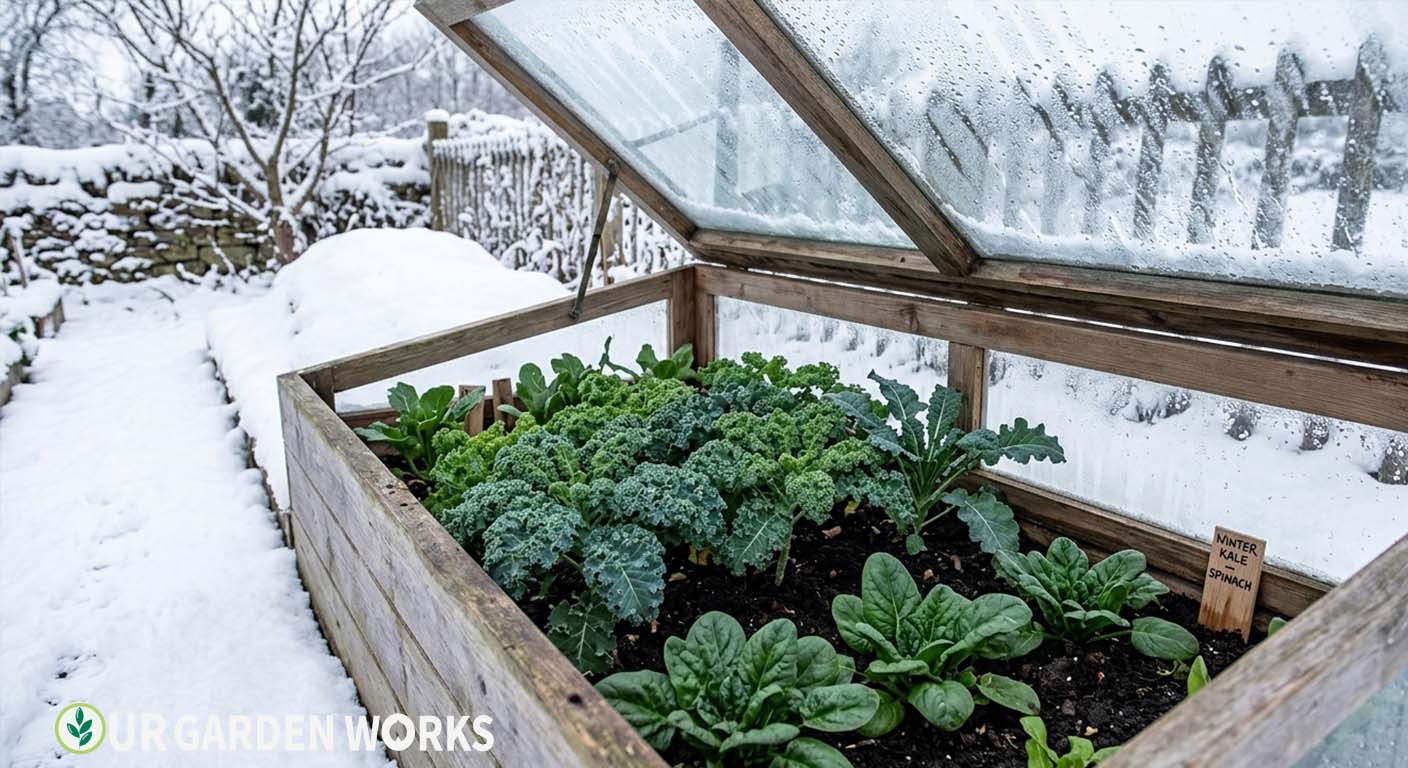
The vegetable garden doesn’t have to stop in October. With the right crops, the right timing, and a simple season-extending structure, you can harvest fresh vegetables through winter — in most climates in North America, often with surprisingly little extra effort once the system is set up.
Winter gardening isn’t about growing summer crops in cold weather. It’s about growing the cool-season crops that actually prefer cold temperatures — and understanding that harvesting in winter means planting in fall, not January.
Quick Answer: Plant winter crops in late summer/early fall (6–8 weeks before first frost for transplants, 8–10 weeks for seeds). Choose cold-hardy varieties — kale, spinach, mache, arugula, claytonia, chard, and overwintering onions. Use cold frames or row covers to extend the harvest window by 4–6 weeks in cold climates.
💡 The timing secret most gardeners miss
Winter vegetables are grown in fall and harvested in winter — they’re not planted in winter. The critical planting window is late July through September depending on your zone. Miss this window and you’re starting from scratch in spring.
Why Cold-Hardy Crops Actually Improve in Winter
It seems counterintuitive, but many winter vegetables genuinely taste better after a frost.
Kale, spinach, Brussels sprouts, and several other cold-hardy crops convert stored starches into sugars as a natural antifreeze response — the plant’s cells lower their freezing point by increasing sugar concentration.
The practical result is sweeter, more complex flavor in vegetables harvested after a light freeze compared to the same crop harvested in warm weather.
This is also why winter gardening tends to have far fewer pest and disease problems than summer growing.
Most insect pests and fungal diseases are dormant or simply can’t survive the cold, which means winter crops often need less intervention than their summer counterparts — one of the more pleasant surprises for gardeners trying this approach for the first time.
Preparing Beds Before Winter Sets In
Soil preparation for winter crops happens in late summer while the ground is still workable, not once cold weather has already arrived.
Work in compost and a balanced fertilizer before planting, since amending frozen or waterlogged winter soil is far more difficult than doing it while conditions are still favorable.
Mulching around winter plantings with straw or shredded leaves provides meaningful insulation for the root zone, often making the difference between a plant that survives a hard freeze and one that doesn’t.
Apply mulch once plants are established but before the first hard frost arrives, leaving a small gap around stems to prevent rot.
Best Vegetables for Winter Growing
| Crop | Cold Hardiness | Notes |
|---|---|---|
| Kale | Hardy to 10°F | Gets sweeter after frost; one of the best winter crops |
| Spinach | Hardy to 20°F (with cover) | Overwinters beautifully in Zones 6+; cold frame in Zones 4–5 |
| Mâche (corn salad) | Hardy to 5°F | Most cold-tolerant salad green; almost no maintenance |
| Arugula | Hardy to 15°F | Slower growing in cold but excellent flavor; perfect for cold frames |
| Claytonia (miner’s lettuce) | Hardy to 15°F | Grows through winter in mild climates, self-seeds prolifically |
| Swiss chard | Hardy to 15°F | Survives light frost; needs protection below 15°F |
| Overwintering onions | Hardy to 0°F | Plant in fall, harvest in early summer — larger than spring-planted onions |
| Garlic | Hardy to -20°F | Fall-planted; harvested the following summer |
| Brussels sprouts | Hardy to 10°F | Flavor improves dramatically after frost |
| Leeks | Hardy to 0°F | Harvest through winter as needed; don’t need to be dug |
Season-Extension Tools
Row Covers (Easiest, Most Affordable)
Lightweight spunbonded fabric (sold as Agribon, Reemay, or generic frost cloth) provides 2–4°F of frost protection and extends your season significantly with almost no investment.
Drape it directly over plants or over wire hoops. Lightweight row cover (1.0 oz/sq yd) allows 85% light transmission — plants grow normally underneath. Heavier cover (1.5–2.0 oz) provides more frost protection but reduces light.
Cold Frames
A cold frame is a box (wood, brick, or straw bales) topped with a transparent lid (old window, polycarbonate, or greenhouse plastic).
It creates a miniature greenhouse effect that can keep the interior 10–15°F warmer than outside temperatures. Vent on sunny days — interior temperatures can reach 80°F+ on a clear winter day even when it’s 30°F outside. Cold frames extend your season by 4–6 weeks in both spring and fall.
Unheated Greenhouse / High Tunnel
An unheated greenhouse or hoop house provides 20–30°F of frost protection — enough to grow cold-hardy crops through winter in Zones 5–6 and to significantly extend the season in colder zones. This is the most effective structure but requires the most investment.
Whichever structure you choose, ventilation matters as much as insulation. A cold frame or hoop house sealed tight on a sunny winter day can overheat fast enough to stress or even cook tender greens, so checking and venting on bright days — even when it’s well below freezing outside — is a habit worth building into your winter routine.
Choosing Between Row Covers, Cold Frames, and Tunnels
| Structure | Frost Protection | Cost | Best For |
|---|---|---|---|
| Row cover | 2–4°F | Low | Extending an existing bed’s season by a few weeks |
| Cold frame | 10–15°F | Low–Moderate | Small dedicated winter beds, salad greens |
| Unheated greenhouse/tunnel | 20–30°F | Moderate–High | Serious winter production across multiple beds |
Many gardeners layer these tools together rather than choosing just one — a row cover draped inside a cold frame, for instance, adds another several degrees of protection during the very coldest nights without any additional structure to build.
Watering and General Care Through Winter
Winter crops need far less attention than summer vegetables, but they’re not entirely maintenance-free.
Check soil moisture every 1–2 weeks rather than watering on a fixed schedule, since growth slows dramatically in cold weather and overwatering dormant or slow-growing plants risks root rot more than drought stress.
Snow cover is actually beneficial rather than something to clear away — it insulates plants from harsher air temperatures above. Brush snow off a cold frame or row cover only when you need to harvest or check on plants, then let it settle back into place afterward.
Planting Schedule by Zone
| Zone | Plant Winter Crops | What Grows Without Cover | What Needs Cover |
|---|---|---|---|
| Zones 7–11 | Sept–Nov | Kale, spinach, chard, arugula, lettuce | Little or none needed |
| Zones 5–6 | Aug–Sept | Kale, mache, overwintering onions, garlic | Spinach, arugula (row cover) |
| Zones 3–4 | July–Aug | Garlic, overwintering onions (mulched) | Kale, spinach (cold frame required) |
Frequently Asked Questions
Can I harvest vegetables when there's snow on the ground?
Yes — if the plants beneath the snow are cold-hardy varieties like kale, mache, or spinach. Snow is actually an excellent insulator. Brush it off the cold frame or row cover, harvest what you need, and re-cover. Kale and mache can be harvested after being frozen solid and thawed repeatedly without damage.
Do I need to water winter vegetables?
Much less than summer crops — plant growth slows significantly and evaporation is much lower. Check moisture every 1–2 weeks and water if the soil is dry at 2 inches deep. In climates with regular winter rain or snow, supplemental watering may not be needed at all.
Can I grow tomatoes in winter indoors?
With significant artificial lighting (LED grow lights providing enough intensity) in a warm space, yes — but the investment in electricity and equipment rarely makes economic sense for a home gardener.
Cherry tomatoes are the most realistic option for indoor winter growing. Cold-hardy greens like spinach and mache are far more productive per dollar of investment for winter indoor growing.
What happens to winter crops during an extreme cold snap below their hardiness rating?
A brief dip below a crop’s stated hardiness threshold often causes only minor leaf damage rather than killing the plant outright, especially if snow or row cover provides any buffer at all.
Sustained cold well below the rating, however, can kill even hardy crops — doubling up protection (row cover inside a cold frame) before a forecasted extreme event is worth the extra effort.
Is it worth starting winter gardening if I've never tried it before?
Yes — most gardeners find winter growing easier than expected once they understand the fall planting window. Starting small with a single row cover over a bed of kale or spinach is a low-risk way to test the approach before investing in a cold frame or hoop house.
🥬 Related Articles in Our Vegetable Gardening Guide
Final Thoughts
We hope this guide opens up a whole new growing season for you. Winter gardening is genuinely one of the most satisfying parts of vegetable gardening — harvesting fresh greens when it’s snowing feels like a small miracle. For all our vegetable growing guides, our vegetable gardening guide links to everything.
Share this post with a fellow gardener who’s ready to get growing — and let us know in the comments which winter crops you’re trying this year and what structure you’re using. Happy growing!
