

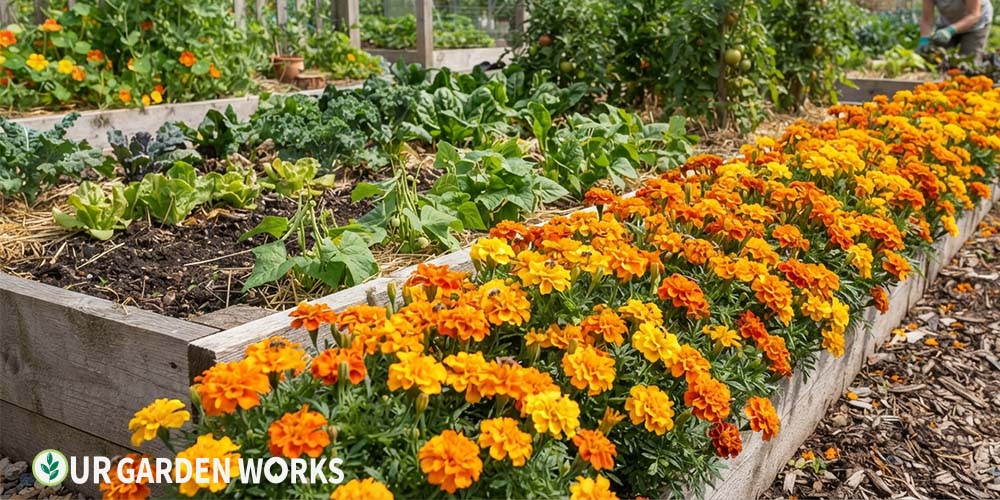
“Plant marigolds to repel pests” is one of the most repeated pieces of gardening advice in existence, which makes it worth asking directly: does the evidence actually back this up?
The honest answer is more nuanced than either the enthusiastic yes or the dismissive no you’ll find in different corners of the internet.
Quick Answer: Marigolds have genuine, research-supported effects against root-knot nematodes in soil and some evidence of deterring whiteflies through their scent. They do not provide the broad, garden-wide pest shield that folklore often claims — aphids, slugs, and many common pests show little to no consistent avoidance of marigolds in controlled studies.
The One Effect With Real Scientific Backing — Nematodes
French marigolds (Tagetes patula) produce a compound called alpha-terthienyl in their roots, and this is genuinely the best-documented pest-control mechanism marigolds have.
Alpha-terthienyl is toxic to root-knot nematodes — microscopic soil-dwelling worms that damage plant roots and stunt growth, particularly in tomatoes and many vegetables.
This effect is real, but it comes with an important caveat most companion-planting advice leaves out: it requires marigolds to be grown densely as a cover crop in the soil for a full season, then tilled in, rather than simply planted as a border around your vegetables.
A few marigolds scattered between tomato plants provide some benefit, but nowhere near the level of protection that a dedicated marigold cover crop rotation delivers.
How Alpha-Terthienyl Actually Works at the Cellular Level
It’s worth understanding the mechanism a bit further, since it explains why density and duration matter so much for this particular benefit.
Alpha-terthienyl is what’s called a phototoxic compound — it becomes significantly more damaging to nematode cells when activated by light, which is part of why the effect concentrates so heavily in and around the living root zone where the compound is actively produced and present in highest concentration.
A sparse scattering of marigold roots throughout a bed simply doesn’t generate enough of this compound, distributed widely enough through the soil, to meaningfully suppress a nematode population across the whole area.
A dense planting, by contrast, saturates the root zone with the compound throughout the entire growing season, and tilling the spent plants into the soil afterward releases additional compound from decomposing root tissue — which is exactly the two-stage process most casual “marigolds repel nematodes” advice skips over entirely.
This is also why the benefit is specifically tied to French marigolds rather than marigolds as a general category — alpha-terthienyl production varies meaningfully between marigold species and varieties, and the bulk of the supporting research used French marigold specifically rather than testing every type sold under the broader “marigold” name at a garden center.
What the Evidence Says About Other Pests
Whiteflies — Some Supporting Evidence
Marigold scent appears to have a modest deterrent effect on whiteflies in several studies, likely due to volatile compounds the plant releases that whiteflies find unappealing for feeding or egg-laying.
This is one of the stronger claims beyond nematode suppression, though the effect is generally described as a deterrent rather than a guarantee of avoidance.
Aphids — Weak or Inconsistent Evidence
Despite being one of the most commonly cited marigold benefits, controlled studies on aphid deterrence show inconsistent results — some find a mild effect, others find none.
If anything, marigolds can sometimes attract aphids themselves, meaning the popular advice may have the relationship partly backwards in some conditions.
Slugs, Beetles, and Most Chewing Insects — Little to No Evidence
The broad claim that marigolds repel “garden pests” generally doesn’t hold up against slugs, Japanese beetles, or most leaf-chewing insects in controlled research. If you’re dealing with these specifically, marigolds shouldn’t be your primary strategy.
Why the Marigold Myth Spread So Widely in the First Place
It’s worth understanding how a claim with such limited overall evidence became one of the most universally repeated pieces of gardening folklore, since the explanation says something useful about evaluating companion planting advice generally.
The nematode-suppression research is genuinely solid and dates back several decades, conducted by legitimate agricultural researchers studying crop rotation strategies.
Somewhere in the process of that specific, narrow finding being passed along through gardening books, magazines, and word of mouth, the qualifier — “suppresses nematodes when grown densely as a cover crop” — got dropped, and the claim broadened into a generic “marigolds repel pests” that then absorbed every other pest gardeners commonly worry about, regardless of whether any research ever supported those specific claims.
This pattern is worth watching for elsewhere in companion planting advice generally: a narrow, real finding about one specific mechanism and one specific pest frequently gets generalized into a much broader claim that the original research never actually made.
What Marigolds Are Genuinely Good For
Even setting aside the inflated pest-repellent reputation, marigolds earn their spot in a garden for reasons that are arguably more useful day-to-day.
- Attracting pollinators and beneficial insects: Marigold flowers are genuinely attractive to bees and to predatory insects like hoverflies, which feed on aphids in their larval stage.
- Visual pest monitoring: Marigolds can act as an early-warning indicator — spider mites and other pests sometimes show visible damage on marigold foliage before damage appears on nearby vegetables, giving you a head start on noticing a problem.
- Genuinely easy to grow: Whatever their pest-control merits, marigolds tolerate poor soil, heat, and irregular watering better than almost any other annual flower, making them a low-effort addition to any bed.
The pollinator-attraction benefit deserves a closer look, since it’s arguably more valuable to overall garden productivity than any direct pest-repellent effect would be even if the broader folklore were true.
Many vegetable crops — squash, cucumbers, melons — depend entirely on bee visits for fruit set, and a garden with more reliable pollinator traffic produces measurably better yields regardless of pest pressure.
Marigolds contribute to that traffic in a way that’s well-documented and doesn’t require the more uncertain claims about direct pest deterrence to justify planting them.
The early-warning function is also worth taking seriously as a practical tool rather than a minor side benefit.
Because marigolds are fast-growing and visually distinct from most vegetables, a gardener doing a quick visual scan tends to notice changes in marigold foliage — yellowing, stippling, chewed edges — faster than the same subtle changes on a tomato or pepper plant’s denser canopy.
Treating marigolds partly as a built-in monitoring system, alongside whatever ornamental and pollinator value they provide, is a genuinely useful way to think about their role in the garden.
💡 Plant marigolds for the real benefits, not the myth
If nematode suppression is your goal, grow marigolds densely as a dedicated rotation crop rather than scattered border plants.
If you want general pest monitoring and pollinator support, a border planting works well — just don’t expect it to replace active pest monitoring for problems like aphids or slugs covered in our spring garden pests guide.
Frequently Asked Questions
Does the marigold variety matter for pest control?
Yes — most of the nematode-suppression research specifically studied French marigolds (Tagetes patula), not the larger African marigolds (Tagetes erecta) often sold for ornamental display. If nematode control is your specific goal, look for French marigold varieties.
Should I still plant marigolds with my tomatoes even given the mixed evidence?
There’s little downside to it — marigolds are easy to grow, attract beneficial pollinators, and provide modest nematode suppression even in a border planting. Just plan your actual pest management strategy around proven methods rather than relying on marigolds alone.
Our tomato growing guide covers the rest of what tomatoes actually need to thrive, marigolds or no marigolds.
Do marigolds repel mosquitoes?
This is another widely repeated claim with limited direct evidence. Some studies suggest marigold extract has mild repellent properties against mosquitoes when concentrated, but a planted marigold border in open air provides nowhere near the concentration needed for a noticeable effect.
Should I bother planting marigolds at all, given the limited evidence for most claims?
Yes, generally — the genuine benefits (pollinator support, easy growing, visual monitoring, and real nematode suppression if grown densely) make marigolds worth including in most gardens, even setting aside the broader pest-repellent reputation.
The key is adjusting your expectations to match what’s actually documented rather than what folklore claims, so you’re not relying on marigolds alone to handle an aphid or slug problem that needs a different approach.
How to Think About Companion Planting Claims Generally
Marigolds are a useful case study for evaluating companion planting advice more broadly, since the gap between the narrow, real research and the broad, popular claim is so well documented in this specific case.
A reasonable approach is to treat any companion planting claim with a quick mental check: is this describing a specific mechanism (a chemical compound, a scent profile, a visual attraction) against a specific pest, or is it a vague, sweeping claim about general pest protection?
The former is far more likely to hold up under scrutiny, even if it requires more specific growing conditions than a quick border planting to actually deliver the benefit. The latter is exactly the pattern that produced the inflated marigold reputation in the first place.
This doesn’t mean dismissing companion planting outright — the nematode suppression effect alone is a legitimate, useful tool for gardeners dealing with that specific problem. It simply means reading the fine print on what a given companion plant actually does, rather than assuming a popular reputation reflects the full underlying evidence.
🐛 Related Articles in Our Pest Control Guide
Final Thoughts
We hope this gives you a more accurate picture of what marigolds can and can’t do in your garden — genuinely useful for nematodes and pollinators, less reliable as a broad pest shield.
For the pests marigolds don’t reliably handle, our pest control guides cover targeted treatment for each.
None of this is meant to discourage planting marigolds — quite the opposite.
Understanding exactly what they do well lets you use them more effectively, pairing the genuine nematode-suppression and pollinator benefits with a separate, evidence-based plan for whatever specific pest is actually troubling your garden, rather than relying on marigolds alone to handle a problem they were never well-documented to solve.
A border of marigolds plus a real treatment plan beats either one alone, and now you have a clearer sense of exactly what each part of that combination is actually doing for your garden.
Share this post with a fellow gardener who’s ready to get growing — and let us know in the comments what you’ve personally observed growing marigolds alongside your vegetables. Happy growing!
