

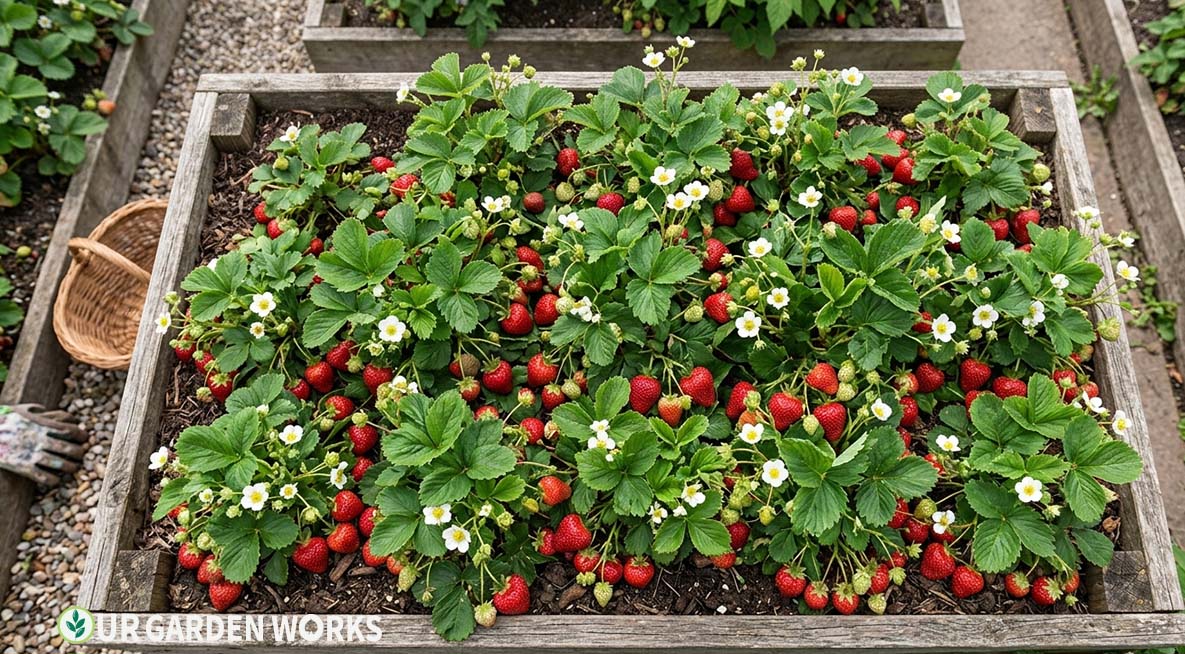
Here’s a little secret experienced gardeners don’t always share: strawberries are one of the most beginner-friendly perennial crops you can grow.
Plant them right once, and they’ll reward you with harvests for 3–5 years without replanting. The berry you pick warm from the garden tastes nothing like the cold, flavorless ones at the supermarket — and once you grow your own, you’ll understand why.
The biggest mistake beginners make with strawberries is planting too late and in soil that hasn’t been properly prepared. We’ll make sure you avoid both.
In this guide, you’ll get the complete planting-to-harvest process — plus the runner management technique that doubles your plant count for free every year.
How to Grow Strawberries – Quick Guide: Plant strawberry crowns in early spring, crown level with the soil surface — not buried, not too high. Full sun, well-draining slightly acidic soil (pH 5.5–6.5). June-bearing varieties produce one big crop; everbearing and day-neutral types produce smaller amounts all season. Harvest when berries are fully red with no white shoulders.
Choosing Your Strawberry Type
Your variety choice determines your harvest pattern for the next 3–5 years — so let’s get this right.
| Type | Harvest Pattern | Best Varieties | Best For |
|---|---|---|---|
| June-bearing | One large crop in 3–4 weeks (June) | Allstar, Earliglow, Jewel, Chandler | Preserves, jam, freezing — big batches at once |
| Everbearing | Two crops: spring and fall | Ozark Beauty, Fort Laramie | Fresh eating across the season |
| Day-neutral | Continuous light crop all season | Seascape, Albion, Tristar | Container growing, constant fresh supply |
Allstar (June-bearing) for in-ground beds — reliable, disease-resistant, excellent flavor. Albion (day-neutral) for containers — compact, productive all season, handles heat well. Pick one type and get it right before mixing.
Strawberry Growing Requirements
🍓 What Strawberries Need
- Sunlight: Full sun — 8+ hours. More sun = more fruit, more flavor.
- Soil pH: 5.5–6.5. Slightly acidic is essential. Above 6.5, iron becomes unavailable and leaves yellow.
- Soil drainage: Critical. Strawberry roots rot in waterlogged soil within days. Raised beds are ideal.
- Spacing: 18 inches between plants, 3–4 feet between rows (for runners to fill).
- Years of production: 3–5 years with good care, then replant from runners.
Strawberries are also surprisingly cold-hardy once established — most varieties tolerate winter temperatures well below freezing as long as the crown is protected with mulch. The bigger long-term risk isn’t cold, it’s disease buildup in an aging bed, which is exactly why the runner-based renovation strategy covered below matters so much for a planting you intend to keep productive for several years.
How to Grow Strawberries: Step by Step
Step 1 — Prepare the Bed
Directions
- Choose the sunniest spot in your garden — no exceptions here. Shade is the number-one reason strawberry beds underperform.
- Test soil pH. If above 6.5, lower it by working in sulfur (follow package rates). If below 5.5, add small amounts of lime.
- Work in 3–4 inches of compost and a balanced fertilizer (10-10-10). Strawberries are moderate feeders — well-amended soil at planting sets the tone for years.
- Eliminate all perennial weeds thoroughly before planting. Quack grass and bindweed growing through a mature strawberry bed are nearly impossible to remove without pulling the entire planting.
Step 2 — Plant at Exactly the Right Depth
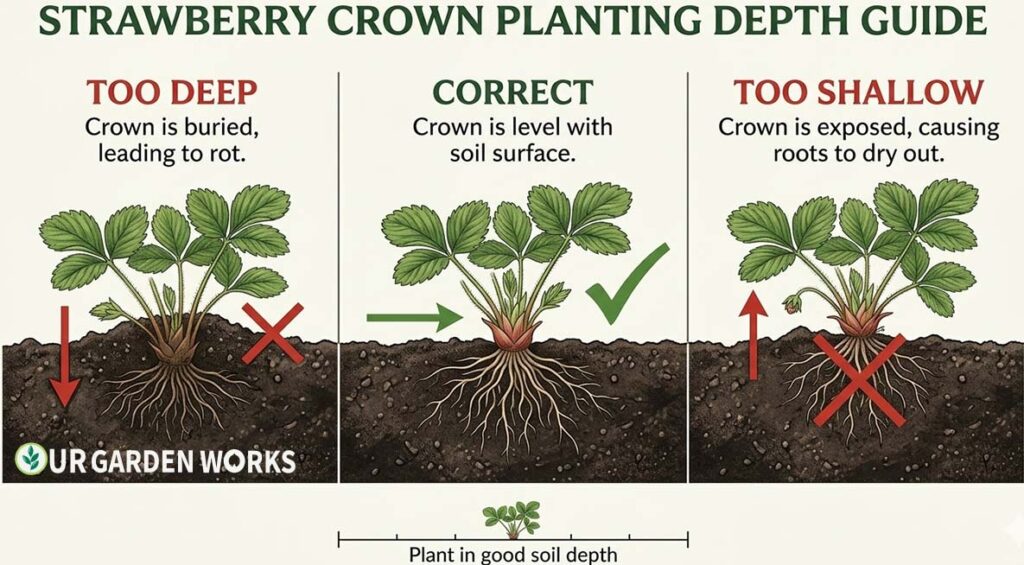
This is the single most critical strawberry planting technique. Get the crown depth wrong and the plant either rots (planted too deep) or desiccates and dies (planted too shallow). The crown — the growing point where leaves emerge — must sit exactly at the soil surface.
Directions
- Soak bare-root strawberry crowns in water for 1 hour before planting if they look dry.
- Dig a hole wide enough to spread roots out fully — roots should not be coiled or bent.
- Create a small mound at the bottom of the hole. Drape roots over the mound with the crown at the mound’s peak — level with the surrounding soil.
- Backfill, firming soil around the roots but leaving the crown exposed.
- Water thoroughly immediately after planting.
⚠️ Don’t bury the crown
A buried crown rots within 2 weeks. If in doubt, plant slightly higher rather than lower — you can always mound soil up later, but you can’t undo crown rot.
Step 3 — Remove First-Year Flowers (June-Bearing Only)
This feels counterintuitive, but pinching off flowers in the first year dramatically improves long-term production. Letting a first-year plant fruit diverts all its energy into berries instead of building the strong root system that produces heavy harvests in years 2 and 3. Sacrifice the first harvest, double the future ones.
Step 4 — Mulch Heavily
Apply 2–3 inches of straw mulch between plants. Straw mulch prevents the soil splash that causes gray mold (botrytis) on fruit, keeps berries clean and off the soil, retains moisture, and suppresses weeds.
In fall, mound straw over the entire planting 3–4 inches deep for winter protection in Zones 5 and colder — remove it in spring when growth resumes.
Step 5 — Manage Runners
Strawberry plants send out long stems called runners that root at nodes to form new plants. These are free propagation material — or they’re weeds stealing energy from your fruit production. Your management depends on your goal:
- Want more plants (renovation): Let runners root in designated gaps in your bed. After rooting, sever the runner from the mother plant.
- Want maximum fruit production: Remove all runners as soon as they appear. This forces the mother plant to put all energy into fruit.
- Replanting beds: After year 3, beds naturally decline. Root runners from your best-performing mother plants into a new prepared bed. You’ll never need to buy new plants.
Watering, Fertilizing, and Pest Management
Watering: 1–1.5 inches per week during the growing season. Consistent moisture is especially critical during fruit development — water stress during this period causes small, seedy fruit. Drip irrigation is ideal: it delivers water at the root zone and keeps berries dry, dramatically reducing gray mold.
Fertilizing: Feed once in early spring as growth resumes with a balanced 10-10-10. Don’t over-fertilize with nitrogen — it pushes leafy growth at the expense of fruit. A second light feeding after the June harvest (June-bearing types) supports runner production and next year’s bud formation.
Gray mold (botrytis): The primary strawberry disease. Caused by wet fruit and poor airflow. Prevention: straw mulch, adequate spacing, and harvesting frequently so no overripe berries sit in the bed. For a full treatment guide, see our garden pest control guide.
Slugs: Love strawberries. Diatomaceous earth around the bed perimeter and picking at dusk catches most of them.
When and How to Harvest
Pick strawberries when they’re fully red — including the shoulders (the area near the cap). White-shouldered berries are under-ripe and will be hard and flavorless. Unlike tomatoes, strawberries don’t ripen meaningfully off the plant — pick fully ripe only.
Harvest in the morning when berries are cool and firm. Use scissors to cut the stem above the cap — pulling the berry tears the stem and bruises the fruit. Check the bed every 1–2 days at peak season; overripe berries left on the plant encourage mold.
Frequently Asked Questions
How long before strawberries produce fruit?
June-bearing plants produce in year 2 if you pinch flowers in year 1. Everbearing and day-neutral types produce a light crop in their first year. All types reach peak production in years 2–3.
Can I grow strawberries in containers?
Yes — day-neutral varieties like Albion and Seascape are excellent container strawberries. Use at least an 8-inch diameter pot per plant with good drainage, and feed every 2 weeks with a balanced liquid fertilizer. See our strawberries in containers guide.
Why are my strawberries small?
Small fruit usually comes from one of three causes: water stress during fruit development, overcrowded beds where plants compete for nutrients, or an aging planting (3+ years) that needs renovation. Check watering consistency first — it’s the most common culprit.
When should I renovate my strawberry bed
Renovate June-bearing beds right after harvest — mow foliage to 1 inch, thin plants to 6 inches apart, fertilize, and apply fresh mulch. This resets the bed for another 2–3 years of production.
Related Articles in Our Vegetable Gardening Guide
- Growing Strawberries in Containers: Pots, Planters & Hanging Baskets (2026)
- How to Grow Kale: Year-Round Harvests Even in Frost (2026)
- Free tool: Succession Planting Scheduler — Never Run Out of Fresh Vegetables Again
- What to Plant with Garlic – Best and Worst Companion Plants
- Vegetable Gardening Guide
Final Thoughts
We hope this guide gives you everything you need to plant a strawberry bed that rewards you for years to come. The crown-depth technique is the one to really nail — get that right and strawberries are one of the most low-maintenance productive crops you can grow.
For all our vegetable growing guides, our vegetable gardening guide links to everything.
Share this post with a fellow gardener who’s ready to grow their own — and let us know in the comments which variety you’re planting and whether you’re going with a bed or containers. Happy growing!
