

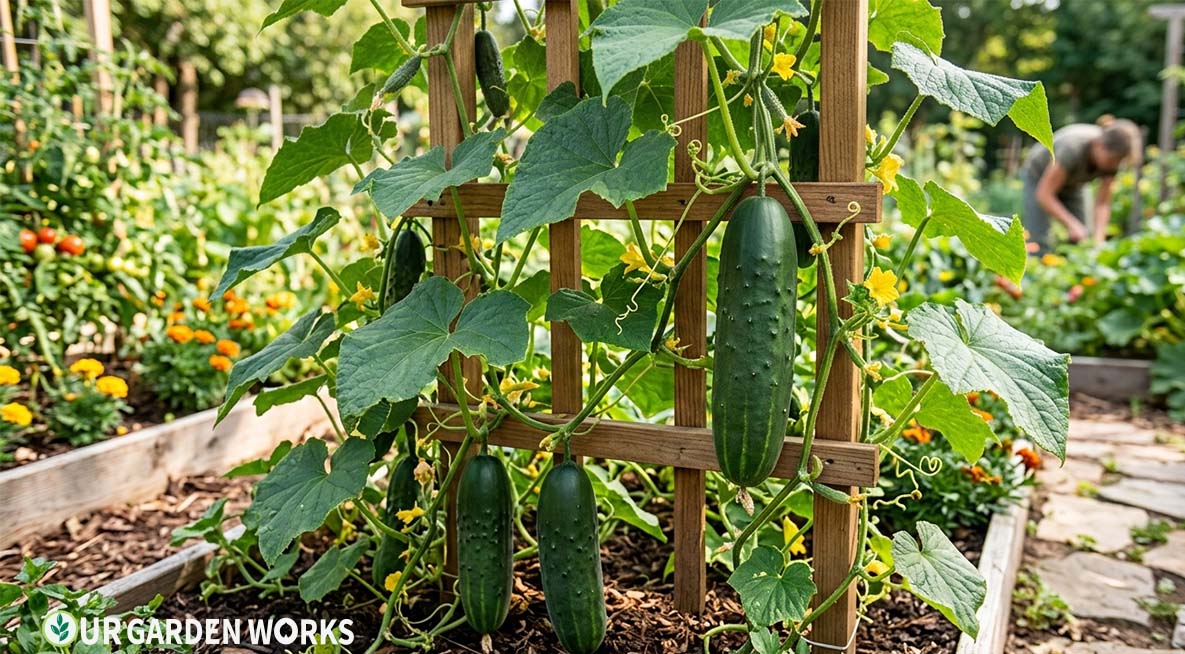
Cucumbers are one of those crops where the homegrown version tastes nothing like what you buy at the store.
Fresh-picked cucumbers are crisp, fragrant, and never waxy — because they haven’t been coated in food-grade wax to survive a 2,000-mile supply chain. Once you grow your own, the grocery store version genuinely tastes wrong.
They’re also one of the fastest producers in the vegetable garden. Plant cucumbers in warm soil and you can be harvesting in as little as 50 days. The main challenges — and we’ll cover both — are giving them the heat and vertical space they want, and harvesting frequently enough to keep the plant producing.
In this guide, you’ll learn how to grow cucumbers from soil prep through final harvest, including the trellis setup that doubles your yield per square foot, the watering rhythm that prevents bitter fruit, and the harvesting frequency that keeps plants producing all season.
How to Grow Cucumbers: Plant cucumbers outdoors when soil reaches 70°F — they’re cold-sensitive and won’t germinate well below this. Direct-sow seeds ½ inch deep or transplant starts with 2–3 true leaves. Grow vertically on a trellis. Harvest every 1–2 days at peak season — leaving overripe cucumbers on the vine stops production.
Slicing vs. Pickling Cucumbers — Which to Grow
You need to make this choice first because the varieties, harvest timing, and end use differ significantly.
| Type | Best Varieties | Harvest Size | Best For |
|---|---|---|---|
| Slicing | Marketmore, Straight Eight, Bush Pickle | 6–8 inches | Fresh eating, salads |
| Pickling | National Pickling, Calypso, Picklebush | 3–4 inches | Pickling, brining |
| English / seedless | Telegraph, Diva, Sweet Success | 12–14 inches | Fresh eating, no peeling needed |
| Lemon cucumber | Lemon (heirloom) | Tennis-ball size | Fresh eating, mild flavor |
| Armenian / Asian | Armenian, Japanese Long | 12–20 inches | Fresh eating, thin skin |
💡 Start with Marketmore or Diva
For beginners, Marketmore 76 is the most reliable slicing cucumber — disease-resistant, productive, and widely available. Diva is even easier (no bitterness even when overgrown) and won a 2002 All-America Selections award. Both are excellent first-season choices.
Cucumber Growing Requirements
🥒 Cucumber Growing Requirements
- Sunlight: Full sun — 8+ hours. Non-negotiable for production.
- Soil temperature: 70°F minimum for germination. Don’t rush planting.
- Soil pH: 6.0–7.0. Broad tolerance, same compost-rich base as all vegetable beds.
- Watering: 1–2 inches per week, consistent. Inconsistent watering = bitter cucumbers.
- Spacing: 12 inches apart on a trellis; 24–36 inches without support.
- Days to harvest: 50–70 days from transplanting.
How to Grow Cucumbers: Step by Step
Step 1 — Direct Sow or Transplant
Cucumbers can be direct-seeded or started indoors. Unlike tomatoes and peppers, they don’t benefit from a long indoor head start — cucumbers grow so fast that a 3-week-old transplant often catches up to one planted 6 weeks indoors within 2 weeks of going outside. Direct sowing into warm soil is often the better choice.
Direct sowing: Sow seeds ½ inch deep when soil reaches 70°F. Seeds germinate in 3–7 days in warm soil. Plant 3 seeds per spot and thin to 1–2 strongest seedlings.
Transplanting: Start indoors 3–4 weeks before your last frost in 3-inch peat pots. Cucumbers hate root disturbance — plant the whole peat pot into the ground without disturbing the root ball. Transplant when soil is 70°F+ and seedlings have 2–3 true leaves.
Step 2 — Set Up Your Trellis Before Planting
Install your trellis or support structure before plants go in the ground. Doing it after planting risks damaging shallow roots and disturbing seedlings.
Trellis Options (Ranked by Ease)
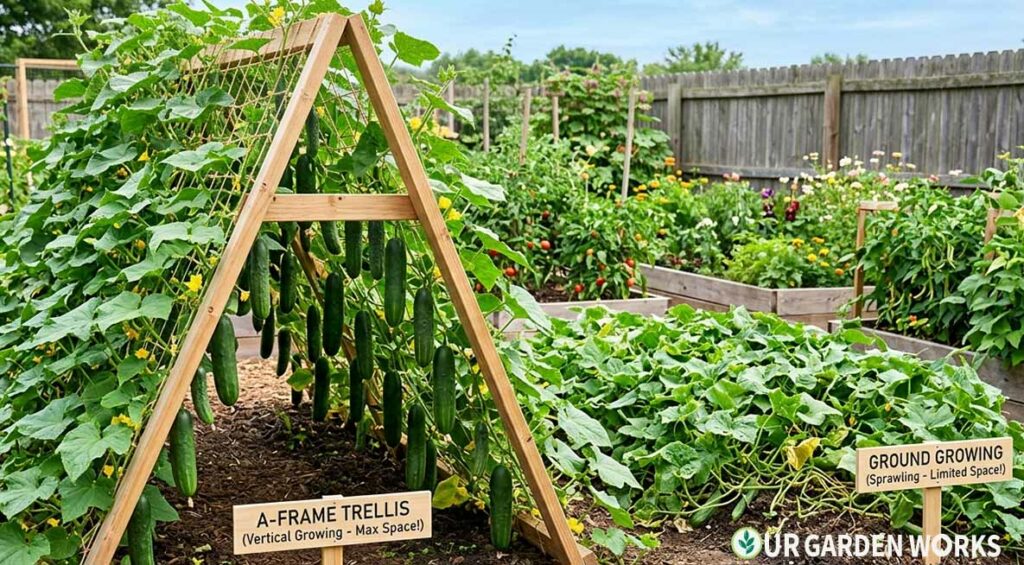
- A-frame trellis: Two panels joined at the top. Plant along each side. Cucumbers hang down, easiest to harvest, most space-efficient.
- Wire or string trellis between T-posts: Run horizontal wires at 12-inch intervals from a post at each end. Simple and effective for long rows.
- Cattle panel arch: Bend a 16-foot cattle panel into an arch — plant along both sides. The tunnel created underneath provides shade for heat-sensitive crops.
- Tomato cage: Works for compact bush varieties, though it limits airflow more than the above options.
Step 3 — Plant and Mulch
- Plant 12 inches apart along the base of your trellis. For ground-growing without support, space 24 inches apart in rows 36 inches wide.
- Apply 2–3 inches of mulch immediately. Cucumbers have shallow roots and benefit more from mulch than almost any other vegetable — it keeps soil consistently moist and prevents the soil splash that spreads bacterial wilt.
- Water immediately after planting.
Step 4 — Train Vines and Water Consistently
Training: As vines grow, weave them through or tie them loosely to the trellis every 6–8 inches with soft ties. This keeps the plant open to airflow and positions cucumbers for easy harvesting.
Watering: This is the biggest factor in cucumber quality. Water at the soil level (never overhead) and keep moisture consistent — not wet, not dry. Inconsistent moisture is the primary cause of bitter cucumbers. The bitterness compound (cucurbitacin) increases in water-stressed plants.
Step 5 — Fertilize
Work balanced 10-10-10 into the soil at planting. Once flowering begins, switch to a fertilizer with more phosphorus and potassium (5-10-10). Cucumbers are heavy potassium users — potassium deficiency shows as yellowing leaf edges and significantly reduces yield.
For our full fertilizer guide for cucumbers, see best fertilizers for cucumbers.
Pollination — Why Your Cucumbers Have Flowers But No Fruit
This is the most common cucumber question we get: “My plant is full of flowers but I’m not getting any cucumbers.” The answer is pollination.
Cucumbers produce separate male and female flowers on the same plant. Male flowers appear first — often 1–2 weeks before female flowers — and they won’t set fruit. This is normal. Female flowers have a tiny immature cucumber at their base before the flower even opens. They need a bee to transfer pollen from a male flower.
- If you have lots of male flowers and few or no female flowers: Normal early in the season. Be patient.
- If you have female flowers but no fruit forming: Pollination is failing. The most common cause is spraying pesticides during the day when bees are active. Spray in the evening only.
- Gynoecious varieties: Some hybrids produce almost all female flowers. They come with a small packet of pollinator seeds — plant a few of these alongside for cross-pollination.
When to Harvest Cucumbers
This is where most home gardeners lose production. Cucumbers left on the vine past their prime don’t just taste worse — they signal the plant to stop making new cucumbers. Once the plant has made seed, its reproductive work is done.
- Slicing cucumbers: Harvest at 6–8 inches long, dark green, and firm. The day you notice them reaching size, pick them — they grow an inch per day in warm weather.
- Pickling cucumbers: Harvest at 3–4 inches. Smaller = crispier pickles. Don’t let them yellow.
- English/seedless: Harvest at 12–14 inches or when they’ve reached full length for the variety.
- Frequency: Check every 1–2 days at peak season. Never let a cucumber turn yellow on the vine — yellow = overripe = production stop signal.
For more detail on harvest timing across all vegetables, see our when to pick cucumbers guide.
Common Cucumber Problems and Fixes
- Bitter cucumbers: Water stress. Keep moisture consistent and mulch well.
- Yellow leaves on lower vine: Normal aging as the plant directs energy upward. Remove yellowing lower leaves to improve airflow.
- Powdery mildew (white coating): End-of-season fungal issue. Improve airflow, apply neem oil or baking soda spray. See pest control guide.
- Cucumber beetle damage (yellow-striped beetles, wilting): One of the most serious cucumber pests. Yellow sticky traps and neem oil spray. Remove and destroy infected plants immediately if bacterial wilt sets in — it spreads through beetle feeding and has no cure.
- Leaves turning yellow broadly: See our cucumber leaves turning yellow guide for specific diagnosis.
Frequently Asked Questions
Do cucumbers need a trellis?
No, but trellising doubles your yield per square foot, dramatically improves airflow (reducing disease), makes harvesting easy, and produces straighter cucumbers. Bush varieties can grow without support, but vining varieties will spread 5–6 feet on the ground without a trellis. For any space-limited garden, a trellis is worth the 20 minutes to install.
Why are my cucumbers short and fat instead of long?
Usually pollination failure — poor pollination produces misshapen fruit. It can also indicate inconsistent watering during fruit development. Ensure bees have access to flowers (no daytime spraying) and keep moisture consistent.
Can I grow cucumbers in a pot?
Yes — use a minimum 5-gallon container for bush varieties and a 10-gallon with a trellis for vining types. Containers dry out quickly in summer — daily watering is often necessary. See our growing cucumbers in containers guide for the full setup.
What should I plant alongside cucumbers to help them along?
Nasturtiums, radishes, dill, and marigolds are the most reliable companions — they reduce aphid and cucumber beetle pressure and draw in pollinators, addressing the three biggest cucumber challenges without any spraying. Avoid planting cucumbers near potatoes, fennel, or melons, which either share diseases or concentrate pest pressure. See our full companion plants for cucumbers guide for the complete layout.
🥬 Related Articles in Our Vegetable Gardening Guide
Final Thoughts
We hope this guide has taken the mystery out of cucumber growing — because once you understand the trellis, the watering rhythm, and the harvest frequency, cucumbers become one of the most productive and low-maintenance crops in your garden.
For all our vegetable growing guides, our vegetable gardening guide is always a good place to start.
Share this post with a fellow gardener who’s ready to get growing — and let us know in the comments which variety you’re trying this season and whether you’re going vertical. Happy growing!
