

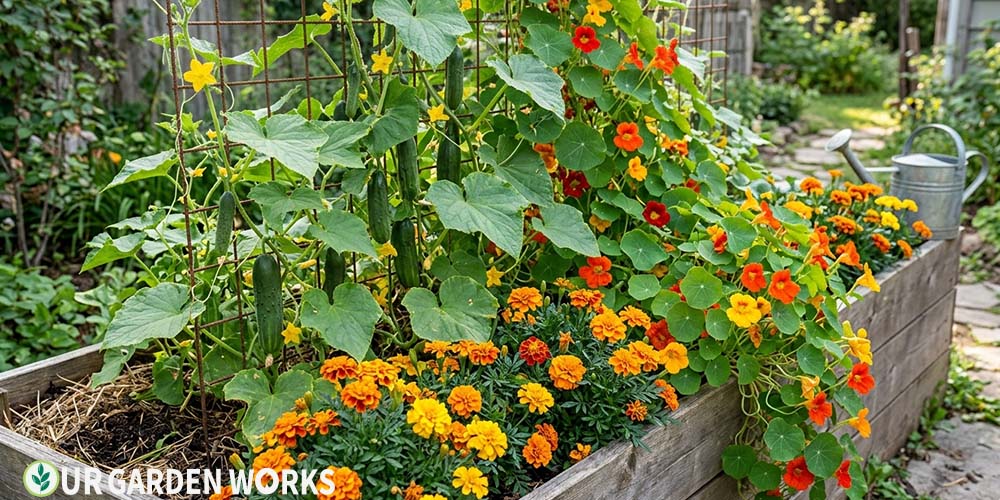
Cucumbers have a fairly short list of enemies in the garden — but those enemies are serious.
Cucumber beetles transmit bacterial wilt, which can kill a plant in days with no cure. Aphids colonize new growth. And powdery mildew arrives reliably by late summer in most climates. The right companion plants address all three problems without a single spray.
In this guide, we’ll cover the best companions for cucumbers with the mechanism behind each one, the plants you should keep well away, and a practical layout for a raised bed that puts them all together.
What’s the best companion plants for cucumbers? The best companion plants for cucumbers are nasturtiums (trap crop for aphids), radishes (repel cucumber beetles), marigolds (attract beneficial insects), dill (attracts parasitic wasps), and sunflowers (pollinator attractors). Keep potatoes, aromatic herbs like sage, and fennel away from cucumbers.
The 8 Best Companion Plants for Cucumbers
#1 Nasturtiums — Best for Aphid Control
Nasturtiums are irresistible to aphids — they preferentially colonize nasturtiums over cucumbers, making them the perfect trap crop.
Plant them at the perimeter of your cucumber bed, not interplanted. Spray the nasturtiums with insecticidal soap when aphid colonies build up, or let ladybirds and lacewings do it for you.
See our insecticidal soap guide for the right product.
#2 Radishes — Best for Cucumber Beetle Deterrence
Radishes are the most-cited companion for cucumber beetle deterrence. Interplant radishes between cucumber seedlings — they don’t compete significantly and their volatile root compounds repel cucumber beetles, which are the primary vector for bacterial wilt.
Leave some radishes to flower (don’t harvest all of them) — the flowers attract parasitic wasps that parasitize cucumber beetle larvae.
#3 Sunflowers — For Pollination
Cucumbers need bee pollination for fruit set. Sunflowers are exceptional bee attractors — bees foraging on the large open flower heads will also visit cucumber flowers nearby. Plant on the north side of your cucumber bed so they don’t cast shade.
#4 Dill (Flowering Stage) — For Beneficial Insects
Allow dill to bolt and flower near your cucumber bed. Flowering dill is one of the most powerful attractors of parasitic wasps — insects that prey on aphids, cucumber beetles, and caterpillars.
The tiny flowers provide nectar for these beneficial insects that flower with too small an opening for bees to access efficiently.
#5 French Marigolds — For Nematodes and General Pest Suppression
Dense plantings of French marigolds produce alpha-terthienyl from their roots — toxic to soil nematodes. Above-ground, their scent deters whiteflies and their flowers attract pollinators and beneficial insects. See our full companion planting guide for the full mechanism.
#6 Beans — For Soil Nitrogen
Pole beans fix atmospheric nitrogen in root nodules, effectively fertilizing the surrounding soil.
Cucumbers are nitrogen-hungry — planting beans nearby provides a slow-release nitrogen source that benefits cucumbers without pushing excessive leafy growth the way synthetic nitrogen fertilizers can.
#7 Corn — For Wind Protection and Vertical Structure
Corn isn’t a traditional companion in the pest-deterrence sense, but it offers something equally valuable in exposed gardens: a windbreak.
Tall corn stalks planted on the windward side of a cucumber bed reduce the physical stress of strong wind on young cucumber vines and can provide light afternoon shade in particularly hot climates without significantly competing for soil nutrients, since the two crops draw from slightly different soil depths.
#8 Oregano — For Ground Cover and General Pest Deterrence
Low-growing oregano planted at the base of cucumber plants acts as a living mulch, suppressing weeds and helping retain soil moisture around the cucumber’s relatively shallow root system.
Its strong aromatic oils are also believed to confuse a range of generalist pest insects searching for cucumber plants by scent, adding a mild layer of deterrence on top of its practical ground-cover benefits.
Plants to Keep Away from Cucumbers
- Potatoes: Share diseases, particularly blight. Keep separate.
- Aromatic herbs (sage, rosemary, basil in large quantities): Some research suggests strong-scented herbs in close proximity can inhibit cucumber growth.
- Fennel: Allelopathic to most vegetables — keep it isolated.
- Melons: Share the same pests (cucumber beetle, aphids) and diseases. Planting together concentrates pest pressure.
⚠️ Why shared pests matter more than shared diseases
When two crops attract the same pest, planting them side by side doesn’t just risk spreading disease — it concentrates the pest population in one area, making an outbreak more severe for both crops simultaneously. This is the main reason melons and cucumbers, despite both being excellent vegetables individually, are best kept in separate parts of the garden rather than interplanted.
Why Companion Planting Works for Cucumbers Specifically
Cucumbers face a fairly narrow set of recurring problems compared to many vegetables, which actually makes companion planting unusually effective for this particular crop.
The cucumber beetle is the single most important pest to manage, not because the beetle itself does much damage by chewing leaves, but because it’s the primary carrier of bacterial wilt — a disease with no cure that can take down a healthy, fruiting plant within a week of infection.
Any companion strategy that reduces cucumber beetle pressure is doing more than cosmetic pest control; it’s protecting against the one problem that can end your harvest entirely.
The second recurring issue is pollination. Cucumbers produce separate male and female flowers on the same plant, and fruit only sets when pollen is physically transferred from one to the other, almost always by bees.
A cucumber bed with poor pollinator activity produces flowers that simply wither and drop instead of becoming fruit, regardless of how well you’ve watered and fed the plants.
Companion plants that draw bees into the area solve a problem that no amount of fertilizer can fix.
The third issue, fungal disease, tends to arrive later in the season as humidity and plant density increase.
While companion planting can’t fully prevent powdery mildew or downy mildew on its own, the air circulation benefits of a well-spaced companion layout, combined with beneficial insects that keep aphid populations (which stress plants and increase disease susceptibility) in check, meaningfully reduce the severity of an outbreak when it does arrive.
Practical Companion Layout for a 4×8 Raised Bed
- Center: 3 cucumber plants on a trellis along the back of the bed
- Front edge: Radishes sown between and in front of cucumber seedlings
- Corners: 2 nasturtium plants (let them sprawl slightly outside the bed)
- Side border: French marigolds along the full perimeter
- Adjacent bed or separate row: Sunflowers to the north, dill allowed to flower
- Ground cover beneath cucumbers: A few oregano plants tucked at the base of the trellis
If you’re planning this layout alongside other crops in the same garden, our vegetable garden planner can help you check that the spacing for cucumbers, beans, and corn together still fits comfortably within your available bed space before you commit seeds to soil.
Frequently Asked Questions
Can I plant cucumbers next to tomatoes?
Yes — cucumbers and tomatoes are compatible companions. They don’t share significant diseases (unlike tomatoes and potatoes) and their different root depths reduce competition. The main consideration is that both need significant space — don’t crowd them together.
Do companion plants eliminate the need for pest treatment?
They reduce pest pressure — they don’t eliminate it. In a high-pressure year with significant cucumber beetle populations, you’ll still need to monitor and potentially treat. Companions are one layer of a broader pest management approach.
How far apart should companion plants be from cucumbers to be effective?
It depends on the mechanism. Trap crops like nasturtiums and beetle-deterrents like radishes need to be within a foot or two of the cucumber plants to have a meaningful effect.
Pollinator-attracting flowers like sunflowers can be effective from several feet away, since the goal is simply to bring more bee activity into the general area rather than directly adjacent to each cucumber flower.
Will companion planting work in a container instead of a garden bed?
Yes, on a smaller scale. A large container (15 gallons or more) can comfortably fit a trellised cucumber with a single nasturtium or a few radishes tucked around its base.
For pollinator and beneficial-insect companions like sunflowers and flowering dill, plant them in a nearby separate container rather than competing for root space in the same pot, since their root systems are more demanding than the small-scale trap crops.
🥬 Related Articles in Our Vegetable Gardening Guide
Final Thoughts
We hope this guide helps you build a cucumber bed that’s genuinely pest-resistant from the ground up.
Companion planting is most effective when it’s built into your garden plan from the start — not added as an afterthought. For all our vegetable growing guides, our vegetable gardening guide links to everything.
Share this post with a fellow gardener who’s ready to get growing — and let us know in the comments which companions you’re already using alongside your cucumbers. Happy growing!
