
(Enter your lawn area in square feet and select your grass type. The calculator shows the correct overseeding seed rate in pounds, the starter fertilizer amount, and the optimal timing window for your zone.)
Overseeding is the most cost-effective way to thicken a thin, patchy lawn — but the seed rate and timing window are both critical. Too little seed and bare patches don’t fill in.
Too much and seedlings compete with each other for resources, producing weak, thin grass. And overseeding at the wrong time of year — for your specific grass type and zone — can result in nearly zero germination despite doing everything else right.
Editor’s Note: Cool-season grasses (fescue, bluegrass, ryegrass): overseed in late August to mid-September — when soil is still warm for germination but air is cooling for establishment. Warm-season grasses (Bermuda, zoysia): overseed in late spring through early summer after green-up. Seed rates: overseeding (existing lawn) uses half the rate of new seeding — typically 2–5 lbs per 1,000 sq ft depending on grass type.
Overseeding Rates by Grass Type
| Grass Type | Overseed Rate | New Lawn Rate | Best Timing |
|---|---|---|---|
| Kentucky Bluegrass | 1–2 lbs/1,000 sq ft | 2–3 lbs | Late Aug–mid-Sep |
| Tall Fescue | 4–6 lbs/1,000 sq ft | 6–8 lbs | Late Aug–Sep |
| Fine Fescue | 2–4 lbs/1,000 sq ft | 4–5 lbs | Late Aug–Sep |
| Perennial Ryegrass | 4–6 lbs/1,000 sq ft | 8–10 lbs | Late Aug–Sep |
| Bermuda Grass | 1–2 lbs/1,000 sq ft | 2–3 lbs | Late May–Jul |
| Zoysia Grass | 1–2 lbs/1,000 sq ft | 2–3 lbs | Late May–Jun |
| St. Augustine | Not typically seeded — sprig or sod | Sprig or sod only | Spring–early summer |
These rates assume you are filling in an existing lawn that has at least 50% grass coverage.
For bare areas over 50% of the lawn, use the new lawn rate — more seed is needed where there is no existing grass to fill in around. For the full spring lawn care context around overseeding timing, our spring lawn care schedule covers where overseeding fits in the overall lawn care sequence.
The Overseeding Process — For Best Germination
Step 1 — Aerate First
Core aerate the lawn before overseeding. The aeration holes provide direct seed-to-soil contact — germination rates in aeration holes are dramatically higher than seed cast on solid turf.
Step 2 — Mow Low
Mow the existing lawn at the lowest setting before overseeding. This reduces competition from existing grass and allows seed to reach the soil surface. Bag the clippings rather than mulching — you want clear access to the soil.
Step 3 — Apply Seed
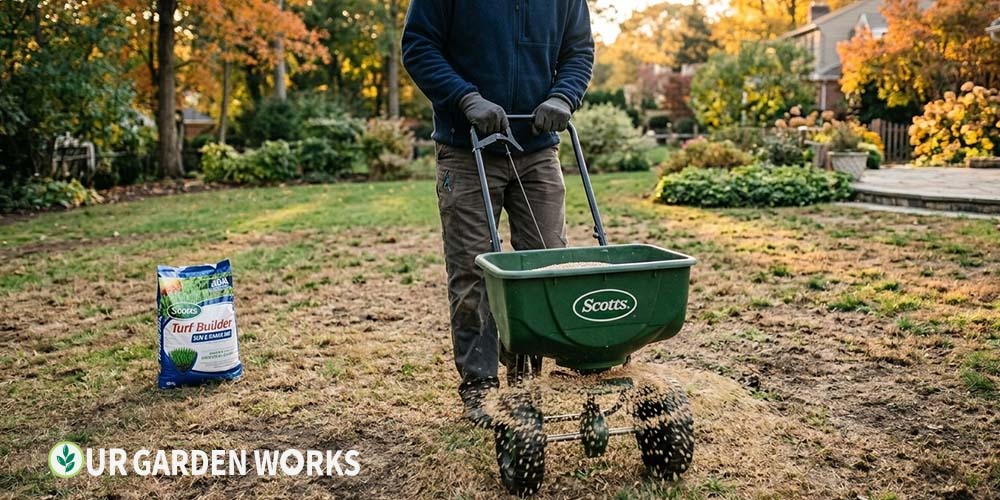
Use a broadcast spreader at the calculated rate. Make two passes in perpendicular directions — half the rate in each direction — for even coverage. Do not seed when wind is forecast above 10 mph.
Step 4 — Apply Starter Fertilizer
Apply a starter fertilizer (high phosphorus — typically 10-18-6 or similar) immediately after seeding. Phosphorus supports root development in new seedlings. Do NOT apply a pre-emergent at this stage — it will prevent grass seed germination.
Step 5 — Water Consistently
Water lightly 2–3 times daily for the first 2 weeks — just enough to keep the top half-inch of soil moist. Once seedlings reach 1 inch tall, shift to deeper, less frequent watering. Do not allow newly seeded areas to dry out completely during the germination period. For irrigation equipment suited to this gentle, frequent application, our best lawn sprinkler for low water pressure guide covers options for consistent light coverage.
Frequently Asked Questions
Can I overseed and apply pre-emergent at the same time?
No — this is a critical conflict. Pre-emergent herbicides prevent all seeds from germinating, including the grass seed you just applied. If you apply pre-emergent in spring for crabgrass control, you cannot overseed in that same spring application window.
The standard recommendation: overseed in fall, apply pre-emergent in spring. Or, if you need to overseed in spring, skip the pre-emergent that year and manage any crabgrass with post-emergent treatment later. Our pre-emergent timing guide covers this timing conflict in detail.
How long before I can mow newly overseeded areas?
Wait until new seedlings reach 3–3.5 inches tall before the first mow — typically 3–4 weeks after germination in good conditions. The first mow should be at the highest setting, removing no more than one-third of the blade height.
Mowing new seedlings too early or too short can uproot them, as their root systems have not yet established. Stay off newly seeded areas entirely for the first 2 weeks — foot traffic compacts the soil and can displace seeds before they germinate.
Free Tools & Guides:
Final Thoughts
We hope this calculator gives you the confidence to finally tackle that thin, patchy lawn this season.
Overseeding is genuinely one of the most rewarding lawn projects — the results are visible within 3 weeks and dramatic by 6 weeks. For the full lawn care picture including timing and product guidance, our spring lawn care schedule covers everything in sequence.
Share this free tool with a fellow gardener who has been looking at their patchy lawn every year and putting off the overseeding project because they were not sure of the seed rates or timing — and let us know in the comments how it helped. Happy growing!
