
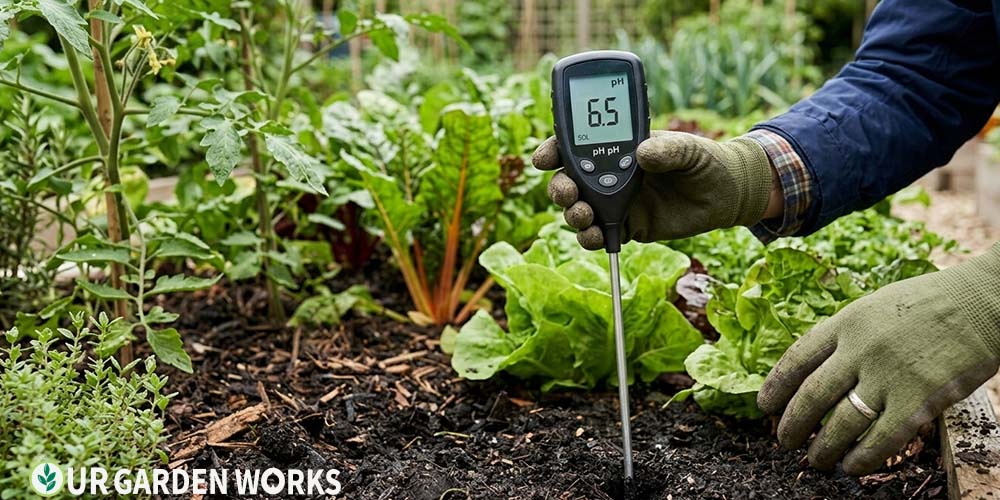
(Enter your current soil pH, your target pH for the crops you want to grow, and your soil type (clay, loam, or sandy). The calculator shows the exact lime or sulfur quantity to add per 100 square feet.)
Soil pH is the single most overlooked factor in vegetable gardening performance. When pH is off — even slightly — nutrients that are physically present in your soil become chemically unavailable to plant roots. You can fertilize a low-pH garden generously, and your plants will still show deficiency symptoms, because the nutrients are locked up. Correcting pH before planting unlocks everything else you add to the soil.
This calculator takes the guesswork out of pH amendment. Enter your current reading, your target pH for the crops you’re growing, and whether your soil is clay, loam, or sandy — and it tells you exactly how much garden lime or elemental sulfur to add per 100 square feet.
Editor’s Note: Most vegetables grow best in the 6.0–7.0 pH range. To raise pH: add ground limestone (dolomitic lime) — 5–10 lbs per 100 sq ft to raise by one full point in loam soil. To lower pH: add elemental sulfur — 1–2 lbs per 100 sq ft to lower by one point in loam soil. Clay soil requires 1.5–2× as much amendment; sandy soil requires about half as much. Always retest 2–3 months after amending.
Why pH Matters More Than Fertilizer
Soil pH is measured on a logarithmic scale from 1 (most acidic) to 14 (most alkaline), with 7.0 being neutral. Most vegetables evolved in slightly acidic soils — between 6.0 and 7.0 — and that range is where nitrogen, phosphorus, potassium, calcium, and the trace minerals are most available to roots simultaneously.
Below pH 6.0, phosphorus becomes increasingly unavailable. Aluminium and manganese become soluble at toxic levels in very acidic soils. Above pH 7.5, iron and manganese become unavailable, causing the yellowing between leaf veins called chlorosis. At either extreme, even well-fertilised plants show deficiency symptoms because the chemistry of nutrient availability has been disrupted.
| Crop | Optimal pH Range | Sensitive to Low pH? |
|---|---|---|
| Tomatoes | 6.0–6.8 | Yes — blossom end rot worsens below 6.0 |
| Peppers | 6.0–6.8 | Moderate |
| Cucumbers | 6.0–7.0 | Moderate |
| Beans | 6.0–7.0 | Low — tolerate down to 5.5 |
| Brassicas | 6.5–7.5 | Yes — prefer slightly alkaline to prevent clubroot |
| Potatoes | 4.8–6.0 | Prefer acid — scab disease worsens above 6.5 |
| Blueberries | 4.5–5.5 | N/A — require acid soil; fail above 6.0 |
| Carrots | 6.0–6.8 | Moderate |
| Lettuce | 6.0–7.0 | Low |
| Garlic / Onions | 6.0–7.0 | Low |
How to Test Your Soil pH
You have three testing options, in order of accuracy and cost:
- Mail-in soil test from your cooperative extension office: The most accurate option — typically $15–25 and includes recommendations for your specific soil and crops. Highly recommended if you have never tested your soil or if you are seeing persistent plant problems despite good care.
- Digital pH meter: Reusable, reads in seconds, accurate to ±0.1 pH. Insert the probe 4–6 inches into moist soil. Take readings from several spots across the bed and average them. Good meters are available for $20–40.
- pH test strips or liquid test kit: Mix a soil sample with distilled water and test. Less accurate than a meter (±0.5 pH) but fine for ballpark assessment and fast enough for regular monitoring.
💡 Always test before amending
Never add lime or sulfur without testing first. Adding lime to already-neutral or alkaline soil raises pH further into an unfavourable range. The correction works in one direction only — you have to add an opposing amendment to reverse an overcorrection, and that takes months. Test first, amend precisely, retest 60–90 days later.
Lime and Sulfur — Which to Use and When
To raise pH (soil too acidic): Use ground dolomitic limestone. Dolomitic lime contains both calcium and magnesium carbonate — it corrects pH and supplements two key nutrients simultaneously. Apply in fall when possible — lime reacts slowly (2–3 months to fully change pH) and fall application lets it work through winter before spring planting.
To lower pH (soil too alkaline): Use elemental sulfur. Soil bacteria oxidise elemental sulfur into sulfuric acid, which lowers pH gradually. This process takes 6–8 weeks in warm, moist soil and works faster in summer than fall. For faster results, acidifying fertilisers (ammonium sulfate) lower pH more quickly but provide a temporary effect rather than a lasting correction.
For gardens where pH correction intersects with specific plant deficiency symptoms, our guide to why grass turns yellow covers the iron and manganese deficiency patterns that often appear when lawn pH is too high, and our guide to how to loosen compacted soil covers the soil structure improvements that work alongside pH correction for heavy clay gardens.
Frequently Asked Questions
How long does it take for lime to change soil pH?
Ground limestone takes 2–3 months to measurably change soil pH. Pelletised lime acts slightly faster. Hydrated lime (slaked lime) acts within days but is more difficult to apply accurately and can overcorrect. For spring planting, apply lime the previous fall for best results. If you need faster results, pelletised lime applied in early spring and watered in gives results within 4–6 weeks.
Can I apply lime and fertiliser at the same time?
Apply them separately, ideally 2–4 weeks apart. Lime and nitrogen fertiliser applied simultaneously can cause ammonia losses — lime raises the pH enough that ammonium nitrogen converts to ammonia gas and volatilises. Apply lime first, water it in, then fertilise after the pH has stabilised. Our fertilizer calculator can help time your fertiliser application correctly after amendment.
My raised bed pH seems fine but plants still show deficiency symptoms — why?
In raised beds, pH can be correct but individual nutrient levels may still be deficient — especially in young beds that have not built up organic matter. The most common issues: calcium deficiency even at correct pH (visible as blossom end rot on tomatoes and peppers — see our tomato blight spray and care guide for treatment), and micronutrient shortages in soilless mix-based beds. A full soil test that reports NPK and micronutrients alongside pH is the definitive diagnostic.
Free Tools & Guides:
Final Thoughts
We hope this calculator removes one layer of uncertainty from your garden planning. Correcting pH before planting is invisible work — the results show up in plant vigour, yield, and disease resistance rather than in anything you can see immediately.
For the complete soil health picture, our vegetable gardening guide connects every soil, fertility, and growing guide we have published.
Share this free tool with a fellow gardener who has been adding fertiliser to a garden that never quite performs — not knowing that pH may be the real reason — and leave a comment below with your results. Happy growing!
