

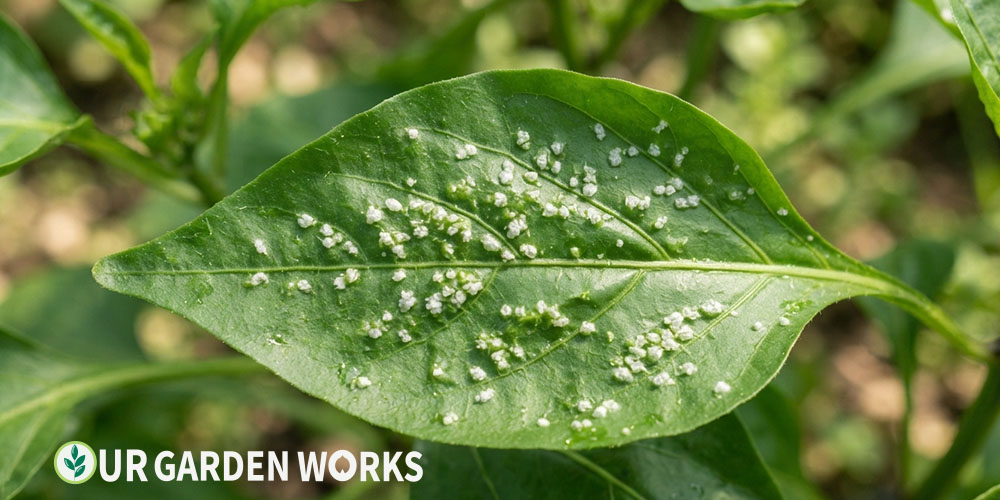
White spots on pepper leaves cover a narrower range of likely causes than some other symptoms, which makes this a relatively quick diagnosis once you know what to check. Texture — whether the spots are flat, raised, or powdery — does most of the diagnostic work here.
We’ll walk through the most common causes, with the specific textural and contextual clues that separate one from another.
Quick Answer: White spots on pepper leaves are most often caused by oedema (small raised bumps from excess water uptake), bacterial spot (small spots with a water-soaked look), powdery mildew (powdery coating, usually starting small and spreading), or pesticide/mineral residue (flat, surface-level, easily wiped away). Check texture and whether the spots wipe off easily to narrow it down.
Cause 1 — Oedema (Edema)
Oedema is a physiological condition, not a disease, caused when a plant absorbs water faster than it can transpire it through leaf pores, causing leaf cells to swell and eventually rupture, leaving small white to tan raised, slightly crusty bumps on the leaf surface.
It’s most common after a period of high soil moisture combined with cool, humid air that slows transpiration.
How to confirm it’s oedema:
- Spots are small, raised bumps rather than flat marks
- Often appears on leaf undersides as well as the top surface
- Follows a period of heavy watering or rain combined with cool, humid conditions
- Plant otherwise looks healthy with no other stress signs
Fix: No treatment reverses existing bumps, but improving conditions prevents further development — reduce watering frequency slightly and improve air circulation around the plant to help normalize transpiration.
Cause 2 — Bacterial Spot
Bacterial spot, more commonly associated with darker lesions, can sometimes present as paler, almost whitish spots in its earlier stages before darkening, particularly with a water-soaked or greasy appearance at the margins.
It spreads via water splash and tends to appear after rain or overhead watering during warm weather.
How to confirm it’s bacterial spot:
- Spots have a slightly greasy or water-soaked appearance at the edges
- May darken over time from pale to brown or black
- Spreads rapidly following rain or overhead watering
- Can also appear on fruit as raised, scabby lesions
Fix: Apply a copper-based bactericide, and shift to watering at the soil level rather than overhead going forward. Avoid working among wet plants, since handling damp foliage spreads bacteria between leaves and plants.
Cause 3 — Powdery Mildew
Powdery mildew on peppers produces the same general white, dusty or powdery coating familiar from squash and cucumber infections, though it’s somewhat less common on peppers than on cucurbits. It typically starts as small isolated patches and expands to cover more of the leaf surface as the infection progresses.
How to confirm it’s powdery mildew:
- Coating has a genuinely powdery, dusty texture, sometimes visible as a fine coating you can smudge with a finger
- Starts as small patches and spreads outward over time
- Worse in warm days with cool nights and high humidity
- Often affects lower, older leaves first
Fix: A baking soda or potassium bicarbonate spray works for mild cases — see our powdery mildew treatment guide for the full spray recipe and application schedule, which applies equally to peppers as it does to squash.
Cause 4 — Pesticide or Mineral Residue
Sometimes the simplest explanation is correct: a recent application of a pesticide, fungicide, or even hard water with high mineral content can leave a visible white residue on leaf surfaces that’s easily mistaken for a disease or pest issue. This is purely cosmetic and not actually affecting the plant’s health.
How to confirm it’s residue:
- Spots or coating wipe off easily with a wet finger or cloth
- Timing correlates with a recent spray application or watering with hard water
- No raised texture, water-soaked appearance, or spreading pattern
Fix: None needed beyond simply rinsing the leaves if the residue bothers you cosmetically. If hard water is the cause and this happens repeatedly, switching to filtered or rainwater for watering reduces future residue buildup.
Telling the Four Causes Apart at a Glance
| Cause | Texture | Wipes Off? | Key Clue |
|---|---|---|---|
| Oedema | Small raised bumps | No | Follows heavy watering + cool humid air |
| Bacterial spot | Flat, water-soaked edges | No | Spreads after rain/overhead watering |
| Powdery mildew | Powdery, dusty coating | Partially (smudges) | Spreads outward over time |
| Pesticide/mineral residue | Flat, surface-level | Yes, easily | Follows a recent spray or hard water use |
Why Container Peppers Are More Prone to Oedema
Container-grown peppers experience oedema more frequently than in-ground plants, largely because container soil can swing between very wet and very dry more dramatically than garden soil, and the confined root system in a pot responds to sudden heavy watering with the same rapid water uptake that triggers this condition.
A container pepper that’s been slightly underwatered and then given a thorough soaking, especially during a stretch of cool, overcast weather, is a near-perfect setup for oedema to appear within a day or two.
Maintaining more consistent soil moisture in containers, rather than letting them dry out significantly before a heavy watering, reduces this swing and the oedema risk that comes with it.
This is one more reason consistent container watering habits matter beyond just preventing wilting or blossom end rot — the watering pattern itself, not just the total amount, influences several different leaf symptoms covered across our pepper troubleshooting guides.
Preventing White Spots Across All Four Causes
While the four causes covered in this guide have different specific triggers, a few general habits reduce the likelihood of any of them appearing in the first place.
Consistent, moderate watering — avoiding both prolonged dry spells and sudden heavy soakings — addresses oedema risk directly and also supports overall plant resilience against bacterial and fungal pressure.
Watering at the soil level rather than overhead remains one of the single most effective habits across nearly every leaf problem covered in this entire series, and white spots from bacterial spot are no exception.
Good airflow from proper plant spacing reduces the humid microclimate that powdery mildew favors, while being mindful of when and how you apply any pesticide or fungicide product helps avoid the cosmetic residue confusion covered as the fourth cause above.
The Wipe Test — A Quick First Diagnostic Step
Before working through the full list above, a simple wipe test with a damp finger or cloth on one affected spot often quickly rules in or out the residue explanation, since this is the only cause among the four that disappears completely with a gentle wipe.
If the spot smudges or comes off entirely, you’ve likely found your answer without needing to consider the other three possibilities at all.
If the spot doesn’t wipe away, move on to checking texture (raised versus flat) and recent watering or weather history, which together narrow the remaining three causes down efficiently.
This quick sequence — wipe test first, then texture and history — resolves most cases of white spots on pepper leaves within just a couple of minutes of careful observation.
Frequently Asked Questions
Is oedema on pepper leaves a sign of a serious problem?
No — oedema is a relatively minor, self-resolving physiological response rather than a disease, and it doesn’t typically affect overall plant health or fruit production significantly. It’s worth noting as feedback that watering or environmental conditions could be adjusted slightly, but it’s not a cause for serious concern on its own.
Can white spots on pepper leaves spread to my tomatoes nearby?
Bacterial spot and powdery mildew can both potentially affect tomatoes as well, since they’re related nightshade family members with overlapping susceptibility to some of the same pathogens. Oedema and residue causes are purely localized to the individual plant’s specific conditions and won’t spread to neighboring plants regardless of species.
Why do white spots on my peppers keep appearing after every rain?
This pattern strongly suggests bacterial spot, which spreads specifically via water splash and tends to flare up predictably after rain events throughout a wet season.
Switching to soil-level watering and improving airflow around the plants addresses the underlying conditions that allow this cycle to repeat each time it rains.
Does the variety of pepper I'm growing affect how susceptible it is to these white spot causes?
To some degree, yes — thinner-leafed pepper varieties, including many hot pepper types, tend to show oedema more readily than thicker-leafed bell pepper varieties, simply due to differences in leaf structure and water regulation.
Bacterial spot resistance also varies by variety, with some modern hybrids bred specifically for improved tolerance, information usually noted directly on seed packets for gardeners dealing with recurring bacterial issues in their specific growing area.
Related Articles in Our Pepper Leaf Problems Guide
- Yellow Leaves on Pepper Plants — Why It Happens
- Holes in Pepper Leaves — Diagnosis Guide
- Brown Spots on Pepper Leaves — Causes and Fixes
- Why Are Pepper Leaves Curling? 6 Causes and How to Fix Each One
- How to Grow Peppers (Bell & Hot) — Complete Guide
- 6 Best Companion Plants for Peppers – Full List (2026)
- Growing Peppers in Containers: Varieties, Pots & Fertilizing (2026)
Final Thoughts
We hope this guide has helped you quickly narrow down what’s behind the white spots on your pepper leaves — the wipe test alone resolves a good number of cases before you even need to dig deeper.
For all our pepper and vegetable growing guides, our vegetable gardening guide links to everything.
Share this post with a fellow gardener who’s troubleshooting their pepper plants — and let us know in the comments which cause matched what you found. Happy growing!
