

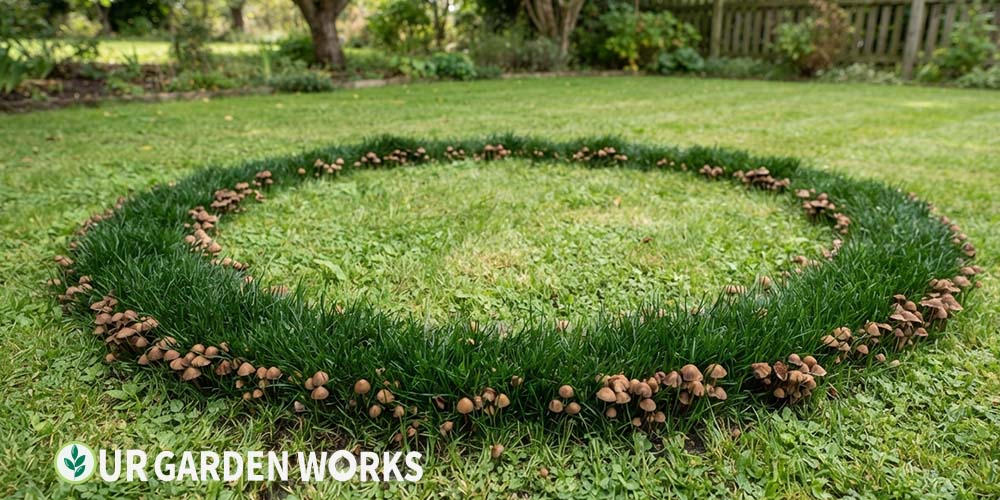
Fairy ring is one of the more recognizable lawn problems once you’ve seen it, and one of the more genuinely difficult to fully resolve, since the underlying cause is buried organic matter slowly decomposing well below where any surface treatment can easily reach.
This guide focuses specifically on fairy ring as its own topic, expanding on what we touched on in our broader yellow rings guide, since this particular cause deserves a closer, dedicated look given how often it appears and how much management confusion surrounds it.
Quick Answer: Fairy rings form when soil fungi decompose buried organic matter — old roots, stumps, or construction debris — growing outward in a ring pattern as they consume material at the colony’s edge. Rings often show mushrooms and either a band of dark green or yellow/dead grass. There’s no quick cure since the fungus lives deep in the soil; management focuses on masking symptoms and supporting overall lawn health while decomposition gradually runs its course.
The Three Visual Types of Fairy Ring
Fairy ring fungus presents in three recognized visual patterns, and knowing which type you’re dealing with helps set realistic expectations for what you’re actually seeing and why treatment approaches sometimes seem inconsistent across different sources.
| Type | Grass Effect | Severity |
|---|---|---|
| Type 1 | Kills grass directly, producing a dead/brown band | Most visually severe |
| Type 2 | Stimulates excessive growth and dark green color | Cosmetic, grass remains healthy |
| Type 3 | Triggers mushroom production with minimal grass change | Mildest, mushrooms the main symptom |
All three types stem from the same basic decomposition mechanism, just with different specific fungal species and different effects on the grass growing above the active fungal network.
Why Fairy Rings Form a Ring Shape Specifically
The ring shape develops because fungal colonies grow outward from a central starting point at a roughly consistent rate in all directions, similar to how a stain spreads outward through fabric.
The fungus is most actively decomposing organic matter, and therefore most visually active, at the colony’s outer growing edge, while the center has often already exhausted the readily available organic material, sometimes allowing grass there to recover to relatively normal appearance even as the ring’s edge continues expanding outward.
This explains why some fairy rings appear as a complete, closed circle while others show as a broken arc or partial ring — the shape simply reflects wherever buried organic matter happens to be distributed in the soil, which isn’t always a perfectly even, symmetrical deposit.
What’s Actually Buried Beneath a Fairy Ring
Understanding what’s decomposing helps make sense of why a ring appeared in a specific location and roughly how long it might persist.
Old tree stumps and root systems left behind after a tree removal are among the most common triggers, since substantial woody material takes years to fully decompose, sustaining fungal activity over an extended period.
Construction debris — wood scraps, cardboard, or other organic material buried during home building or landscaping — is another common source, particularly in lawns established on relatively new construction.
Even significant accumulations of thatch or buried leaf litter can occasionally support a smaller-scale fairy ring, though these decompose faster than substantial woody material and tend to produce shorter-lived rings.
💡 A ring’s size can hint at what’s buried beneath it
Larger, more persistent fairy rings often correlate with more substantial buried material, like a significant stump or root mass, while smaller, faster-resolving rings more often trace back to less substantial organic debris that decomposes and exhausts itself relatively quickly.
This isn’t a precise diagnostic tool, but it’s a reasonable pattern worth noting if you’re trying to understand what you’re dealing with.
Realistic Treatment Expectations
It’s worth being direct about this: there’s no quick, reliable cure that eliminates an established fairy ring in a single treatment, since the fungal network lives well below the surface and continues as long as buried organic matter remains to decompose.
Most management approaches focus on either masking the cosmetic symptom or supporting conditions that help the underlying organic matter break down somewhat faster.
Practical Management Steps
- Apply extra nitrogen fertilizer specifically to the ring area if it’s showing a yellow or dead band — this won’t address the fungus but helps mask the color difference by greening up the affected grass.
- Aerate the ring area to improve water penetration into the soil, which supports faster decomposition of the underlying organic matter over time.
- Water the ring area more deeply and consistently than the surrounding lawn, since dry, water-repellent soil conditions (sometimes created by the fungal mycelium itself) can worsen the ring’s visible symptoms.
- Remove mushrooms regularly if their presence bothers you, understanding this is cosmetic management rather than treatment of the underlying cause.
Why Fairy Ring Sometimes Creates Water-Repellent Soil
One of the more frustrating aspects of fairy ring, beyond the visual ring pattern itself, is that certain fungal species produce a waxy, hydrophobic substance in the soil as part of their growth, which can make the affected soil genuinely repel water rather than simply absorbing it normally.
This water-repellent condition compounds the visible symptoms, since grass growing in soil that can’t properly absorb water struggles with both the direct fungal effects and a secondary drought-like stress, even when you’re watering the area adequately.
If you’ve noticed that water seems to bead up or run off rather than soak in within a fairy ring area, this hydrophobic soil condition is likely part of what’s happening, and it explains why simply increasing watering frequency sometimes doesn’t produce the improvement you’d expect.
Specialized soil surfactant products, sometimes called wetting agents, can help break this water-repellent barrier and improve moisture penetration specifically in affected areas, complementing the aeration and watering approaches covered earlier.
Does Soil Type Affect How Severe Fairy Ring Becomes?
Sandy, well-draining soils tend to show more severe and more visually dramatic fairy ring symptoms compared to heavier clay soils, partly because sandy soil already has lower natural water-holding capacity, making it more vulnerable to the compounding water-repellent effect some fairy ring fungi produce.
This is part of why fairy ring is often discussed as a particularly persistent challenge in regions with naturally sandy lawn soil, such as many coastal areas, compared to regions with heavier native soil types.
This doesn’t mean clay-soil lawns are immune — fairy ring can develop in virtually any soil type given the right buried organic matter and fungal presence — but it does mean that if you’re gardening in naturally sandy soil and notice a fairy ring, the symptoms may appear more severe and the water-repellent soil complication may be more pronounced than what a similar ring would produce in heavier soil under otherwise similar conditions.
Is Full Removal of the Ring Ever Possible?
Complete removal is possible but typically requires excavating and removing the buried organic material entirely, then replacing the soil and reseeding or resodding the affected area — a significant, disruptive project most homeowners only pursue if the ring is in a highly visible, bothersome location and other management approaches haven’t provided acceptable results.
For most fairy rings in less prominent areas of a lawn, this level of intervention isn’t proportionate to the relatively minor cosmetic nature of the problem.
If you do decide to pursue excavation, identifying and removing as much of the underlying organic source as practically possible — a stump, root mass, or significant debris — gives the best chance of preventing the same ring from simply reforming after replanting, since any remaining organic matter left in place will likely continue supporting fungal activity in that spot.
Frequently Asked Questions
How long do fairy rings typically last before resolving on their own?
This varies enormously depending on how much organic matter is buried and decomposing — smaller debris-based rings might resolve within a year or two as the material fully breaks down, while rings tied to substantial tree stumps or root systems can persist for many years, sometimes a decade or more, before the underlying organic source is fully exhausted.
Can fairy ring fungus spread to other parts of my lawn beyond the existing ring?
The ring itself expands gradually outward as the fungal colony continues growing toward fresh organic matter at its perimeter, but fairy ring doesn’t typically “jump” to start entirely new, separate rings elsewhere in the lawn unless there’s another distinct pocket of buried organic matter in a different location supporting a separate fungal colony.
Are commercial fairy ring treatment products worth trying?
Some specialized fungicide products marketed specifically for fairy ring exist and can provide modest improvement for certain fungal species, though results are often inconsistent and temporary given how deep and extensive the underlying fungal network typically is.
Many lawn care professionals view these products as offering, at best, partial symptom management rather than a genuine cure, similar to the nitrogen-masking approach covered above.
Related Articles in Our Lawn Care Guide
Final Thoughts
We hope this guide has given you realistic expectations about fairy ring — it’s a manageable, rarely serious cosmetic issue, even though a true quick fix isn’t really on the table given how the underlying cause works.
For more lawn care guidance, our full collection of lawn articles on the soil and fertility page covers everything from seasonal maintenance to soil health.
Share this post with a fellow homeowner who’s dealing with a fairy ring — and let us know in the comments how long yours has persisted and what’s helped manage it. Happy growing!
