

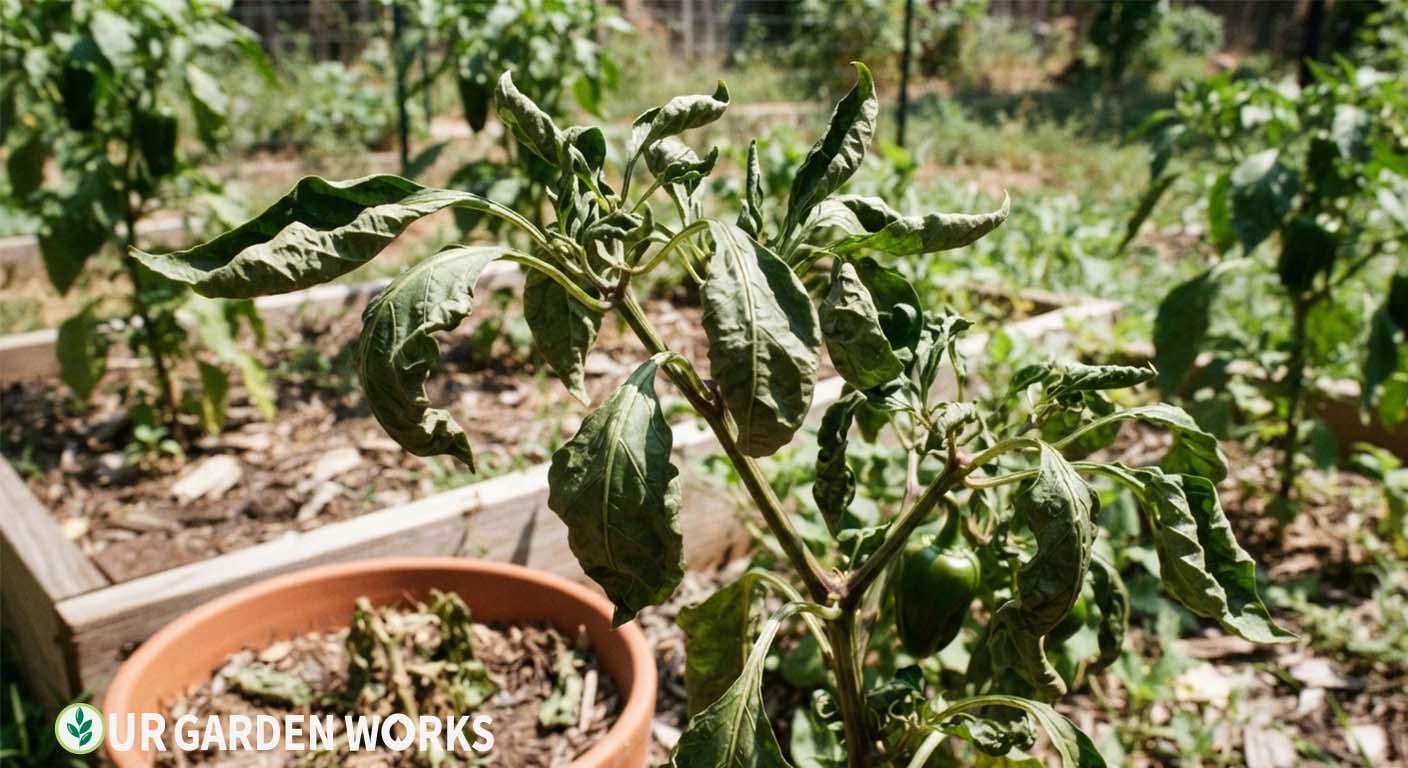
Pepper leaves that curl, roll, or cup are sending you a signal — and the direction of the curl actually tells you a lot about what’s causing it.
Upward curling and downward curling have different causes and completely different fixes. Treating one for the other won’t help at all.
The good news: most pepper leaf curling is reversible once you address the underlying cause. Let’s work through each one.
Quick Answer: Pepper leaves curl from: heat stress (upward curl, edges rolling), underwatering (downward curl, crispy edges), overwatering (downward curl, soft and droopy), aphid infestation (curling with sticky residue), herbicide drift, or physiological leaf roll (normal, no cause for concern). Check soil moisture and temperature first — they cover 70% of cases.
Why Curl Direction Is the Fastest Diagnostic Shortcut
A pepper leaf curls in a specific direction because of where, physically, the stress is hitting hardest. Heat and drought pull water out of the leaf’s upper surface faster than the lower surface, causing the leaf to fold upward as the top layer effectively shrinks relative to the bottom.
Overwatering does the reverse — excess water swells the lower leaf tissue faster than the upper surface can accommodate, pushing the leaf to curl downward and outward instead. This single mechanical difference is why curl direction splits the diagnosis cleanly into two broad categories before you’ve even examined a single leaf up close.
It’s worth noting that this rule applies most cleanly to the water-stress causes (heat, drought, overwatering) rather than the pest and chemical causes.
Aphid damage and herbicide drift both distort leaf tissue in ways that don’t follow this simple up-or-down pattern as consistently. For those two causes, the accompanying clues — visible insects and sticky residue for aphids, irregular twisting concentrated on new growth for herbicide drift — matter more than curl direction alone.
Read the Curl Direction First
| Curl Direction | Most Likely Causes |
|---|---|
| Upward curl / rolling inward | Heat stress, underwatering, physiological leaf roll |
| Downward curl / cupping down | Overwatering, root rot, herbicide drift |
| Edges curling up AND inward with sticky residue | Aphid infestation on underside |
| Random distortion, mosaic color change | Virus (no cure) |
Cause 1 — Heat Stress (Most Common)
Peppers curl their leaves upward in response to high temperatures as a self-protection mechanism — reducing leaf surface area exposed to the sun.
If temperatures are above 90°F and your plant is in full sun, this is almost certainly the cause. The plant is fine; it’s just protecting itself.
How to confirm it’s heat stress:
- Curling is upward and inward, never downward
- Appears during the hottest part of the day and partially relaxes by evening
- Soil moisture is adequate when checked
- Plant continues flowering and producing normally
Fix: Provide afternoon shade with a 30% shade cloth during heat waves. Water deeply in the morning.
The curling typically reverses when temperatures drop in the evening — watch for this as confirmation of the diagnosis.
Cause 2 — Underwatering
Leaves curl upward and inward, and the edges may become slightly crispy. Soil will be dry at 2+ inches deep.
Peppers in containers are especially prone — they can dry out completely in a single hot day, since a container’s limited soil volume holds far less reserve moisture than an in-ground bed.
How to confirm it’s underwatering:
- Curl is upward, often more pronounced than simple heat stress
- Soil is genuinely dry several inches down, not just at the surface
- Leaf edges may feel dry or slightly crisp to the touch
Fix: Water deeply and consistently. For containers, water until it flows freely from drainage holes.
Apply mulch to retain soil moisture between waterings.
Cause 3 — Overwatering
Overwatered pepper leaves curl downward and feel soft and droopy. The leaves may look yellow-green.
Soil will feel consistently wet. Root rot may be developing — waterlogged soil pushes oxygen out of the root zone, and roots starved of oxygen begin failing within days even before any visible wilting shows up above ground.
Fix: Allow soil to dry out before the next watering. Improve drainage.
For containers, ensure drainage holes are clear and stop sitting the pot in standing water. Our garden watering calculator works out how much and how often to actually water based on your bed size and local summer temperatures, which removes the guesswork that leads to overwatering in the first place.
Cause 4 — Aphid Infestation
Aphids colonizing the underside of leaves cause curling as the leaf responds to feeding damage.
Look for small soft-bodied insects (green, yellow, or black) clustered on new growth and leaf undersides. Sticky honeydew residue on leaves confirms aphids.
Aphids feed by piercing the leaf and withdrawing sap directly, and the curling response is the leaf’s reaction to that ongoing tissue damage combined with the saliva aphids inject while feeding, which can interfere with normal cell growth in the affected area.
If you’re not entirely sure the insects you’re seeing are aphids rather than another pest, our pest identifier tool can help narrow it down based on what the damage and the insects themselves actually look like, with treatment links specific to whatever it confirms.
Fix: Spray directly with insecticidal soap, covering the undersides of all leaves. See our insecticidal soap vs neem oil guide.
Repeat every 5 days for 3 applications.
Cause 5 — Herbicide Drift
Herbicide drift causes distinctive distorted, fern-like, or strappy leaf growth. Leaves may cup, twist, or develop abnormally.
New growth is often more severely affected than existing leaves. If neighbours have treated lawns recently in windy conditions, this is a possible cause.
Like tomatoes, peppers are broadleaf plants that are highly sensitive to the synthetic growth hormones in most broadleaf herbicides, often reacting visibly to concentrations far too dilute to have any effect on the lawn grass the product was actually intended for.
Fix: If damage is mild, the plant may outgrow it — remove affected leaves and give the plant clean water and fertilizer. Our fertilizer calculator works out the right rate for peppers specifically, so recovering plants get a measured, correctly dosed feeding rather than a guessed extra-strength dose that could add further stress.
Severe drift damage may be fatal to the plant. No chemical treatment reverses herbicide damage.
Cause 6 — Physiological Leaf Roll (Not a Problem)
Some pepper varieties naturally roll their leaves slightly inward during the heat of the day — especially older, more mature leaves — as a normal response to transpiration.
If the plant is otherwise healthy, producing, and looks fine overall, this isn’t a problem. It resolves in cooler temperatures or morning hours, the same daily cycle covered for tomatoes and many other vegetables in our broader leaf-curl guides.
Why Peppers React to Heat Slightly Differently Than Tomatoes
Peppers and tomatoes share a family (both are nightshades) and show many of the same curl mechanisms, but peppers are genuinely more heat-sensitive in one specific way worth knowing.
Pepper flowers begin dropping at nighttime temperatures above roughly 75°F, a noticeably lower threshold than tomatoes typically tolerate.
This means a pepper plant can be losing blossoms to heat stress at the same time its leaves are curling from that same heat — two separate symptoms from one underlying cause, rather than two unrelated problems.
If you’re seeing curled leaves alongside flowers dropping before they set fruit, this combination points specifically to heat stress rather than any of the other five causes, since none of those other causes typically affect flowering the same way a sustained hot stretch does.
Telling the Six Causes Apart at a Glance
| Cause | Curl Direction | Key Clue |
|---|---|---|
| Heat stress | Upward | Reverses by evening, soil moisture adequate |
| Underwatering | Upward | Soil dry 2+ inches down, edges crisp |
| Overwatering | Downward | Soft, droopy, soil consistently wet |
| Aphids | Curling + sticky | Visible insects, honeydew residue |
| Herbicide drift | Twisted/strappy | Irregular distortion, new growth worst |
| Physiological roll | Slight upward | Mature leaves only, plant otherwise fine |
Frequently Asked Questions
Should I remove curled pepper leaves?
Only if they’re yellowing, brown, or show signs of disease or severe pest damage. Leaves curled from heat stress or physiological roll are still photosynthesising normally — don’t remove them.
My pepper leaves curl every afternoon and uncurl at night — is that normal?
Yes — this is the classic heat stress response. The plant is managing water loss by reducing exposed leaf area during peak heat.
Can curled pepper leaves produce normal peppers?
Yes — heat-stressed plants with curled leaves continue to flower and produce fruit normally as long as temperatures aren’t above 95°F at night (which causes flower drop). Curled leaves don’t prevent fruit production.
Do all pepper varieties curl the same amount under heat stress?
No — thinner-leafed varieties and some hot pepper types show more visible curling than thicker-leafed bell pepper varieties under identical heat conditions, simply due to differences in leaf structure. This variation is cosmetic and doesn’t indicate one variety is healthier than another.
How is pepper leaf curl different from tomato leaf curl?
The underlying mechanisms overlap heavily since both are nightshades, but peppers drop flowers at a lower heat threshold than tomatoes, and tomatoes face a unique viral cause (TYLCV) not typically seen in peppers.
Our tomato leaf curling guide covers the tomato-specific causes in detail if you’re growing both crops side by side.
Related Articles in Our Vegetable Gardening Guide
Free Tools for Diagnosing and Fixing Pepper Problems
Final Thoughts
We hope this guide helped you identify the specific cause of your pepper leaves curling — and the right fix. Most pepper leaf curl is benign and reversible; the key is distinguishing heat response (normal) from pest or overwatering damage (needs fixing). For all our vegetable guides, our vegetable gardening guide is the place to start.
Share this post with a fellow gardener who’s ready to get growing — and let us know in the comments which cause matched your plant’s symptoms and what you tried. Happy growing!
