

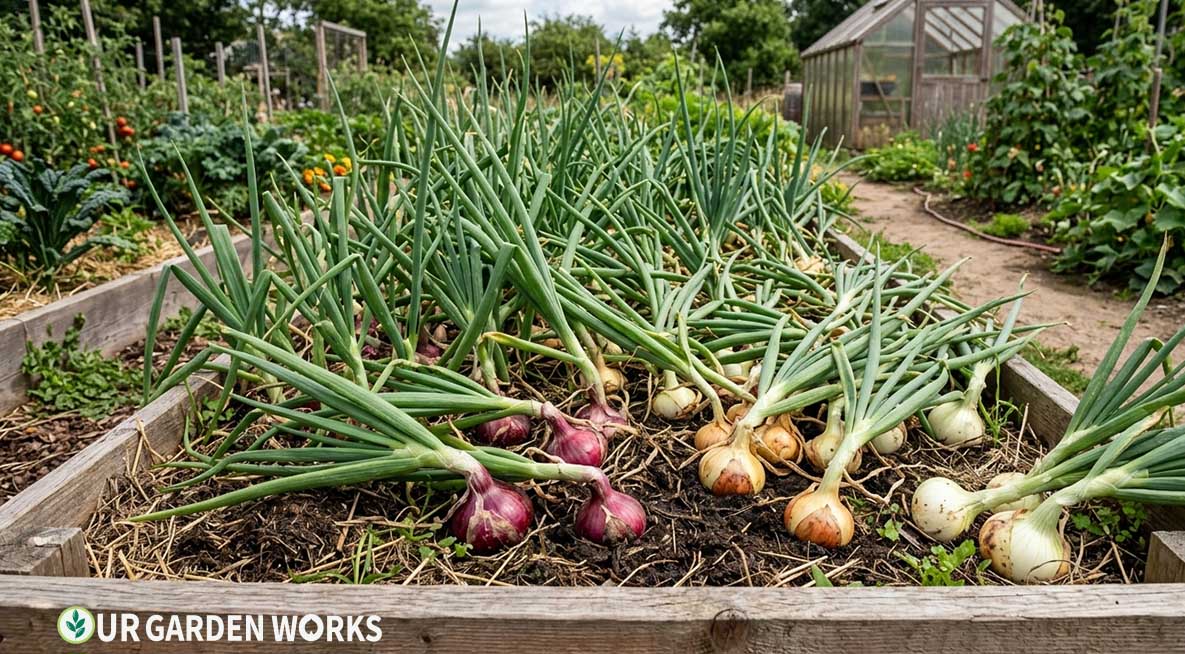
Onions are one of those vegetables that seem intimidating until you grow them once — and then you wonder why you ever bought them.
A 4×8 raised bed properly planted with onion sets can yield 50–80 storage onions that last months in a cool pantry. That’s a serious amount of kitchen value from very little space, and once you’ve nailed the basics, the process repeats reliably year after year.
The critical piece of knowledge most new onion growers don’t have: onions form bulbs based on day length, not temperature. Plant the wrong type for your latitude and your onions will produce lush tops but never form proper bulbs. We’ll solve that first.
How to Grow Onions – Quick Guide: Match your onion type to your latitude: short-day varieties for the South (below 35°N), long-day for the North (above 40°N), and intermediate day for areas in between. Plant sets or transplants 4–6 weeks before last frost, 1 inch deep, 4–6 inches apart. Harvest when necks fall and tops dry back.
The Day-Length Problem — Solve This First
Onions form bulbs when day length reaches a genetically programmed threshold. Short-day varieties bulb when days reach 10–12 hours (in the South, spring). Long-day varieties bulb when days reach 14–16 hours (in the North, early summer).
Planting a long-day onion in Georgia or a short-day onion in Minnesota produces spectacular disappointment.
| Type | Bulbs when days reach | Plant in | Best Varieties |
|---|---|---|---|
| Short-day | 10–12 hours | South (below 35°N): fall planting for spring harvest | Texas Supersweet, Georgia Sweet, Vidalia |
| Intermediate-day | 12–14 hours | 35–40°N latitude | Candy, Super Star, Red Candy Apple |
| Long-day | 14–16 hours | North (above 40°N): early spring planting | Walla Walla, Copra, Patterson, Yellow Sweet Spanish |
🧅 What Onions Need Beyond Day Length
- Sunlight: Full sun — 6+ hours minimum. Shaded onions produce thin, undersized bulbs regardless of variety match.
- Soil pH: 6.0–7.0. Onions are notably sensitive to acidic soil below this range.
- Soil texture: Loose, well-draining, free of large clumps or rocks down to at least 12 inches — compacted soil restricts bulb expansion.
- Spacing: 4–6 inches between plants, rows 12 inches apart — tighter spacing produces smaller bulbs but more total onions per bed.
Starting Method: Sets, Transplants, or Seeds?
| Method | Pros | Cons | Best For |
|---|---|---|---|
| Sets (small dried bulbs) | Easiest, available at any garden center, fastest to establish | Limited variety selection; can bolt in warm spells | Beginners wanting reliable results quickly |
| Transplants (started seedlings) | More variety options than sets, less bolting risk than sets | Need to source from specialty supplier | Best yield and quality; our recommendation for most gardeners |
| Direct seeding | Maximum variety selection, lowest cost | Slowest, needs 10–12 weeks of indoor growing first | Experienced gardeners wanting specific varieties |
Onion transplants (pencil-thin seedlings, not bulb sets) produce the most consistent bulbs with the lowest bolting risk.
Many mail-order seed companies sell them in bundles of 50–100 in early spring, timed for your zone. They’re more reliable than sets and give you access to the best named varieties.
How to Grow Onions: Step by Step
Step 1 — Prepare Rich, Loose Soil
Directions
- Work in 3–4 inches of compost. Onions are heavy feeders and thin, depleted soil produces small bulbs.
- Mix in a balanced fertilizer (10-10-10) at planting — 1 cup per 10 sq ft.
- Loosen to 12 inches. Compacted soil below 6 inches restricts bulb expansion and produces misshapen onions.
- Check pH: 6.0–7.0. Add lime if below 6.0 — onions are sensitive to low pH.
Step 2 — Plant (Sets or Transplants)
Directions
- Plant sets or transplants 4–6 weeks before your last frost date. Onions are cold-tolerant — light frosts don’t damage established plants, and the early planting window is important for long-day types that need maximum growing time before day length triggers bulbing.
- Set transplants or sets 1 inch deep, 4–6 inches apart, in rows 12 inches apart.
- Don’t plant sets deeper than 1 inch — deeper planting encourages bolting in sets.
- Water immediately after planting.
Step 3 — Water and Fertilize Through the Season
Watering: 1 inch per week, consistently. Bulb size is directly related to consistent moisture — drought stress during bulb development produces small, pungent onions. Stop watering 1–2 weeks before harvest to allow necks to dry and wrappers to cure in the ground.
Fertilizing: Side-dress with a nitrogen fertilizer (21-0-0 ammonium sulfate works well) every 3–4 weeks from planting until bulbs start to swell — when you can see the top of the bulb pushing above the soil surface. Stop all fertilizing at that point — late feeding produces soft necks that store poorly.
Step 4 — Harvest and Cure
Harvest signal: tops fall over naturally and the necks soften and dry. Don’t force this by bending tops — it doesn’t help and damages the neck.
When 50–80% of tops have fallen, gently loosen bulbs with a fork and pull. Lay them in a single layer in a warm, dry, airy location for 3–4 weeks until necks are completely dry and papery. Properly cured storage onions last 4–8 months.
For exact timing signals by variety, see our when to harvest onions guide.
Common Pests and Problems
Onion maggots: Larvae tunnel into bulbs near the soil line, causing rot and yellowing tops. Crop rotation and row covers during egg-laying season (spring) are the most reliable prevention — once maggots are inside a bulb, there’s no effective treatment.
Thrips: Tiny insects that cause silvery streaking on leaves, especially in hot, dry weather. A strong water spray and consistent moisture reduce populations; severe infestations may need insecticidal soap.
Botrytis neck rot: A storage disease that begins in the field but only shows up months later as bulbs soften from the neck down. Proper curing — fully dry necks before storage — is the single best prevention, since spores need moisture to establish.
Storing Your Harvest
Not all onions store equally well. Pungent, strong-flavored varieties like Copra and Patterson cure into long-lasting storage onions that keep 6–8 months in the right conditions.
Sweet varieties like Vidalia and Walla Walla have higher water content and shorter storage life — typically 4–8 weeks — making them better suited to eating relatively soon after harvest rather than long-term storage.
Store cured onions in a cool (35–50°F), dry, dark location with good airflow — a mesh bag, basket, or old pantyhose tied with knots between bulbs all work well.
Check stored onions every few weeks and remove any that start to soften, since one rotting bulb can affect neighbors nearby.
Frequently Asked Questions
Why did my onions bolt (go to seed)?
Bolting in onions is triggered by cold stress — a warm-cool-warm temperature pattern in early spring tells the plant it’s gone through winter and should flower. It’s most common with sets planted during cold spells. Use transplants instead of sets, and plant after the worst cold snaps have passed in your area.
Can I grow onions in containers?
Yes, but they need depth — at least 10–12 inches. They also need consistent watering (containers dry out fast) and bright sun. Green onions and scallions work better in containers than storage onions due to their smaller root system.
Why are my onion bulbs small?
Small bulbs usually come from: wrong variety for your day length, inconsistent watering during bulb development, too much nitrogen late in the season, or overcrowding. Check your variety choice first — a long-day onion planted in the South will always produce a small bulb regardless of care.
Can I grow green onions (scallions) the same way as bulb onions?
Green onions are simply harvested young, before bulbing begins, so they skip the day-length concerns entirely. Sow any onion variety thickly and harvest at pencil thickness for scallions — this works regardless of whether the variety matches your latitude’s day length.
Should I plant onions from seed instead of sets if I want the absolute best yield?
Seed-grown onions, started indoors 10–12 weeks before transplanting, generally produce the largest bulbs of the three starting methods, since they spend more total time developing before bulbing begins. The tradeoff is the extra time and indoor growing space required — most home gardeners find transplants offer the best balance of yield and convenience.
Related Articles in Our Vegetable Gardening Guide
Final Thoughts
We hope this guide has cleared up the day-length mystery that trips up so many first-time onion growers — and given you a clear path to a proper harvest. Match your variety to your latitude, plant early, feed consistently, and cure properly.
For all our vegetable growing articles, our vegetable gardening guide links to everything.
Share this post with a fellow gardener who’s ready to grow their own — and let us know in the comments which variety you’re planting and what method you’re using — sets, transplants, or seed. Happy growing!
