

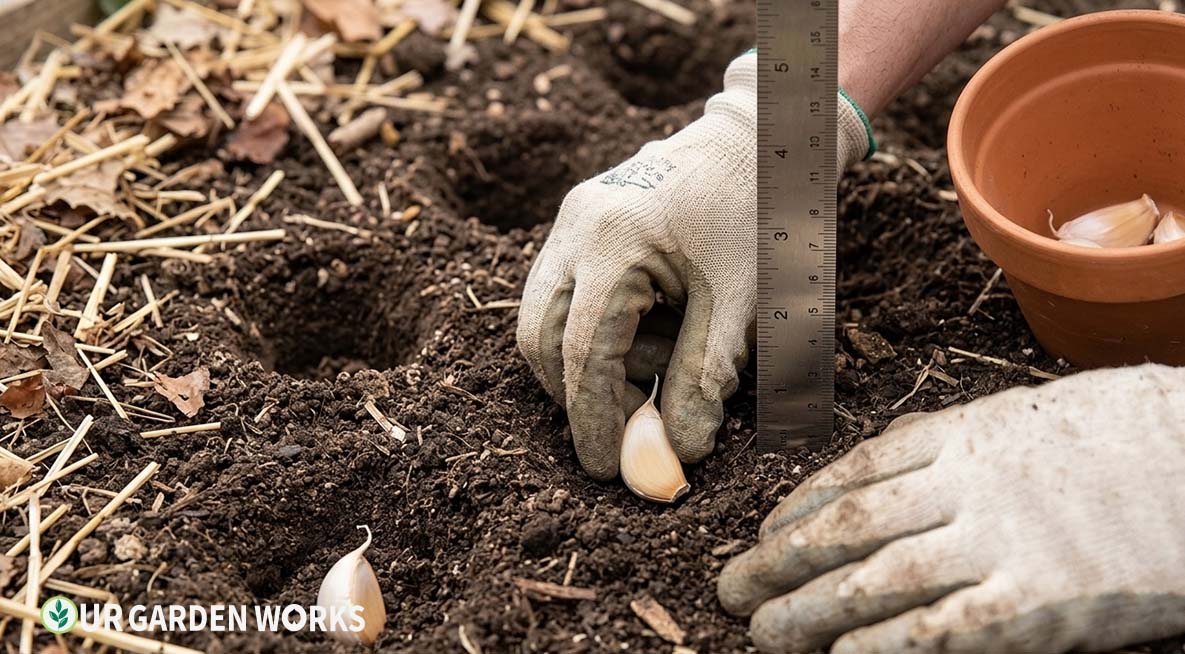
Garlic is one of the most forgiving crops in the vegetable garden — but planting depth is one of the few things it’s genuinely fussy about.
Plant too shallow and cloves heave out of the ground during winter freeze-thaw cycles. Plant too deep and cloves struggle to push through the soil in spring, especially in heavy clay. The right depth is specific, and it’s worth getting right.
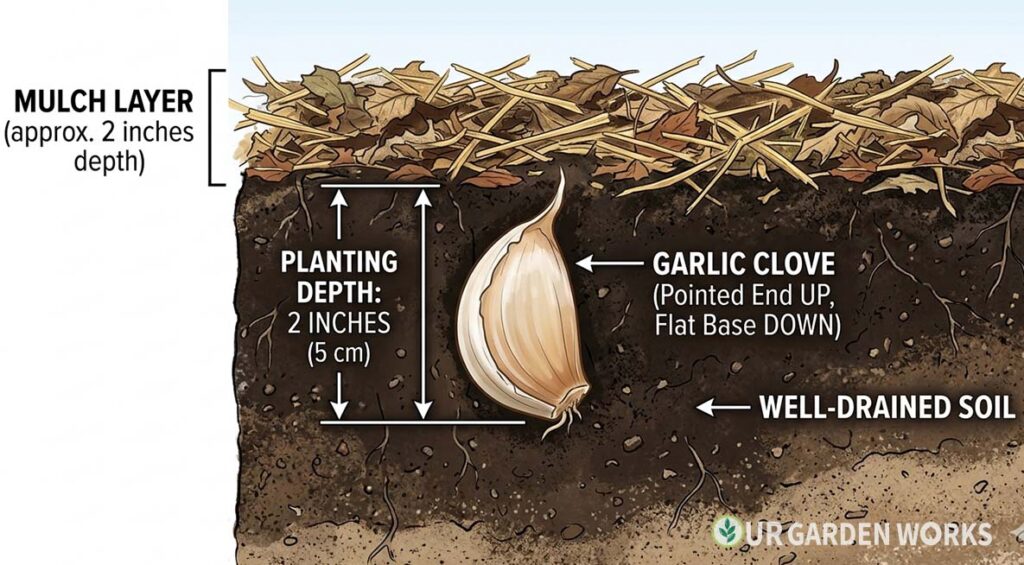
Quick Answer: Plant garlic cloves 2 inches deep (measured from the top of the clove to the soil surface) with the pointed end facing up. Space cloves 6 inches apart in rows 12 inches apart. In cold climates (Zones 3–5), plant 3 inches deep for better frost protection. Cover with 3–4 inches of mulch after planting.
Why Depth Matters More for Garlic Than for Most Bulbs
Garlic occupies an unusual position among the fall-planted bulbs. Tulips and daffodils are planted deep enough that frost rarely threatens them, and they have an entire winter to root before any green growth appears above ground.
Garlic, by contrast, is expected to put down roots, often produce a few inches of visible green shoot before winter, and survive months of repeated freezing and thawing — all while sitting much closer to the soil surface than most ornamental bulbs.
That combination of shallow planting and an active growth cycle through winter is exactly why depth becomes such a precise variable.
A clove planted slightly too shallow doesn’t simply grow a bit awkwardly the way a too-shallow tulip bulb might — it can be physically lifted out of the ground entirely as freeze-thaw cycles expand and contract the soil around it, a phenomenon called frost heaving.
Get the depth right from the start, and this entire category of problems disappears.
Planting Depth by Climate
| Zone | Climate | Planting Depth | Why |
|---|---|---|---|
| Zones 3–5 | Cold winters, deep freeze | 3 inches deep | Extra depth protects from freeze-thaw heaving; deeper roots anchor the clove through hard frosts |
| Zones 6–7 | Moderate winters | 2 inches deep | Standard depth — good balance of frost protection and easy spring emergence |
| Zones 8–9 | Mild winters | 1–2 inches deep | Shallow enough for easy spring emergence in mild soil; less frost protection needed |
| Zones 10–11 | Nearly frost-free | 1–2 inches deep | Garlic needs vernalization (cold period) to bulb — may need refrigerator pre-chilling before planting |
Spacing — Equally as Important as Depth
🧄 Garlic Planting Spacing at a Glance
- Clove to clove spacing: 6 inches apart within the row
- Row to row spacing: 12 inches between rows
- Raised beds: 6 inches in all directions (square foot method — 4 cloves per square foot)
- Minimum spacing: 4 inches if space is very tight — but bulb size will be smaller
Garlic spaced too closely competes for nutrients and produces smaller bulbs. Each clove needs room for its roots to extend 4–6 inches in all directions.
Under-spacing is the most common reason for disappointingly small garlic at harvest — not soil quality, not variety, not timing. Give them the space the bulb size requires.
How to Plant Garlic — Step by Step
Materials
- Certified seed garlic (hardneck or softneck — see variety note below)
- Garden fork or trowel
- Compost
- Mulch (straw, shredded leaves, or wood chips)
- Ruler or marked stick (for consistent depth)
Directions
- Prepare the bed. Work 2–3 inches of compost into the top 8 inches of soil. Garlic prefers pH 6.0–7.0 and well-draining soil — waterlogged beds cause rot. Raised beds are ideal.
- Separate cloves from the bulb. Do this the day you plant — don’t separate days ahead or the cloves dry out. Keep the papery skin on each clove. Discard any soft, damaged, or tiny inner cloves.
- Make holes at the correct depth using a dibber, your finger, or the blunt end of a pencil. Use your ruler: the top of the clove should sit exactly 2 inches below the soil surface (3 inches in cold climates).
- Drop each clove in pointed end up, flat base down. The pointed end is where the green shoot emerges. Planting upside down isn’t fatal — the shoot will find its way — but it slows emergence significantly.
- Backfill gently and firm the soil over each clove. Don’t compact heavily — the roots need to penetrate easily.
- Water in well if the soil is dry. In most fall planting situations, natural rainfall is sufficient after this initial watering.
- Mulch immediately. Apply 3–4 inches of straw, shredded leaves, or wood chips over the entire bed. Mulch prevents freeze-thaw heaving, insulates roots through winter, suppresses spring weeds, and retains moisture. This step is especially critical in Zones 3–6.
When to Plant Garlic
Garlic is a fall-planted crop in most of North America. The timing window is specific — too early and it grows too much before winter (weak plants), too late and it doesn’t develop enough root before hard freeze.
| Zone | Planting Window | Notes |
|---|---|---|
| Zones 3–4 | Late September – mid October | Plant before ground freezes. Mulch heavily (4–6 inches). |
| Zones 5–6 | Mid October – early November | Standard fall window — most of the US Midwest and Northeast |
| Zones 7–8 | November – early December | Later planting = smaller green growth before winter = fine |
| Zones 9–11 | December – January | Needs vernalisation — choose varieties bred for mild climates (Lorz Italian, Creole types) |
💡 Plant with your fall-planted tulip bulbs
The garlic planting window overlaps almost exactly with tulip bulb planting — same depth, same soil prep, same mulching. If you grow spring bulbs, planting garlic on the same day is an easy way to remember the timing.
Try our free tool: Frost Dates by Zone — How to Use Them for Planting
Hardneck vs. Softneck — Which to Plant
- Hardneck garlic (Rocambole, Porcelain, Purple Stripe): produces a scape (curling green shoot) in spring, richer and more complex flavor, stores 6–9 months. Best for Zones 3–7, where winters are cold enough for proper vernalization.
- Softneck garlic (Artichoke, Silverskin): no scape, milder flavor, stores 9–12 months, can be braided. Better for Zones 8–11 and commercial growing. Most grocery store garlic is softneck.
The depth and spacing guidance above applies equally to both types — the difference between hardneck and softneck shows up later in the season, in scape production and storage life, not in how deep you plant the clove.
If you’re undecided, planting a short row of each in the same bed at the same depth is an easy way to compare their performance in your specific soil and climate before committing to one type going forward.
For the complete guide to growing garlic from planting through harvest and storage, see our how to grow garlic guide and our when to harvest garlic guide.
Frequently Asked Questions
What happens if I plant garlic too shallow?
Shallow cloves (less than 1.5 inches) are vulnerable to freeze-thaw heaving — the ground expanding and contracting as it freezes and thaws repeatedly pushes cloves up and out of the soil. You’ll find them sitting on the surface in early spring, frost-killed. Proper depth and heavy mulching prevent this entirely.
Can I plant garlic in spring?
Yes — but results are significantly smaller than fall-planted garlic. Garlic needs a vernalization period (cold exposure) to trigger bulbing.
Fall-planted garlic gets this naturally through winter. Spring-planted garlic gets less vernalization time and produces smaller bulbs with fewer cloves. In Zones 3–4 where fall planting is extremely short, spring planting is sometimes the only option — accept smaller yields.
Should I fertilize at planting?
Work compost into the bed at planting — that’s typically sufficient for fall establishment. A light application of balanced fertilizer (10-10-10) can be added to the soil at planting.
The main fertilizing push comes in spring when the green tops emerge and the plant begins active growth — apply nitrogen-rich fertilizer at this point for maximum bulb development.
My garlic is already sprouting green tops in fall — is that a problem?
No — 1–3 inches of green growth before winter is normal and expected. The tops will die back when hard frost hits, and the plant resumes from the roots in spring.
Problems only occur if cloves sprout 6+ inches before freeze — this means planting was too early for your zone. Next year, plant 2–3 weeks later.
Does planting depth affect bulb size at harvest?
Indirectly, yes. Depth itself doesn’t make a bulb larger, but planting at the correct depth for your zone is what allows the clove to survive winter intact and establish a strong root system before active growth begins in spring — and that early root establishment is what ultimately drives bulb size.
A clove that heaves out of the ground midwinter, or one planted so deep it struggles to emerge, both lose growing time and vigor that show up as smaller bulbs at harvest.
Related Articles in Our Vegetable Gardening Guide
Final Thoughts
We hope this guide means every clove you plant this fall ends up exactly where it needs to be — 2 inches down, pointed end up, covered with mulch. It’s a small detail that makes a real difference come harvest time.
For all our vegetable growing guides, our vegetable gardening guide links to everything.
Share this post with a fellow gardener who’s ready to get growing — and let us know in the comments which garlic variety you’re planting and your zone. Happy growing!
