

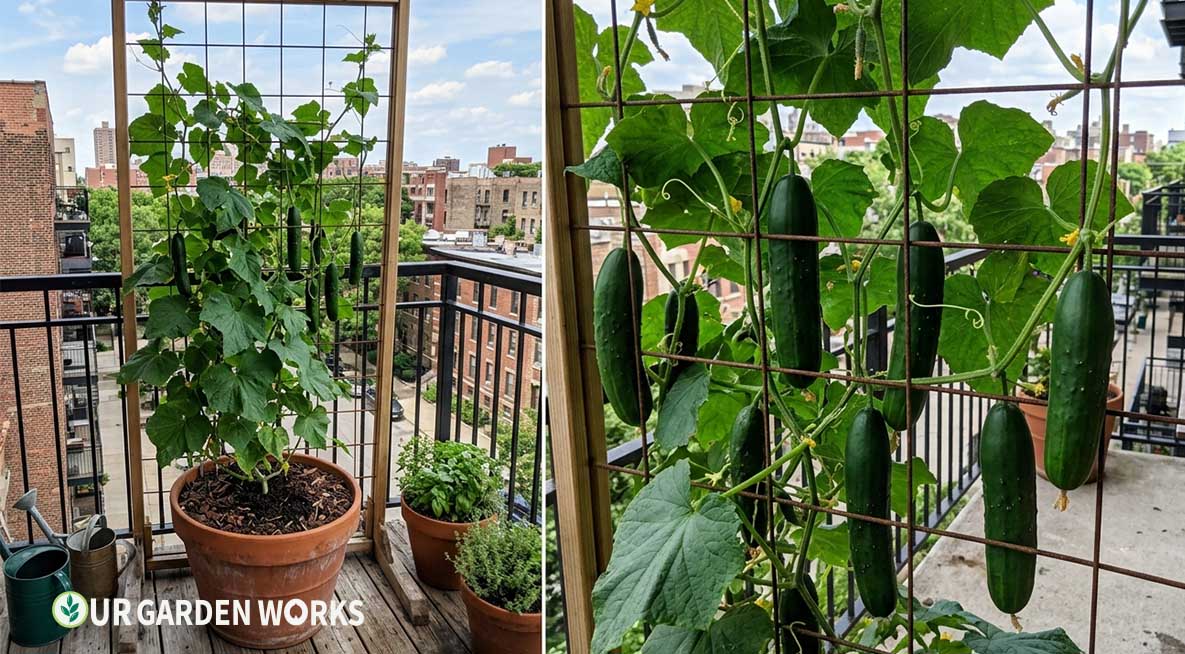
Container cucumbers have a reputation for being temperamental — and that reputation is mostly deserved when people try to grow vining cucumbers in undersized pots without support.
Flip the approach — grow them vertically in a proper-sized container with a dedicated trellis — and cucumbers become one of the most productive balcony and patio crops you can grow.
The vertical container method is genuinely transformative. Growing upward instead of sprawling sideways means a single 10-gallon container with a 5-foot trellis produces as many cucumbers as 6 square feet of garden bed. The cucumbers hang straight and clean, easy to spot and harvest. I
t’s one of our favorite small-space growing setups, and once you’ve tried it, growing cucumbers any other way in a container feels like working against the plant instead of with it.
How to grow cucumbers in containers: Use a minimum 10-gallon container for vining cucumbers (5-gallon for bush types). Plant 1–2 seeds or transplants per container. Set up a 4–5 foot vertical trellis before planting. Water daily in summer — cucumbers in containers dry out faster than almost any other crop. Harvest every 1–2 days at 6–8 inches to keep production going.
Why Containers Actually Suit Cucumbers Well
It seems counterintuitive at first — cucumbers have a reputation as sprawling, space-hungry vines, which makes container growing sound like a compromise.
In practice, the opposite is often true. Cucumbers are shallow-rooted compared to tomatoes, which means they don’t need the deep soil volume that a tomato or pepper plant demands.
What they need instead is consistent moisture and excellent drainage — two things that are actually easier to control in a container than in open garden soil.
A container also gives you precise control over soil quality from day one. Cucumber roots are sensitive to compaction and waterlogging, and garden soil — especially clay-heavy soil — rarely drains as fast as cucumbers prefer.
A premium potting mix in a container starts you with ideal conditions rather than asking you to amend and improve native soil over several seasons.
The other underrated advantage is pest management. Cucumber beetles, the primary vector for bacterial wilt, are less likely to find an isolated container on a second-floor balcony than a ground-level garden bed surrounded by other host plants.
Many container growers report noticeably lower pest pressure than their in-ground counterparts simply because of physical isolation.
6 Best Cucumber Varieties for Containers
| Variety | Type | Container Size | Notes |
|---|---|---|---|
| Bush Pickle | Compact bush | 5 gal | Bred for small spaces; no trellis needed; productive |
| Spacemaster | Compact bush | 5–10 gal | Classic small-space variety; slicing type |
| Salad Bush | Compact | 5 gal | AAS winner; excellent flavor; short vines |
| Diva | Vining (compact) | 10 gal + trellis | Seedless, never bitter, excellent flavor; great container choice |
| Straight Eight | Vining | 10–15 gal + trellis | Classic slicer; needs trellis; very productive |
| Lemon Cucumber | Vining | 10 gal + trellis | Round, mild, yellow — excellent container performer |
💡 Diva is the best container cucumber, full stop
Diva is an All-America Selections winner that’s self-fertile (no pollinator needed), never produces bitter fruit even when overgrown, and has compact vines ideal for a 10-gallon container with a trellis. If you’re growing cucumbers in containers for the first time, start with Diva.
Choosing the Right Container
Container size is the single decision that determines almost everything else about your cucumber’s performance.
Too small, and the plant will wilt repeatedly through summer regardless of how attentively you water, simply because the soil volume can’t hold enough moisture between waterings.
Too large, and you’re hauling unnecessary weight and using more potting mix than the plant actually needs.
For bush varieties, a 5-gallon container is genuinely sufficient — these plants are bred to stay compact and don’t need the extra root room a vining type requires.
For vining varieties grown on a trellis, 10 gallons is the practical minimum, and 15 gallons gives noticeably better drought tolerance during heat waves, which matters more than almost anything else in container cucumber success.
Material matters too. Dark-colored plastic and metal containers absorb heat and can cook roots in full summer sun — a real risk for a crop already prone to heat and water stress. Light-colored glazed ceramic, wood, or fabric grow bags all moderate root zone temperature better.
If you do use a dark plastic pot, consider double-potting (placing it inside a slightly larger light-colored container) or providing afternoon shade for the pot itself, even while the foliage stays in full sun.
How to Grow Cucumbers in Containers: Step by Step
Step 1 — Container and Trellis Setup
Directions
- Choose a container of at least 10 gallons for vining types (5-gallon for bush varieties).
- Fill with premium potting mix amended with 15–20% perlite. Cucumbers need exceptional drainage — waterlogged roots produce wilting plants even in hot weather.
- Set up the vertical trellis before planting. Options: bamboo stakes lashed into a triangle (teepee style), a wire tomato cage, a garden obelisk, or a piece of trellis netting attached to a fence directly behind the container.
- Position the container in full sun. 8+ hours is minimum. Against a south-facing wall or fence maximizes reflected heat — cucumbers love warmth.
Step 2 — Plant in Warm Conditions
Cucumbers are cold-sensitive — don’t transplant until daytime temperatures are consistently above 65°F and the container soil reaches 70°F. This is typically 2–3 weeks after tomatoes go out. Direct sow 2–3 seeds per container at ½-inch depth; thin to 1–2 plants after germination.
If you’re starting from transplants rather than direct sowing, handle the root ball carefully — cucumbers resent root disturbance more than most vegetables, and a rough transplant often causes a visible setback of several days before the plant resumes active growth. Water transplants in well immediately and provide light shade for the first 24–48 hours if the weather is intensely sunny.
Step 3 — Water Daily Without Exception
This is the critical step most gardeners underestimate. A cucumber plant in a 10-gallon container on a sunny patio can transpire and evaporate its entire water content in a single hot day.
Check the container every morning — if the top inch of potting mix is dry, water until it drains from the bottom. In a heat wave, check again in the afternoon.
Inconsistent watering produces bitter cucumbers — it’s the primary cause. The bitterness compound (cucurbitacin) increases when plants are water-stressed. A self-watering container or a reservoir drip system makes this much easier to manage.
If you travel frequently in summer or know your watering attention will be inconsistent, investing in a self-watering planter for cucumbers specifically is one of the highest-value upgrades you can make — far more impactful than any fertilizer or pest treatment.
⚠️ The afternoon wilt trap
Cucumber leaves often wilt visibly in early afternoon heat even when soil moisture is adequate — this is a normal response to reduce water loss during peak heat, not necessarily a sign of drought stress. Check the soil before adding more water. If the plant has recovered by evening and the soil was already moist, you don’t need to water more; the plant is simply managing heat the way it’s designed to.
Step 4 — Train Vines and Harvest Frequently
As vines grow, weave them through your trellis or tie loosely with soft plant ties every 6 inches. This keeps the plant structured, improves airflow, and positions cucumbers for easy spotting at harvest time.
Harvest every 1–2 days at peak season. At 6–8 inches for slicing types, 3–4 inches for pickling types. Leaving cucumbers past their prime size on the vine stops new production — in a container where root space is limited and production window is short, this cost is even higher than in a garden bed. Be aggressive about harvesting.
Feeding Container Cucumbers Through the Season
Container cucumbers are heavier feeders than many gardeners expect, because the limited soil volume can’t hold the nutrient reserves that an in-ground bed naturally has.
Start with a balanced 10-10-10 liquid fertilizer every two weeks from transplant through the first flush of flowers. Once fruiting begins in earnest, switch to a formula slightly higher in potassium — it supports continued fruit development without pushing excessive new vine growth at the expense of the cucumbers already forming.
Watch the lower leaves for early signs of nutrient stress — pale yellowing that starts at the leaf margins and moves inward is often the first visible sign that a container has used up its available nitrogen between feedings.
Catching this early and adjusting your feeding schedule prevents a more serious decline later in the season when the plant is under the additional stress of heavy fruit production.
Frequently Asked Questions
Why are my container cucumbers flowering but not fruiting?
Container cucumbers sometimes fail to pollinate because the confined space doesn’t get as many bee visits as an open garden bed. Hand-pollinate: use a small paintbrush to transfer pollen from male flowers (straight stem) to female flowers (tiny cucumber at base). Do this in the morning when flowers are open. Or choose Diva — it’s parthenocarpic and doesn’t need pollination.
Can I grow cucumbers in containers without a trellis?
For bush varieties (Spacemaster, Salad Bush), yes — they stay compact enough to not need support. For vining types, you can let them cascade over the edge of the container, but the productivity is much lower than trained vertically. The trellis takes 10 minutes to set up and doubles your yield. For a full comparison of trellis options and training methods, see our guide to trellising cucumbers.
Why did my cucumber plant collapse suddenly?
In containers, sudden collapse is almost always root rot from overwatering or poor drainage — or, less commonly, bacterial wilt spread by cucumber beetles. Check your drainage: water should flow freely from the bottom within seconds of pouring. If the mix stays soggy for hours, add more perlite or switch to a better-draining mix.
Can I grow more than one cucumber plant in the same large container?
In a 15-gallon or larger container, two compact vining plants can share the space if each has its own dedicated section of the trellis to climb. Crowding two vigorous vining plants into a 10-gallon container, however, typically results in both plants underperforming due to root competition. When in doubt, give each plant its own container — the yield per plant is almost always higher than splitting the same volume between two crowded plants.
Related Articles in Our Vegetable Gardening Guide
- How to Grow Cucumbers — Complete Guide
- Do Cucumbers Need a Trellis? (+ How to Train Them Vertically)
- 8 Best Companion Plants for Cucumbers – And What to Keep Away
- Free tool: Garden Watering Calculator — How Much Water Your Crops Actually Need
- Growing Tomatoes in Containers: Pot Size, Varieties & Watering (2026)
- Growing Peppers in Containers
- Vegetable Gardening Guide
Final Thoughts
We hope this guide has shown you that container cucumbers, done right, are genuinely one of the best balcony or patio crops you can grow. The vertical trellis method changes everything.
For all our vegetable growing guides, our vegetable gardening guide has them all.
Share this post with a fellow gardener who’s ready to grow their own — and let us know in the comments which variety you’re growing and whether you’re trying the vertical trellis method. Happy growing!
