

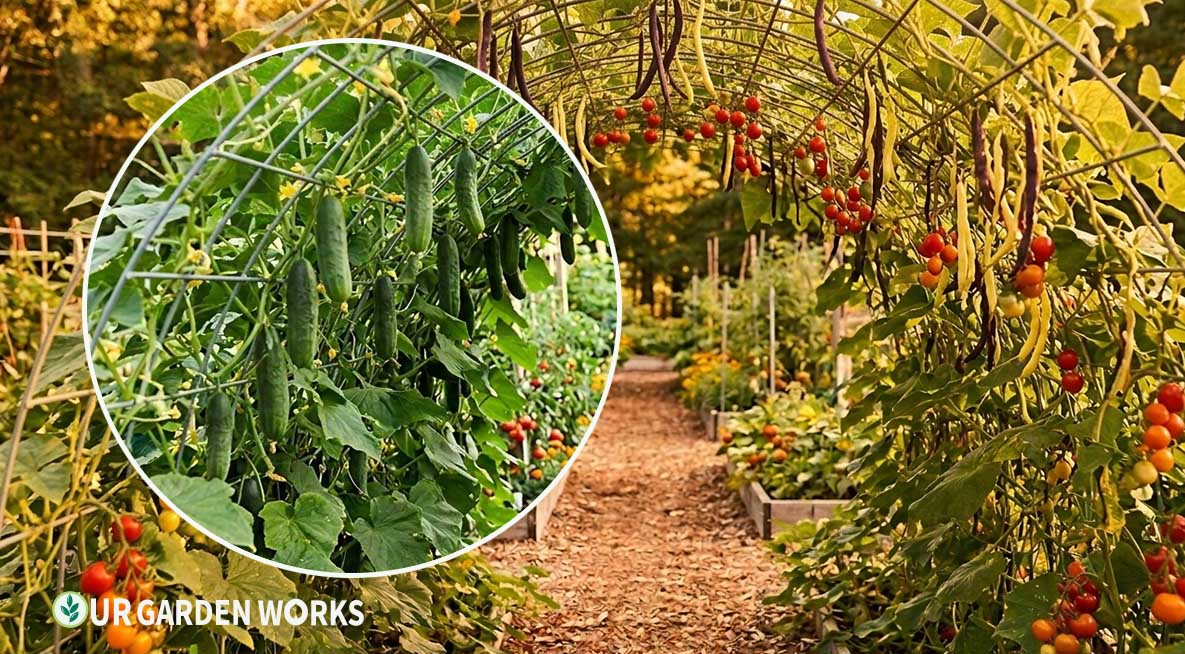
The short answer: no, cucumbers don’t technically need a trellis. Left to their own devices they’ll sprawl across the ground, produce fruit, and grow perfectly well. Farmers grew cucumbers on the ground for thousands of years.
The better answer: cucumbers grown vertically on a trellis produce dramatically more fruit in half the space, with significantly less disease, and are dramatically easier to harvest. Once you’ve grown cucumbers on a trellis, growing them on the ground feels like a step backward.
In this guide, we’ll cover why vertical growing works so well, which cucumber varieties suit it best, and five trellis options from the simplest to the most space-efficient — with step-by-step setup for each.
Editor’s Note: Cucumbers don’t need a trellis but benefit enormously from one. Vertical growing doubles yield per square foot, dramatically improves airflow (reducing powdery mildew and other fungal diseases), produces straighter fruit, and makes harvesting easy. Vining varieties need a trellis 5–6 feet tall. Bush varieties can grow without support in as little as 18 inches of space.
Vining vs. Bush Cucumbers — Choose the Right Type First
This distinction matters before you decide on a trellis.
| Vining Cucumbers | Bush Cucumbers | |
|---|---|---|
| Vine length | 5–8 feet when mature | 18–30 inches |
| Trellis needed? | Strongly recommended | Optional / no |
| Yield per plant | Higher (more vine = more fruit) | Lower but concentrated |
| Best for | Trellised beds, vertical gardens | Containers, small beds, no-trellis growing |
| Popular varieties | Marketmore, Straight Eight, English Telegraph, Diva | Bush Pickle, Spacemaster, Patio Snacker |
💡 Check your seed packet
Most seed packets label the variety as “vining” or “bush” directly. If unlisted, check the mature vine length — anything over 3 feet is a vining type that benefits from a trellis.
5 Reasons Vertical Growing Beats Ground Growing
- More fruit per square foot. A trellised cucumber uses 2 square feet of ground space. The same plant sprawling takes 9–12 square feet. You can fit 4–5 trellised plants where one ground-grown plant would go.
- Better airflow = less disease. Powdery mildew, downy mildew, and angular leaf spot all thrive in the humid, still air under a sprawling cucumber canopy. A vertical plant’s leaves are exposed to airflow on all sides — fungal disease pressure drops significantly.
- Straighter fruit. Cucumbers hanging vertically develop straight under gravity. Ground-grown cucumbers curl and bend as they rest on uneven soil.
- Easier harvesting. You can see every fruit. Ground-grown cucumbers hide under foliage and get missed — becoming overripe before you find them. Overripe fruit on the vine stops production.
- Cleaner fruit. No soil contact means no soil-splash diseases and no slug damage on the fruit itself.
5 Trellis Options — Setup Instructions for Each
Option 1 — Single Wire or String Trellis (Simplest)
Best for: Beginners, small gardens, one or two plants.
Setup
- Drive two T-posts or wooden stakes 5–6 feet tall at each end of your planting row, 6–8 feet apart.
- Run 3–4 horizontal wires or strings between the posts at 12-inch intervals from 1 foot off the ground to the top.
- Plant cucumbers at the base and weave emerging vines through the wires as they grow. Loosely tie any sections that don’t self-cling.
Option 2 — A-Frame Trellis (Best for Harvest Access)
Best for: 4–6 plants, raised bed integration, easy harvesting from both sides.
Setup
- Create two panels of wire mesh or wooden lattice, each 3 feet wide and 5–6 feet tall.
- Join them at the top with hinges or lashing twine to form an A shape. Set over the bed with plants on each side.
- The fruit hangs down inside the A — clearly visible and easy to harvest from either side by simply reaching under.
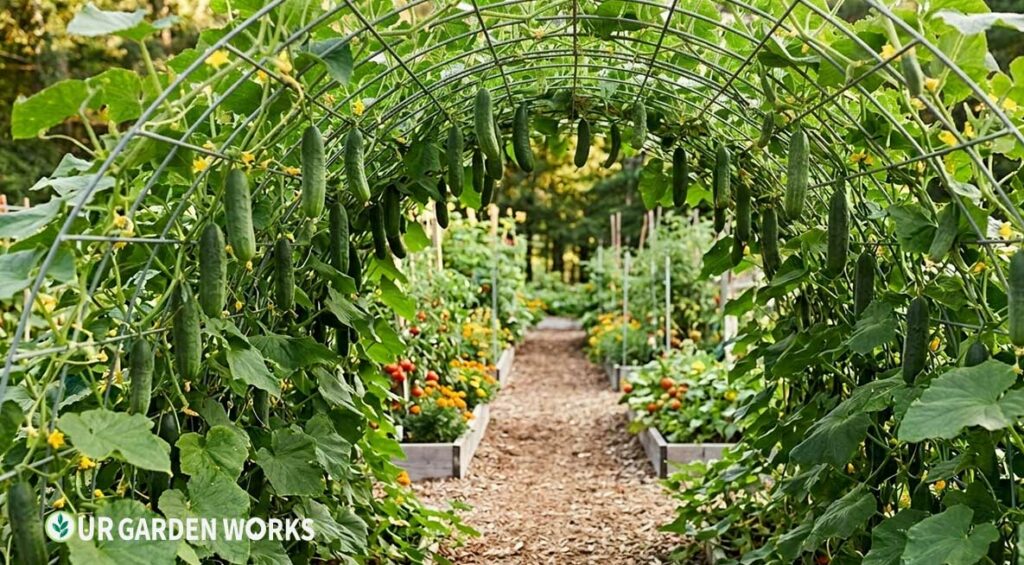
Option 3 — Cattle Panel Arch (Most Space-Efficient)
Best for: 6–10 plants, maximizing yield per foot of garden length.
Setup
- Purchase a 16-foot cattle panel (livestock wire, available at farm supply stores) approximately $30–40.
- Bend into an arch between two raised beds or two rows, secured at each end with T-posts or rebar. The arch stands 5–6 feet tall and 4 feet wide.
- Plant cucumbers along both sides of the arch. Vines climb up, and fruit hangs down inside the tunnel for easy harvesting while walking through.
Option 4 — Tomato Cage (Quick and Easy)
Best for: Single plants, existing cages already on hand, container growing.
A heavy-duty wire tomato cage (not the flimsy lightweight ones) works for a single vining cucumber. The vine climbs the cage rings and the fruit hangs outside. Airflow is slightly compromised compared to open trellis systems, but it’s vastly better than ground growing and requires no installation.
Option 5 — DIY Bamboo Teepee
Best for: Aesthetic gardens, companion plantings, temporary setup.
Setup
- Push 5–6 bamboo poles (6–7 feet tall) into the ground in a circle 2–3 feet in diameter.
- Gather and tie the tops together with twine.
- Wrap horizontal string around the outside at 8-inch intervals for the vine to cling to.
- Plant one cucumber at the base of each pole.
How to Train Cucumbers Up a Trellis
Training Directions
- Let seedlings establish first. Don’t rush training. Wait until plants are 6–8 inches tall with their first true tendrils developing.
- Guide the main stem. Gently weave the main stem through the lowest wire or trellis opening. Cucumbers have tendrils that self-cling — once started in the right direction, they mostly take over.
- Check every 2–3 days. Cucumbers grow fast. A vine that was at the first wire on Monday may be past the second wire by Thursday. Guide it upward before it starts growing sideways or tangling with itself.
- Loosely tie wayward stems. Use soft ties, strips of fabric, or tomato clips — never wire or tight twine. Leave room for stem expansion.
- Pinch the growing tip at the top. When the main vine reaches the top of your trellis, pinch the growing tip. This redirects energy into fruit development and side shoots rather than further upward growth the trellis can’t support.
Ground Growing — When It’s the Right Choice
Trellising isn’t always the right answer. Ground growing makes sense when:
- You’re growing bush varieties specifically bred for compact ground growing
- You have more horizontal space than vertical (wide low-growing bed, not a raised bed)
- You’re growing pickling cucumbers for a large bulk harvest where aesthetics and individual fruit quality matter less
- You’re in a very windy location where a tall trellis would be structurally problematic
If growing on the ground: mulch heavily under the vines to prevent soil splash and disease. Lay straw or plastic mulch directly under developing fruit to keep them off the soil and reduce slug damage and rot.
Frequently Asked Questions
How tall does a cucumber trellis need to be?
5–6 feet for most vining varieties. Indeterminate English/telegraph cucumbers can reach 8 feet — provide the full height. Bush varieties need no trellis or a maximum 3-foot support if you choose to use one.
Will cucumbers climb on their own or do I need to tie them?
Cucumbers have tendrils that actively reach for and grip supports — they’re natural climbers. You need to start them in the right direction and guide wayward stems occasionally, but they do most of the climbing themselves. Tying is only needed for stems that grow sideways instead of upward.
Can cucumbers and tomatoes share a trellis?
Structurally yes — if the trellis is sturdy enough for both. Ecologically, it’s not ideal. Cucumbers and tomatoes don’t share significant diseases, but they compete for the same trellis space and can shade each other. If sharing a trellis, plant them on opposite sides facing different directions.
My cucumber vines keep falling off the trellis — what's wrong?
Usually the trellis openings are too large for the tendrils to grip effectively, or the stems are growing faster than you’re guiding them. Use a trellis with openings of 4–6 inches — large enough for fruit to pass through, small enough for tendrils to grip. Add more horizontal tie points and train every 2–3 days during peak growth.
Does trellising work for cucumbers grown in containers too?
Yes — and it matters even more in a container than in a garden bed, since pot space is at a premium. A simple teepee of bamboo stakes or a small wire obelisk set into a 10-gallon container gives a vining cucumber the vertical structure it needs without taking up any extra footprint on a balcony or patio. See our guide to growing cucumbers in containers for container-specific trellis setups and sizing.
Related Articles in Our Vegetable Gardening Guide:
Final Thoughts
We hope this guide has convinced you to go vertical this season — because the difference between ground-grown and trellised cucumbers is one of those changes you make once and never undo.
For the full cucumber growing guide, our how to grow cucumbers guide covers every stage. And for all our vegetable growing guides, our vegetable gardening guide links to everything.
Share this post with a fellow gardener who’s ready to get growing — and let us know in the comments which trellis setup you’re using and how many plants you’re growing vertically. Happy growing!
