

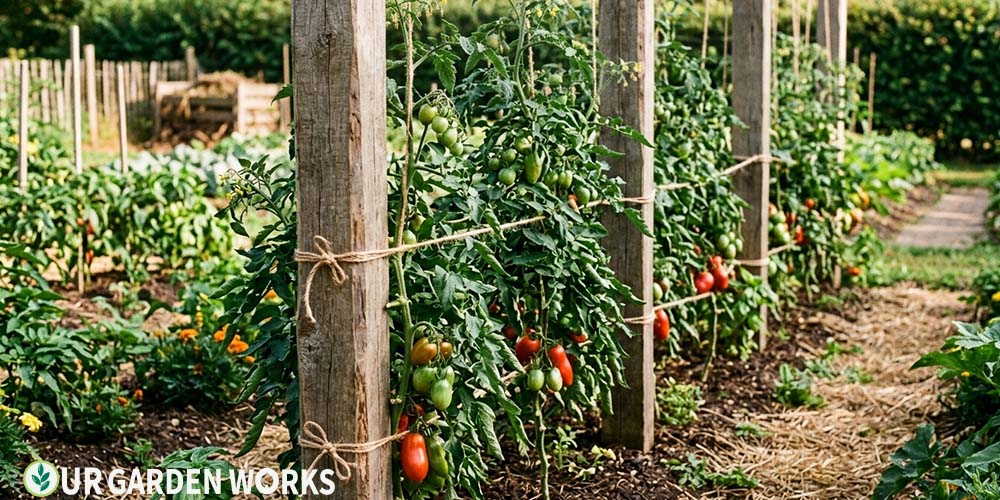
Unsupported tomato plants fall over, snap branches, produce less, and develop more disease. Yet many gardeners underinvest in their staking setup — buying flimsy cages that collapse in August, or stakes too short for indeterminate varieties that eventually hit 8 feet.
The right support method depends on your specific situation: the variety you’re growing, your available space, how much maintenance time you’re willing to spend, and whether you’re growing in-ground, in raised beds, or containers.
This guide covers all 5 common methods with honest pros and cons for each.
How to Stake Tomatoes: For indeterminate varieties: use a 6-foot hardwood stake per plant, or a heavy-duty wire cage at least 4 feet tall and 18 inches wide. For determinate varieties: a lighter cage or single 4-foot stake is sufficient. Install any support at planting time — doing it later risks root damage.
⚠️ Install support at transplanting — not later
The most common staking mistake is waiting until plants need it. By then, root systems extend 12–18 inches from the stem — any stake or cage installed late risks severing roots. Install all supports at the same time you transplant.
Method 1 — Single Stake (Best for Indeterminates, Single-Stem Training)
Best for: Gardeners willing to prune suckers to a single stem; maximum airflow and fruit size per plant.
Setup
- Choose a hardwood stake (oak, poplar, bamboo) at least 6 feet tall and 1–1.5 inches wide for indeterminate varieties. Thin bamboo stakes bend and snap under a full plant’s weight. Use proper square hardwood garden stakes.
- Drive the stake 12 inches into the ground, 4–6 inches away from where the transplant will go.
- Transplant. As the plant grows, tie the main stem to the stake every 8–10 inches using soft ties, figure-eight knots, or tomato clips. Never tie too tightly — leave room for stem expansion.
- Remove all suckers to maintain a single stem up the stake. This is the most labor-intensive method but produces the cleanest plant and best airflow.
Method 2 — Wire Cage (Easiest, Best for Beginners)
Best for: Beginners, determinate varieties, gardeners who don’t want to prune suckers.
Setup
- Buy heavy-duty cages — concrete reinforcing wire cages (18 inches diameter, 4–5 feet tall) or commercial tomato cages labeled for indeterminate varieties. The lightweight green cages sold for $2–3 each are appropriate only for small determinate varieties.
- Place the cage over the transplant at planting time. Push the legs firmly into the soil.
- As the plant grows, weave branches through the cage openings or loosely tie them to the cage.
- For indeterminate varieties reaching above cage height, extend with a single stake tied to the cage top.
Method 3 — Florida Weave / String Trellis (Best for Rows)
Best for: Multiple plants in a row, commercial-style efficiency.
Drive a post at each end of your tomato row, and one between every 3–4 plants. Run a length of twine at 12 inches height, weaving it in front of and behind each plant. Add another horizontal run every 8–10 inches as the plants grow.
The plants are supported on both sides by the weave without individual ties. This method requires no per-plant cages or stakes and is fast to set up for long rows.
Method 4 — Cattle Panel Arch (Most Space-Efficient for Indeterminates)
Best for: Gardeners wanting maximum production from a small footprint; two rows of plants in one structure.
A 16-foot cattle panel bent into an arch creates a 4-foot-wide, 6-foot-tall growing structure. Plant indeterminate tomatoes along both sides. Vines grow up and over the arch — you harvest from inside the tunnel.
This method provides excellent airflow, sturdy support for even the largest plants, and can double as shade infrastructure for cool-season crops grown underneath in summer.
Method 5 — Trellis Net (Best for Greenhouse or Vertical Growing)
Best for: Greenhouse growing, high-density planting, growing in a structure with overhead anchor points.
Hang a nylon trellis net vertically from an overhead support (greenhouse frame, pergola, fence). Train tomato stems by tucking them through the net openings as they grow.
This method allows extremely dense planting and is the standard in commercial greenhouse tomato production.
Staking Method Comparison
| Method | Setup Time | Cost | Maintenance | Best For |
|---|---|---|---|---|
| Single stake | 5 min/plant | Low | High (tying, pruning) | Single-stem indeterminates |
| Wire cage | 2 min/plant | Medium–high | Low | Beginners, determinates |
| Florida weave | 30 min/row | Low | Medium (add rows) | Row planting |
| Cattle panel arch | 1 hour total | Medium | Low | High production, small space |
| Trellis net | 30 min | Low | Medium | Greenhouse, vertical growing |
Frequently Asked Questions
Do determinate tomatoes need staking?
Most do — even compact determinate varieties become top-heavy when loaded with fruit and can snap without support. A single short stake (3–4 feet) or a lightweight cage is usually sufficient. The heavy-duty 6-foot stakes are only necessary for indeterminate varieties.
My tomato plant fell over — can I stake it now?
Yes, but carefully. Insert the stake as far from the stem as possible, angling it to avoid the root zone. Gently lift the plant and tie it loosely to the stake. The plant will right itself within a few days. Expect some recovery time if stems were damaged by the fall.
What's the best material for tying tomato plants?
Soft fabric strips, dedicated tomato clips, or natural jute twine in a figure-eight configuration. Avoid wire, twist ties, or anything that doesn’t stretch — a rigid tie cuts into the stem as it expands. The figure-eight loop between plant and stake cushions the stem while keeping it positioned correctly.
🥬 Related Articles in Our Vegetable Gardening Guide
Final Thoughts
We hope this guide helps you choose the staking method that fits your garden setup — and install it at the right time.
The investment in good support pays off in fewer broken branches, better airflow, and higher yields. For all our vegetable growing guides, our vegetable gardening guide links to everything.
Share this post with a fellow gardener who’s ready to get growing — and let us know in the comments which staking method you’re using and how it’s working for your plants. Happy growing!
