
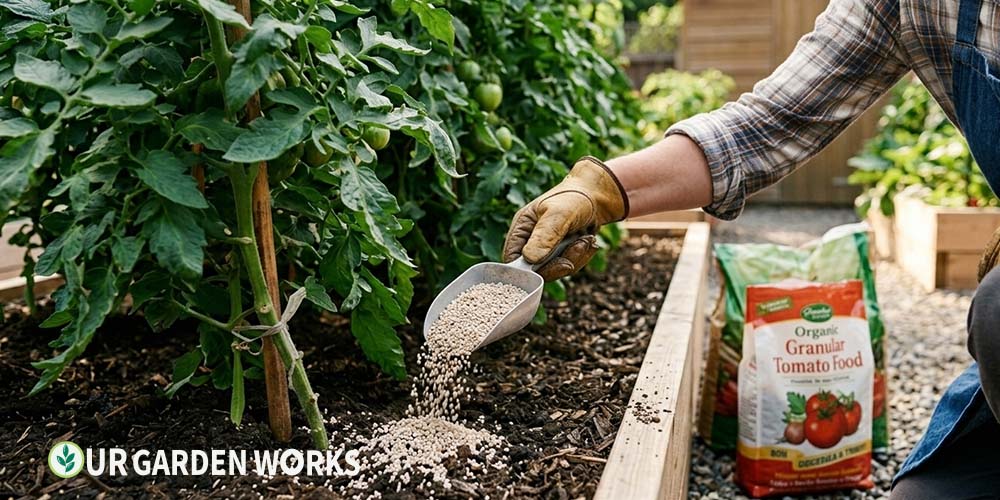
(Select your crop, enter your bed size, and choose the growth stage (establishing, vegetative, flowering/fruiting, or late season). The calculator recommends fertilizer type, NPK ratio, and the exact application rate for your bed.)
Over-fertilizing is a more common problem in home vegetable gardens than under-fertilizing. Excess nitrogen produces lush, dark green plants with impressive foliage — and disappointing harvests.
Too much phosphorus locks out zinc and iron. Too much potassium blocks calcium uptake and contributes directly to blossom end rot. The fertilizer label showing a pound per 1,000 square feet does not tell you that your specific crops at their specific growth stage need something completely different from that one-size recommendation.
This calculator matches your crops and growth stage to the fertilizer type and rate that actually serves your plants — not just the generic maximum rate that sells more bags.
Editor’s Note: Leafy crops (lettuce, spinach, kale, basil) need nitrogen-forward fertilizer (high first number in NPK) throughout the season. Fruiting crops (tomatoes, peppers, cucumbers) need high nitrogen only during establishment — switch to lower nitrogen and higher phosphorus and potassium at flowering. Root crops (carrots, beets, potatoes) need low nitrogen and higher phosphorus throughout. Never fertilize any crop in the 2 weeks before harvest.
Understanding NPK — What the Three Numbers Actually Mean
Every fertilizer label shows three numbers separated by hyphens: N-P-K. Nitrogen (N) drives leafy, vegetative growth. Phosphorus (P) supports root development, flowering, and fruit formation. Potassium (K) strengthens cell walls, improves disease resistance, and supports fruit quality. The numbers are percentages by weight of each nutrient in the bag.
A 10-10-10 balanced fertilizer contains 10% each of nitrogen, phosphorus, and potassium. A 5-10-10 fertilizer (common for fruiting crops in flower) contains less nitrogen and more of the nutrients that support fruit development. A 21-0-0 fertilizer (ammonium sulfate) is pure nitrogen — appropriate only for nitrogen-deficient lawns or leafy greens, never for fruiting crops at flowering.
| Crop Type | Establishment | Mid-Season | Flowering/Fruiting |
|---|---|---|---|
| Tomatoes, peppers | 10-10-10 balanced | 8-8-8 or similar | 5-10-10 or tomato-specific |
| Leafy greens (lettuce, kale) | High N (21-0-0 or fish emulsion) | Continue nitrogen | N/A — harvest before bolting |
| Root crops (carrots, beets) | Low N, moderate P (5-10-10) | Maintain low N | N/A — roots, not fruit |
| Beans, peas (legumes) | Low N only — they fix their own | Minimal — self-sufficient | Light potassium at pod fill |
| Cucumbers, squash | Balanced 10-10-10 | Switch to lower N | 5-10-10 through fruiting |
| Corn | High N | Continue high N | Reduce at tasseling |
Organic vs Synthetic Fertilizers — Practical Differences
The nutrient content of organic and synthetic fertilizers is chemically identical once it reaches plant roots — nitrogen from blood meal and nitrogen from ammonium nitrate are both used in the same way. The practical differences are in release rate and soil impact.
Synthetic fertilizers: Fast-release. Nutrients available within days. Precise NPK ratios. Can burn plants if overapplied. No organic matter benefit to soil. Best for correcting a known deficiency quickly or for container growing where soil-building is irrelevant.
Organic fertilizers: Slow-release (weeks to months, depending on soil temperature and microbial activity). Lower and more variable NPK. Build soil organic matter and feed beneficial microorganisms. Very difficult to burn plants. Best for in-ground and raised bed growing where long-term soil health matters.
For specific organic fertilizer product recommendations matched to specific plants, our best fertilizer for petunias and best fertilizers for geraniums show how we approach fertilizer selection for flowering plants — the same methodology applies to vegetables.
Common Fertilizing Mistakes and How to Avoid Them
- Fertilizing at the wrong growth stage: Applying high-nitrogen fertilizer to tomatoes at flowering redirects energy from fruit to foliage. Switch to a lower-nitrogen fertilizer as soon as you see the first flower buds.
- Fertilizing dry soil: Always water thoroughly before applying granular fertilizer. Dry soil concentrates nutrients around roots and causes burn. Water before, apply fertilizer, water again to work it in.
- Skipping the soil test: Adding fertilizer without knowing your baseline nutrient levels can create imbalances that lock out other nutrients. A $15–25 soil test from your cooperative extension office is the highest-value investment in any vegetable garden. Pair with our soil pH calculator to correct pH before adding nutrients.
- Fertilizing stressed plants: Never fertilize a plant that is wilting, heat-stressed, drought-stressed, or showing disease symptoms. Nutrients cannot be absorbed by a plant under stress, and the salt load from fertilizer worsens the stress. Correct the underlying problem first.
Frequently Asked Questions
How often should I fertilise my vegetable garden?
For in-ground gardens with a good compost base: once at planting with a balanced granular fertilizer, then a mid-season side dressing of nitrogen for heavy feeders (tomatoes, corn, brassicas) around 4–6 weeks after transplanting. Raised bed gardens built on soilless mixes need more frequent feeding — liquid fertilizer every 2–3 weeks is typical because the mix has no organic reserve. Container gardens need the most frequent feeding — weekly liquid fertilizer for actively growing plants.
Why are my tomato leaves dark green but I have almost no fruit?
Dark green, lush foliage with poor fruit set is the classic sign of excess nitrogen — too much of the first number in NPK. Nitrogen drives vegetative growth at the expense of reproductive (fruit) development. Switch to a low-nitrogen fertilizer (5-10-10 or 0-10-10) immediately and reduce or stop nitrogen applications until fruiting improves. This is extremely common when gardeners use general-purpose lawn fertilizer on vegetable gardens — lawn fertilizer is formulated for maximum nitrogen, the opposite of what fruiting vegetables need after establishment.
Can I use the same fertiliser on all my vegetables?
A balanced 10-10-10 at planting works as a starting point for most crops. But mid-season, different crops need very different things. Leafy greens benefit from continued nitrogen. Fruiting crops need less nitrogen and more potassium and phosphorus. Root crops need minimal nitrogen throughout. Using one fertilizer uniformly for the whole garden all season is a common compromise that produces mediocre results across all crops rather than optimized results for each.
Free Tools & Guides:
Final Thoughts
We hope this calculator makes fertilizing feel less like guesswork and more like a precise, satisfying part of garden management.
The right fertilizer at the right growth stage is genuinely visible in your harvest — tomatoes set more fruit, lettuce stays productive longer, and everything tastes better. For the complete soil and fertility picture, our vegetable gardening guide connects every growing guide we have published.
Share this free tool with a fellow gardener who has been applying the same balanced fertilizer to every vegetable all season and wondering why some crops never quite perform — and leave a comment below with your results. Happy growing!
